saint
St. Agatha of Sicily
A young noblewoman of Catania whom the Roman governor Quintianus pursued for her wealth and beauty. Refused, he had her breasts torn off; the apostle Peter appeared to heal her in prison before her death. Patroness of nurses and of those who suffer in the body.
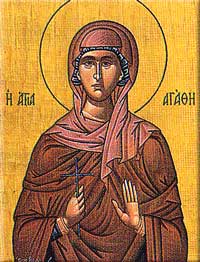
Agatha of Sicily — Public domain. Via Wikimedia Commons.
Life
Agatha was born around 231 in the city of Catania on the eastern coast of Sicily (in the shadow of Mount Etna), into one of the wealthier noble families of the city. Her parents were Greek-speaking Sicilian Christians of senatorial rank — Catania was at this period a Greek-Sicilian rather than a Roman city, with deep cultural and family ties to the Greek east. They were among the richest landowners of the city's hinterland; Agatha was their only child and was raised in considerable privilege.
She was given the unusually thorough education of a wealthy Christian girl of the period — Greek rhetoric, Latin (for the Roman side of the family's political connections), the standard catechesis. She made a private vow of virginity to the Lord at the age of fifteen, with the encouragement of her mother. She wore the simple dress that marked a Christian virgin and gave away most of her clothes and jewels to the poor of the city.
The decisive event of her life came when she was about twenty. The Roman senator Quintianus had recently been appointed proconsul of Sicily under the Emperor Decius. He took up residence at Catania in the latter part of 250 and began the standard administrative business of the province — collecting taxes, enforcing imperial decrees, holding the assize courts. The Decian persecution had begun the previous year; the standard procedure was to require every citizen to offer a small sacrifice to the imperial gods and to receive a certificate (a "libellus") attesting that they had done so. Quintianus's secretaries had already begun working through the senatorial families of the city.
Quintianus first saw Agatha at a public ceremony at Catania. He was struck by her beauty and made inquiries about her family. He learned that she was the heiress of one of the great Sicilian families, that she was unmarried, and that she was a Christian. The combination — wealth, beauty, and the legal vulnerability of being a Christian during the persecution — appealed to him. He summoned her to his residence.
She came in the standard escort of her family's retainers. Quintianus made her several offers, in ascending order of seriousness: first a marriage proposal, with full senatorial honors and the protection of his court; then, when she refused, the standard offer of imperial favor in exchange for a single token sacrifice; finally, when she refused that too, the threat of the imperial law's full force against her as a Christian.
She did not yield. Quintianus turned her over to a Roman woman of his household named Aphrodisia, who ran a brothel — an officially licensed Roman institution — at the edge of the city. Quintianus's calculation was that thirty days under Aphrodisia's care, with the pressure of her daughters and the everyday violence of the place, would break Agatha's resistance. Agatha was held there for thirty days. She did not yield; she did not even speak much during the thirty days, keeping a steady silence punctuated only by prayer.
At the end of the thirty days Aphrodisia returned her to Quintianus. He gave the order for the first round of formal interrogation. She was beaten on the rack; she was burned with torches. The most distinctive torment — the one that would fix her iconography for sixteen centuries — was the cutting off of her breasts with iron shears, performed in Quintianus's presence to compel her recantation. She did not recant.
She was thrown into a dungeon. That night the apostle Peter appeared to her in a vision, accompanied by an old man (whom the early sources interpret as her guardian angel) bearing a small bowl of healing salve. Peter washed her wounds and restored her breasts whole. She woke from the vision restored. The next morning the prison guards reported the miracle to Quintianus; he refused to believe it and ordered her tortured again.
She was rolled naked over sharp potsherds heated red-hot in a fire; she was scourged again. As she was being scourged, an earthquake struck the city of Catania. Two prominent friends of Quintianus — the consular Silvinus and one of his counselors named Falconius — were killed in the collapse of the building in which the trial was being held. The mob of the city, taking the earthquake as a divine warning, surrounded the praetorium and demanded that Quintianus stop the trial. He retreated to his apartments and refused to come out. Agatha was returned to her dungeon and died there in the night — by the standard hagiography, of the cumulative effect of her tortures, but with her body restored and at peace.
She was twenty-one. Her relics were recovered by the local Christian community and buried in the catacomb of the Christians of Catania. The very next year (252) — by another tradition the year after, in 253 — Mount Etna erupted with unusual violence, threatening to overwhelm the city. The people of Catania, taking up the veil that had been on Agatha's head in death (preserved by the Christian community), went out and held it in the path of the lava flow. The lava stopped at the veil.
The veil of St. Agatha has been the central religious object of the city of Catania ever since. It is paraded through the streets of the city on her feast and on the anniversaries of major eruptions of Etna. The Cathedral of Catania, built on the site of her dungeon, houses her relics and the veil. She is the patroness of Catania, of breast-cancer patients (whose iconography has historically been associated with her), of bell-founders (the bells of her iconography being a folk-medieval pun on the appearance of her severed breasts on the silver platter she is shown holding), and of every woman who suffers in the body for her chastity. Her feast is February 5.
Traditions
Feast day
February 5
Topics
Works in library