father
St. Alexander of Alexandria
Patriarch of Alexandria (313–326), the first to discern and oppose the teaching of his presbyter Arius. He convened the synod that excommunicated Arius, drafted the encyclical letters that carried the case to the whole Church, attended Nicaea, and brought with him as deacon his successor — the young Athanasius.
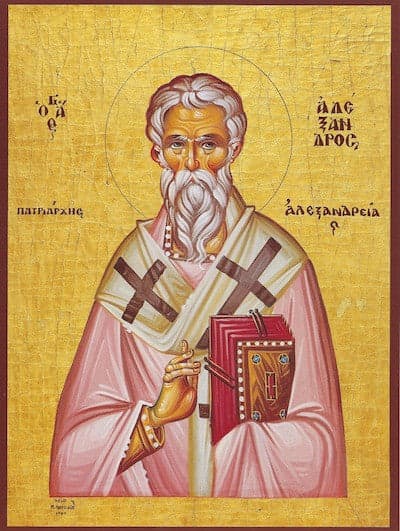
Saint Alexander of Alexandria — Hand-curated icon.
Life
Alexander was bishop of Alexandria from around 312 until his death in 328. He is the bishop who first heard, and first condemned, the teaching of Arius — a presbyter of his own city who had begun to preach that the Son of God was a creature, brought into being by the Father's will at the beginning of time and therefore not co-eternal with Him. Alexander summoned a local council that excommunicated Arius and his followers around 318, and when Arius sought refuge with sympathetic bishops in other provinces, the controversy rapidly spread to engulf the whole Church.
It fell to Alexander, with his young deacon Athanasius beside him, to represent the Alexandrian position at the First Ecumenical Council of Nicaea in 325. The council vindicated his teaching in the clearest possible terms, formulating the creed in which the Son is confessed as "of the same substance as the Father" (homoousios), and Arius was condemned and exiled. Alexander died three months after the council, transferring his see to Athanasius; tradition records that his last words were an anxious calling of that name.
His surviving letters — principally the encyclical to the bishops of Egypt and Libya announcing Arius's condemnation — are important historical documents for the origins of the Arian controversy. He is venerated as a saint in the Orthodox Church; his feast falls on May 29.
Traditions
Feast day
May 29
Topics
Works in library
Readings and commentaries
Epistles on the Arian Heresy
The encyclical letters by which Alexander, patriarch of Alexandria, carried the case against his presbyter Arius to the whole Christian world — the documents that opened the Arian controversy and prepared the ground for Nicaea.