saint
St. Alexius, Metropolitan of Moscow
Metropolitan of Moscow during the regency of Demetrius Donskoy, a healer and statesman who was sent to the court of the Khan to cure the Khan's mother of blindness and won safety for the Russian Church.
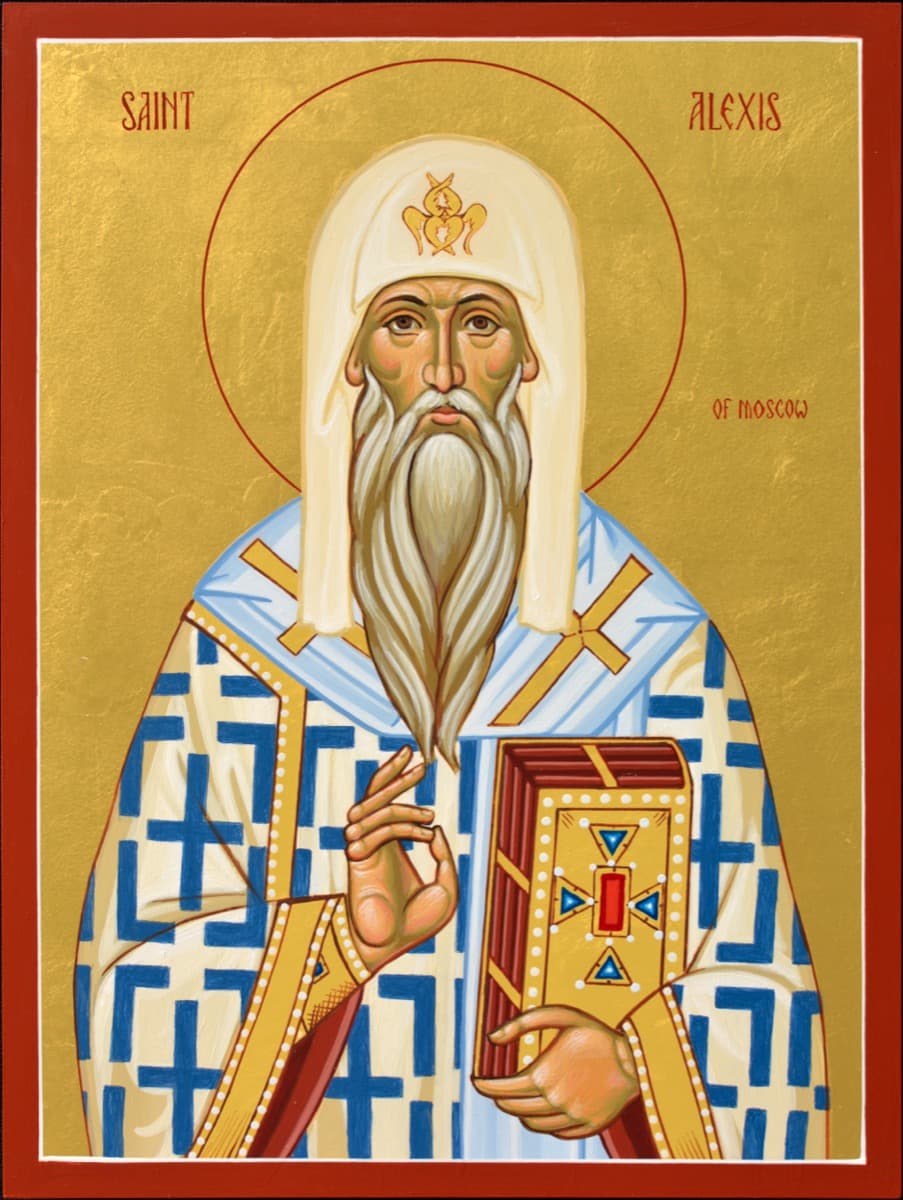
Saint Alexius of Moscow — Hand-curated icon.
Life
Alexius was born around 1296 in Moscow, into the noble boyar family of the Byakont — substantial landholders of the principality with connections to the rising Moscow court. He was given the baptismal name Eleutherius and educated in the household of Grand Prince Ivan I (Ivan Kalita), who was his godfather. He entered monastic life at twenty-one (1317) at the Bogoyavlensky (Epiphany) Monastery in Moscow, taking the name Alexius, and served there for twenty years as a quiet monk known particularly for his learning in Greek (rare among Russian monks of the period).
He was made bishop of Vladimir in 1352 by Metropolitan Theognost (the successor of Peter), who recognized in him the candidate to succeed himself. Theognost reposed in 1354, naming Alexius as his successor. The patriarchal confirmation from Constantinople — required for any new Russian metropolitan — was delayed for some months, but came through in 1354. Alexius traveled to Constantinople for his consecration, returning to Moscow in 1355 as Metropolitan of Kiev and All Rus'.
The metropolitanate Alexius inherited was institutionally weak and politically embattled. The Russian Church was still under Greek jurisdiction; the Russian princes were still tributary to the Mongols of the Golden Horde; the Lithuanian-Polish powers to the west were absorbing the western Russian territories at speed. Alexius held the metropolitanate together through a combination of personal force, diplomatic skill, and what the Russian Church soon came to recognize as the gift of miraculous intervention.
The decisive event of his life — the one that gave him popular as well as ecclesiastical standing — was the healing of Taidula, the senior khansha of the Golden Horde at Sarai. Taidula, the widow of Khan Jani Beg and mother of Khan Berdi Beg, had been blind for two years; her court physicians could not help her. She had heard of the holiness of the Moscow metropolitan and sent a request through the standard diplomatic channels for him to come to Sarai. Alexius came in 1357, accompanied by a small delegation. He prayed over her at her tent at Sarai; she received her sight back. Her gratitude to him personally — and through him to Moscow — became the diplomatic capital that protected Moscow through the next twenty years.
He served as metropolitan for twenty-three years (1354-1378). His major work was institutional: he founded several monasteries (including the Andronikov Monastery in Moscow, which would house the great icon-painter Andrei Rublev a generation later); he served as effective regent of Moscow during the minority of Grand Prince Demetrius (the future Demetrius Donskoy) from 1359 to 1370, holding the Moscow throne in trust against the rival claims of the Tver and Suzdal princes; he kept the metropolitanate from being split by Lithuanian-Polish pressure to establish a separate Kievan-Lithuanian metropolitanate.
He reposed at Moscow on February 12, 1378, at eighty-two. He was buried at the Chudov Monastery in the Moscow Kremlin which he had founded. His relics were translated to the Bogoyavlensky Cathedral in 1948 (the Chudov having been destroyed by the Soviets in 1929) and to the Patriarchal Cathedral of the Epiphany in Yelokhovo in Moscow, where they rest today.
He was glorified in 1448 by the Russian Church on its declaration of autocephaly from Constantinople. He is the patron of Moscow alongside Peter, and of diplomats serving in difficult circumstances. His feasts are February 12 (repose) and May 20 (translation of relics).
Traditions
Feast day
February 12 and May 20
Topics
Works in library