father
St. Ambrose of Milan
Bishop of Milan who baptized Augustine, hymnographer who taught the Latin Church to sing, and the imperial conscience who made Theodosius do public penance after the massacre at Thessalonica. Doctor of the Church and Father of Latin sacramental theology.
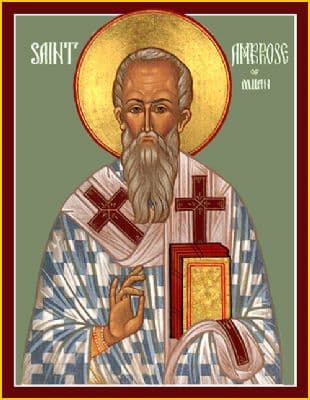
St. Ambrose of Milan — CC BY 4.0. Via Wikimedia Commons.
Life
Aurelius Ambrosius was born around the year 340 in Trier to a family of senatorial rank; his father was praetorian prefect of Gaul, and his sister Marcellina was a consecrated virgin. Educated at Rome in rhetoric and law, he rose to become governor of the provinces of Liguria and Emilia, with his seat at Milan. When the bishop of Milan died around 374, the Arian and Nicene factions could not agree on a successor. A voice cried out in the church — tradition says it was a child's voice — calling for the unbaptized governor. The crowd took it up, and Ambrose was elected bishop by acclamation.
He was baptized, ordained through every grade of the clergy in rapid succession, and consecrated within eight days. He immediately gave away his personal wealth to the poor and his property to his sister, and devoted himself with an intensity born of necessity to theological study — reading Greek fluently, he made himself a faithful transmitter of Eastern theology, particularly the Alexandrian tradition, to the Latin West. He also introduced the singing of hymns in the antiphonal Eastern style into his congregation, becoming in the process the founder of hymnody in the Western Church.
His episcopate was marked by confrontations with imperial power. When the Empress Justina demanded basilicas in Milan for Arian worship, Ambrose and his congregation occupied the churches for weeks, singing through the nights the hymns he had composed for the occasion. When the Emperor Theodosius massacred thousands in Thessalonica in reprisal for a riot, Ambrose refused him communion until he had done public penance — and the most powerful man in the Roman world submitted. Above all he was the bishop who baptized Augustine at the Easter Vigil of 387, opening the eyes of that restless young rhetor to the depths of Scripture and setting in motion the theological legacy that would shape the next millennium. He reposed on April 4, 397. The Orthodox Church honors him on December 7, the feast of his episcopal consecration.
Traditions
Feast day
December 7
Topics
Works in library
Readings and commentaries
Concerning Virgins
Three books on the consecrated virginal life, written for Ambrose's sister Marcellina — among the most influential Latin treatments of virginity in the patristic age.
Concerning Widows
Pastoral letter on Christian widowhood as a vocation of prayer and almsgiving — a companion to Concerning Virgins.
Letters
Selected letters of Ambrose — pastoral correspondence, theological argument, and the famous public exchanges with Emperor Theodosius after the massacre of Thessalonica.
Memorial of Symmachus
Ambrose's two letters to the Emperor Valentinian II in the Altar of Victory controversy — answering the pagan senator Symmachus's plea to restore the altar removed from the Roman senate house. A defining text in the Christian-pagan rhetorical contest of the late fourth century.
On Repentance
Two books arguing — against the rigorist Novatians — that the Church has the authority to absolve grave post-baptismal sin, including idolatry, adultery, and murder. The foundational Latin treatise on penitential discipline.
On the Christian Faith (De Fide)
Five-book anti-Arian Trinitarian treatise written for the emperor Gratian before his eastern campaign — the major Latin systematic defense of the consubstantiality of the Son.
On the Death of Satyrus
Funeral oration and consolation on the death of Ambrose's brother Satyrus — a personal, theologically rich Latin reflection on grief, resurrection, and Christian hope.
On the Duties of the Clergy (De Officiis)
Three books of pastoral and moral counsel for clergy — Ambrose's Christian counterpart to Cicero's De Officiis, recasting Stoic civic virtue as the discipline of priestly life.
On the Holy Spirit
Three books on the doxological honor of the Holy Spirit — the foundational Latin pneumatology, deeply indebted to Basil of Caesarea's De Spiritu Sancto written six years earlier.
On the Mysteries
Mystagogical instruction for the newly baptized — Ambrose's Latin counterpart to Cyril of Jerusalem's Mystagogical Catecheses, expounding baptism, chrismation, and the Eucharist to those who have just received them.
Sermon against Auxentius on Giving Up the Basilicas
Anti-Arian sermon preached during the Milan basilica controversy — when the Arian empress Justina demanded a church for her court and Ambrose, with his people, occupied the basilica until she withdrew.