saint
St. Ambrose of Optina
The most-loved of the Optina elders, to whose cell came peasants and princes, Dostoevsky and Tolstoy, with their burdens. He bore long illness with humor and gathered the sisterhood at Shamordino. The portrait of the ideal Russian starets.
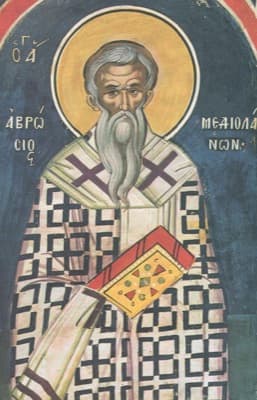
Ambrose of Optina — Public domain. Via Wikimedia Commons.
Life
Alexander Mikhailovich Grenkov was born on November 23, 1812, in the small village of Bolshie Lipovitsy in the Tambov province of central Russia, into a poor priestly family (his father was the parish reader; his grandfather had been the village priest). He was the sixth of eight children. The family had little money; his mother Marfa — the spiritual presence in his early years — taught him his catechism and to read out of the Slavonic Psalter.
He was educated at the Tambov diocesan seminary, which he entered at fourteen and finished at twenty-three (he was particularly gifted in languages, especially Greek and Latin). He was a charming, energetic, even somewhat carefree young seminarian — quick-witted, fond of singing and the lighter company. His original intention had been to enter the Tambov seminary as a teacher and to marry the daughter of one of his professors, settling into the standard career of a married Russian priest.
The decisive event of his life came in his last seminary year. He fell seriously ill with what was diagnosed as a wasting nervous fever; the local doctor gave him a poor prognosis. He prayed at the icon of the Mother of God of the Tambov Cathedral and vowed that if he should be healed he would enter the monastic life. He was healed within a week. He passed his examinations in 1836, accepted a teaching post at the Lipetsk theological school for a year (struggling for some time with whether to honor the vow he had made), and finally in October 1839 set out on foot for the Optina Hermitage in the Kaluga province.
He arrived at Optina on October 8, 1839 — the feast of the Venerable Sergius — and was received by the great elder Leonid (Lev) Nagolkin, the founder of the Optina starets tradition. He spent his first year as a novice under Father Leonid, then (after Leonid's repose in 1841) under Father Macarius Ivanov, the second great Optina elder. He was tonsured Ambrose in 1842 and ordained hieromonk in 1845.
He served at Optina for the next fifty-two years (1839-1891) and rose gradually to become the third of the three great Optina elders. The order of their succession is one of the standard markers of the Russian spiritual history of the nineteenth century: Leonid → Macarius → Ambrose. Each was the recognized starets of the hermitage in his turn, drawing pilgrims from across Russia for spiritual counsel and confession.
Ambrose succeeded Macarius as elder in 1860 and held the office for thirty-one years (1860-1891). The pilgrims came in their thousands. He saw between fifty and a hundred each day in his small cell-house at the side of the hermitage — peasants, students, professors, generals, princes, the famous and the unknown. He was equally direct with all of them. The reception was structured in a rhythm: a confession, a brief counsel of two or three sentences, sometimes a small piece of bread or a pinch of incense given as a gift. Then the next pilgrim came in.
Among his particular pilgrims were Fyodor Dostoevsky (who came to him in the summer of 1878 with the still-recent death of his three-year-old son Alyosha; the encounter is one of the sources of the portrait of the elder Zosima in The Brothers Karamazov), Vladimir Solovyov (the great Russian religious philosopher), Constantine Leontiev (the conservative critic who entered monasticism partly through Ambrose's influence), and Leo Tolstoy (who visited Ambrose three times — the last visit, in 1890, was a stormy one, with Ambrose openly challenging Tolstoy's heterodoxy).
His personal life was austere. He kept the standard Optina dietary discipline (vegetarian, with extra fasting in Great Lent); he slept three to four hours a night; his health, broken by the long illness of his youth and never strong, deteriorated through the 1870s and 1880s. He developed in his last decade a serious heart condition. He moved in 1888 to the small new women's hermitage of Shamordino, twelve miles from Optina, which he had founded and which had grown into a community of some seven hundred sisters under his direction.
He reposed at Shamordino on October 10, 1891, at the age of seventy-eight, after a particularly painful final illness. He was buried at Optina by the cathedral church. His grave became immediately a place of pilgrimage; over a century after his death, the line of pilgrims at his shrine is still continuous on the major feast days.
He was glorified by the Russian Orthodox Church in 1988 (the millennium of the baptism of Rus') as one of the great Russian saints of the modern period. His relics were translated to a new shrine at Optina in 1998. He is the principal patron of Russian elders and the icon of the great Optina starets tradition. His feast is October 10.
Traditions
Feast day
October 10
Topics
Works in library