saint
St. Anastasia the Deliverer-from-bonds
A noble Roman of Sirmium under Diocletian who used her wealth to ransom and serve the Christians imprisoned at Aquileia and Sirmium. After the slaughter, she was bound, starved, and finally burned together with three sisters of her household. The patroness of those in prison and those bound by addiction.
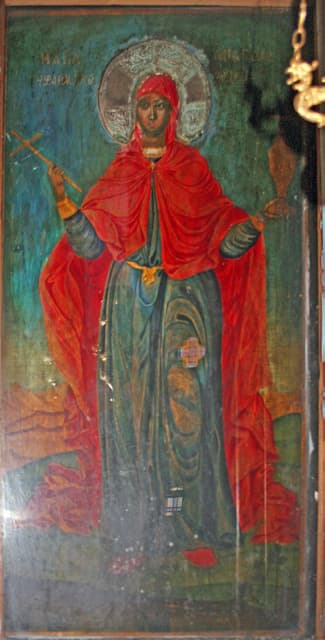
Great-martyr Anastasia — Public domain. Stergios Dimitriou. Via Wikimedia Commons.
Life
Anastasia was born around 281 in Rome, the only daughter of the Roman senator Praetextatus by his Christian wife Fausta. Her father, a pagan, agreed at his wife's request to raise the daughter as a Christian, and Anastasia was baptized as an infant and tutored from her earliest years by the Christian teacher and confessor Chrysogonus — a Greek of the Roman Christian community whose later martyrdom would also be remembered.
In her late teens her father gave her in marriage, against her wish, to a pagan Roman named Publius. The marriage was a torment. Publius kept her sequestered at home (he had heard rumors of her faith and wanted to break it), would not permit her to receive Communion, beat her when she persisted in her prayers. To her servants she made her peace by treating them with great gentleness; with her teacher Chrysogonus she stayed in touch by smuggled letters. Some of these letters have survived, and they are the calmest documents of what a Christian wife's interior life under a hostile pagan husband could be.
In the year 304 her husband Publius was sent on imperial business to the Persian frontier and died there (Anastasia was about twenty-three). She was free. She inherited his fortune, sold it at once, and went out into the empire to do what she had always wanted: ransom Christian prisoners. The Great Persecution of Diocletian was at its height; tens of thousands of Christians were in chains across Italy, Illyricum, and Greece. Anastasia traveled from prison to prison — Rome to Aquileia, Aquileia to Sirmium (in modern Serbia), Sirmium across the Balkans — bringing food, paying bribes for releases, smuggling in priests for the sacraments, comforting the dying. Her name in the Roman synaxaria, "the Deliverer-from-Bonds," is the literal description of her ministry.
She was at Sirmium in late 304 when she herself was arrested by an order of the local prefect. She was, by then, well known and well hated by the pagan officials of the region. She was tried at Sirmium, condemned, and given over to a long imprisonment in which she was starved (the standard preparation for a planned martyrdom in the arena). She did not die; finally, on December 25, 304, the prefect ordered her bound to four stakes and burned alive together with three women of her household.
Her body was preserved by Christian women of Sirmium and translated to Constantinople in the fifth century, where her relics rest still at the church of the Holy Anastasia. Her feast in the Orthodox calendar is December 22 (with some Western use of December 25, the actual date of her martyrdom, which the East has given over to the Nativity).
She is the patroness of those in prison (especially those wrongfully held), of those bound by addiction, of those in unhappy marriages, and of women whose work is the alleviation of suffering. Her name in liturgical Greek, "Anastasia Pharmakolytria" — Anastasia the Healer-from-Drugs — has made her in the modern Orthodox world a particular patroness for those struggling with substance dependency.
Traditions
Feast day
December 22
Topics
Works in library