father
St. Andrew of Crete
Archbishop of Crete and author of the Great Canon read in Great Lent — a masterpiece of penitential poetry that walks the soul through the whole of Scripture in the voice of personal contrition. The first ode begins: 'Where shall I begin to weep for the deeds of my wretched life?'
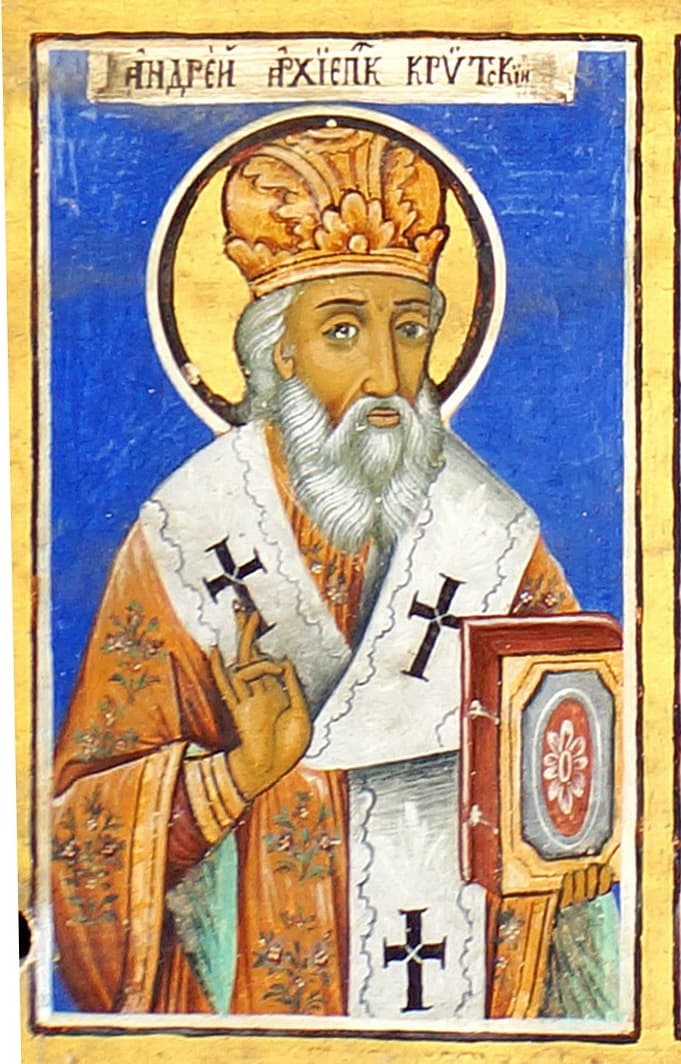
Andrew of Crete — Public domain. Димитър Христов и Зафир. 1843. Via Wikimedia Commons.
Life
Andrew was born around 660 in the Syrian city of Damascus (then under the recent Arab conquest), into a Greek-speaking Christian family of moderate means. The city of Damascus in the late seventh century was a remarkable place — the new capital of the Umayyad Caliphate under Mu'awiyah I and his successors, with a substantial Christian population that still ran much of the administrative apparatus of the new Arab state. Andrew's family was probably of the official class; his Greek education would not otherwise be explicable.
He was, by the family record, mute until the age of seven — unable to speak a word. He was brought to the cathedral of Damascus on the feast of the Theotokos in 667 and received Holy Communion; he came back to the family carriage on the way home and spoke for the first time. The Greek hagiography reads this as the spiritual sign that his speech, when it came, would be the speech of the Mother of God's hymnographer. The remainder of his childhood was unremarkable in any other respect.
He was tonsured a monk at fourteen — the standard early-Byzantine age for a serious vocation — at the Lavra of St. Sabbas in the Judean desert near Jerusalem. He served there for some twenty years. The Sabbaite Lavra at the time was one of the great monastic schools of the eastern Mediterranean, with traditions of both ascetical and intellectual rigor; Andrew received from it the systematic patristic education that would mark his later writing.
He was made a deacon at thirty and was sent in 685 to Constantinople as the Sabbaite representative to the Council of Constantinople III — the Sixth Ecumenical Council of the Christian Church, which had defined the two wills (divine and human) of Christ against the heresy of Monothelitism. Andrew, then perhaps twenty-five, was an observer and recording secretary; he did not participate as a voting member, but the council made an impression on him that would shape his later thought.
He stayed at Constantinople after the council, attached to the chancery of the Patriarchate and serving as the chief deacon of the great orphanage of the Capital (a major imperial-ecclesiastical institution that maintained an orphan school of several hundred children at any given time). He served there for some twenty-six years (685-711), supervising the orphan school and producing — gradually, as the decades unfolded — the body of theological and liturgical work that would make his name.
He was consecrated Archbishop of Crete in 711 by the Patriarch Cyrus of Constantinople. He served on the island for the next thirty years and died on a journey from Crete to Constantinople, at the small port of Hierissos on the island of Mytilene (Lesbos), around the year 740. He was buried at the cathedral church of Hierissos. His relics were translated to Constantinople in the ninth century and rest at the Church of the Holy Apostles.
His literary work falls into several categories. He wrote a substantial body of homilies on the feasts of the Lord and the Theotokos — particularly fine sermons on the Annunciation, the Dormition, and the Nativity. He composed some thirty-two canon-cycles for the various feasts; these are the long, structured hymn-cycles of the Eastern Liturgy that consist of nine "odes," each based on one of the biblical canticles (the Song of Moses at the Red Sea, the Prayer of Hannah, the Hymn of the Three Holy Children in the furnace, etc.). His Marian hymn-cycles in particular have shaped all later Greek Marian devotion.
His most famous work is the Great Canon — a single canon of unprecedented length, consisting of two hundred fifty stanzas across nine odes, that walks the soul through the entire history of fall and redemption in the voice of personal contrition. The first stanza of the first ode begins: "Where shall I begin to weep for the deeds of my wretched life? What manner of beginning shall I make for this present lament? But do thou, O compassionate Christ, grant me forgiveness of my offences." The Great Canon goes through Adam and Eve, Cain and Abel, Noah, Abraham, Isaac, the patriarchs, Moses, Joshua, the judges, David and Solomon, the prophets, the New Testament generations, and the Lord's own life — taking each biblical figure as a starting point for personal reflection on the soul's own failures.
It is chanted in two halves: the first half (the "small" canon) on the four evening services of the first week of Great Lent, one quarter each night Monday through Thursday; the second half (the "great" canon proper) is chanted entire on the Wednesday of the fifth week of Great Lent at a long service that lasts well over three hours. The custom of the Greek Lenten observance has placed it among the most demanding spiritual practices of the Christian year; the custom of the Russian observance has done the same.
Andrew is the patron of liturgical poets, of hymnographers, and of those who labor at long penitential services. He is one of the two principal hymnographers of the Byzantine office (with John of Damascus, who was about thirty years younger and was probably his student during the years at the Sabbaite Lavra). His feast is July 4.
Traditions
Feast day
July 4
Topics
Works in library
Readings and commentaries
The Great Canon
The longest and most penitential kanon in the Byzantine hymnographic tradition — 250 troparia in nine odes, each ode opening with an irmos and continuing with troparia of confession and repentance addressed to the soul and to God. The text retraces the entire Scriptural narrative, holding up paradigm after paradigm of sin and repentance from Genesis to the Gospels, and laments the soul's own complicity in each. The Great Canon is read during Great Compline of the first four evenings of Great Lent (Mon-Thu of Clean Week) and chanted in full at Matins on the Thursday of the Fifth Week ('Standing of Mary').