saint
St. Holy Princess Anna of Kashin
Wife of the martyr-prince Michael of Tver and mother of two more martyred princes. After the deaths of her family she withdrew to the monastery of Kashin, where she reposed as a nun. Patroness of widows and bereaved mothers.
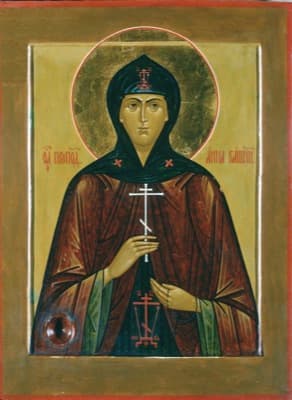
Saint Anna of Kashin — Public domain. Via Wikimedia Commons.
Life
Anna was born around 1280, the daughter of Prince Dmitri Borisovich of Rostov, into the high Rurikid nobility of the Russian principalities under the Mongol yoke. She was given the standard noble Russian education of the period — domestic skills, embroidery, the reading of the Slavonic Psalter, the practice of the daily monastic offices. In 1294, at fourteen, she was married to the young Prince Michael of Tver — the heir of one of the most powerful of the Russian principalities, a man five years older than herself and already widely respected for his piety and political ability.
The marriage was a happy one in personal terms; in political terms it was a long ordeal. The marriage produced five children: four sons (Dmitri, Alexander, Theodore, Constantine) and a daughter (Theodosia). All four sons inherited their father's political position in some form. The first decade of the marriage saw the steady rise of Michael of Tver as the senior prince of northeastern Rus' (he was confirmed Grand Prince of Vladimir — the senior Russian throne — by the Khan in 1305); the next decade saw the rise of Moscow under Yuri Daniilovich as the contesting power; the third decade was a long succession of Mongol-engineered conflicts that destroyed the Tver dynasty.
Michael was summoned to the Khan's court at Sarai in 1318 to answer political charges fabricated by the Moscow faction. Anna watched her husband leave; she would not see him again. He was tortured for some weeks at the Khan's court, then executed on November 22, 1318. His body was returned to Anna at Tver after some delay. He was forty-eight; she was thirty-eight, with five children, the senior of whom (Dmitri) was about seventeen.
She entered widowhood under unusually grim circumstances. Her oldest son Dmitri ("Dmitri Krasnyi Glaza" — "Dmitri of the Terrible Eyes") inherited the Tver throne; he avenged his father by killing Yuri of Moscow at the Khan's court in 1325, and was himself executed at the Khan's court the same year. He was twenty-six. Anna's second son Alexander, who succeeded Dmitri, was eventually executed at the Khan's court in 1339 along with his own son Theodore — Anna's grandson. She had now lost husband, two sons, and a grandson to the same political machine, all of them on her behalf martyred for resistance to Moscow's encroachment on the Tver claim.
She entered monastic life in 1346, at sixty-six, at the convent of the Theotokos in Tver, taking the name Sophia. She moved in 1357 to the convent at Kashin (which her son Vasili — the third surviving son — had founded for her), taking the great schema there with the new name Anna (the name she had been baptized with), and spent her last years in deep silence at the small wooden cell adjoining the convent church.
She reposed at Kashin on October 2, 1368, at eighty-eight. She was buried at the convent church. Her cult emerged immediately after her death; she was venerated locally for two centuries. She was canonized in 1649 by Patriarch Joseph of Moscow under unusual circumstances — her cult had become entangled with the Old Believer schism (the surviving record of her relics' uncovering noted that her hands had been arranged in what later became the Old Believer style of crossing oneself), and her canonization was reversed in 1677 by the new Patriarch Joachim, who was attempting to suppress the Old Believer movement. Her veneration continued underground and at the local level through the next two centuries; she was re-canonized in 1909 by the Synod of the Russian Church under Emperor Nicholas II.
Her relics rest at the convent at Kashin. She is the patron of widows of murdered husbands, of mothers who have lost children to political violence, and of every Russian woman who has watched the men of her family broken by the machinations of state. Her feasts are October 2 (repose) and June 12 (translation of relics).
Traditions
Feast day
June 12 and October 2
Topics
Works in library