saint
Holy Anna the Prophetess
Widow of the tribe of Asher who served God in the Temple by fastings and prayers night and day until in extreme old age she beheld the Child and spake of Him to all who looked for the redemption of Israel.
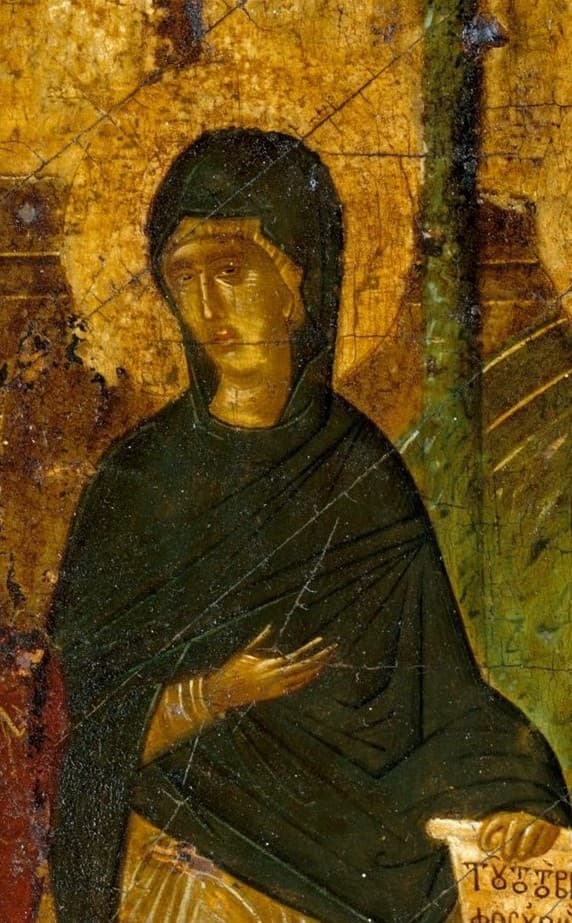
Anna the Prophetess — Public domain. Via Wikimedia Commons.
Life
Anna was born around 80 BC in the territory of the tribe of Asher in northern Galilee, near the city of Tiberias (which had not yet been founded — the date is the more notable for being so early). Her father Phanuel — a name preserved in the brief Gospel notice — was a man of the tribe of Asher, one of the few Jews of the period who could still claim a definite tribal descent in one of the lost northern tribes. The family was deeply pious and possibly priestly by association (the surviving genealogies from this period are often partial).
She married young — perhaps fourteen or fifteen — in the standard Jewish practice of her time. She was widowed seven years later, at perhaps twenty-one or twenty-two, before she had borne any children. She had two choices then in the social world of her time: to return to her father's house to await a second marriage, or to take up the difficult vocation of a Temple widow, devoting herself to perpetual prayer in the courts of the Temple at Jerusalem. She chose the second.
She came to Jerusalem in her early twenties, perhaps around 60 BC, and took up residence in the women's quarters near the Temple. She lived there as a Temple widow for the next sixty years. The Gospel of Luke describes her practice: "She departed not from the Temple, but served God with fastings and prayers night and day." Her life was disciplined in the strictest Pharisee way — three meal-fasts a week (Monday, Thursday, and Friday) on top of the standard Jewish liturgical fasts, repeated psalter recitations, and the standing hours of the Temple ritual through which she walked daily.
She is described in the Gospel as "a prophetess." The title was not casually given. The Temple of the second-Temple period contained a small but real prophetic community of women who served the daily Temple worship: anointers, singers, and a recognized class of female prophets whose role was to speak the word of God to those who came up to the Temple with particular spiritual concerns. Anna was one of the senior figures of this community in the years leading up to the Lord's birth. She would have been about seventy when the Lord was born and about eighty when His parents brought Him to the Temple for the rite of presentation.
She was perhaps eighty-four years old on the morning of the Feast of the Meeting (February 2 by Christian reckoning) when Joseph and Mary brought the forty-day-old Christ Child for the prescribed offering. The elder Simeon, also moved by the Spirit, was there to meet them and took the Child in his arms with the Nunc Dimittis. Anna had been at her usual station of prayer in the women's gallery; she came down to the spot, knew the Child by the Spirit's prompting, and "spake of him to all them that looked for redemption in Jerusalem."
She was — in this small and unobtrusive moment — the second public witness of the Christ Child in Jerusalem (after Simeon), and the first witness to be specifically described as a prophet. She is the type of every elderly Christian woman of long faithfulness and quiet prayer whose recognition of Christ in His coming is the result of decades of patient waiting. She is also the type of every Christian widow who continues in the prayer of the Church through long years of single-handed faithfulness — Saint Paul will pick up the type in his First Letter to Timothy in his description of the office of widow in the early Church.
She reposed shortly after the encounter with the Christ Child — most traditions place her death within two years of the visit. She was buried at Jerusalem, near the Temple precinct she had served. Her relics, in keeping with the early Christian veneration of the holy women of the Gospels, were preserved at the Anastasis in the Constantinian period; portions were translated to Constantinople by Justinian. They were dispersed in the Latin sack of 1204 and are now at several sites — the largest portion at the Monastery of Stavropoleos in Bucharest.
She is the patron of widows, of the elderly faithful, of those whose recognition of Christ has come at the end of long years of prayer. Her feast is February 3 (kept jointly with Simeon the God-Receiver as the major commemoration of those who met the Christ Child at the Meeting on February 2).
Traditions
Feast day
February 3
Topics
Works in library