saint
St. Anthony of the Caves of Kiev
Father of Russian monasticism, who brought the Athonite life to the hillsides of Kiev and dug out the first caves where the Lavra would grow. His cell became the seed of the Kiev Caves Lavra and of every Russian monastery after.
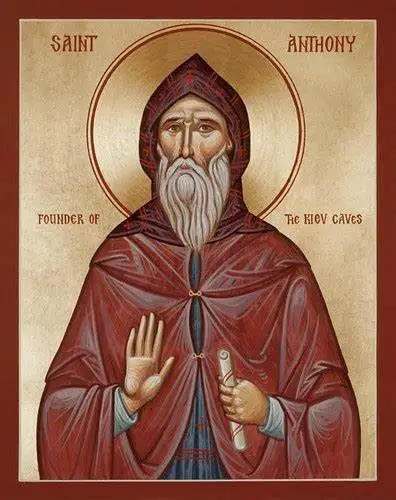
Saint Anthony of the Caves — Hand-curated icon.
Life
Antipas was born around 983 in the small Russian town of Lyubech on the upper Dnieper, into a family of free peasants who had taken the Christian faith two or three decades earlier — almost immediately after the baptism of Kievan Rus' under St. Vladimir in 988. He was given the village priest's education in basic literacy, but from a young age was drawn to the monastic life. There were as yet no Russian monasteries; he set out at perhaps twenty for Mount Athos, where Slavic monks were already settled in small numbers among the older Greek houses.
He was tonsured at Esphigmenou Monastery on the eastern side of the Athonite peninsula and given the name Anthony — after the great Egyptian father whose life Athanasius had written. He lived at Esphigmenou for some years as a model monk and was eventually sent back to Russia by his hegumen with the word: "Anthony, you shall be the father of many monks in your own land." The Russian Church was at that point about a generation old and had no native monastic tradition.
He arrived in Kiev some time around 1013 — the year of Vladimir's funeral and the murder of the holy brothers Boris and Gleb. He found the small Russian Church in a state of high political tension and several Greek monastic foundations attached to the cathedral that did not fit the rigorous discipline he had learned at Athos. He withdrew to the wooded hillsides above the Dnieper a mile or two south of the city, found a small cave dug out of the soft yellow earth (probably by a Varangian raider or some earlier hermit), and settled in it. The cave is now called the Far Cave of the Kiev Lavra and is still a place of pilgrimage.
He lived in absolute solitude for some years on coarse rye bread and water. Disciples began to come — first a single young noble named Theodosius (the future St. Theodosius of the Caves), then a small group of seekers from the city. He dug them caves of their own to either side of his own (the Near Caves and Far Caves of the modern Lavra preserve the layout) and gave them the rule of the Studion he had learned at Athos: a fixed program of prayer, manual work, communal Liturgy. By 1051 the community numbered twelve monks; in 1058 he stepped aside as abbot and went into a separate hermitage cave, leaving Theodosius to run the rapidly growing community.
He lived another decade in his hermit's cave, receiving only the abbot and the senior elders of the community. He reposed in 1073 at the age of about ninety, having spent some fifty years in his caves at the bank of the Dnieper. He was buried in the cave where he had lived. The Kiev Caves Lavra has grown around his cave and the cave of his disciple Theodosius; both caves are still venerated. The whole tradition of Russian monasticism descends from his foundation — every Russian monastery is in some sense a daughter or granddaughter of the Kiev Caves.
His feasts are July 10 (the day of his repose) and September 2 (the day of his arrival in Kiev from Athos). He is commemorated jointly with his disciple Theodosius on August 14 (the Synaxis of the Saints of the Kiev Caves).
Traditions
Feast day
July 10 and September 2
Topics
Works in library