saint
St. Anthony the Great
The Egyptian who heard the Gospel words 'sell what you have and give to the poor' as said to him personally, and went out to the desert where he became the father of all monastic life. His life, written by Athanasius, shaped Christian asceticism for all time. He lived to be one hundred and five years old, contending with demons and counseling those who came up the mountain to him.
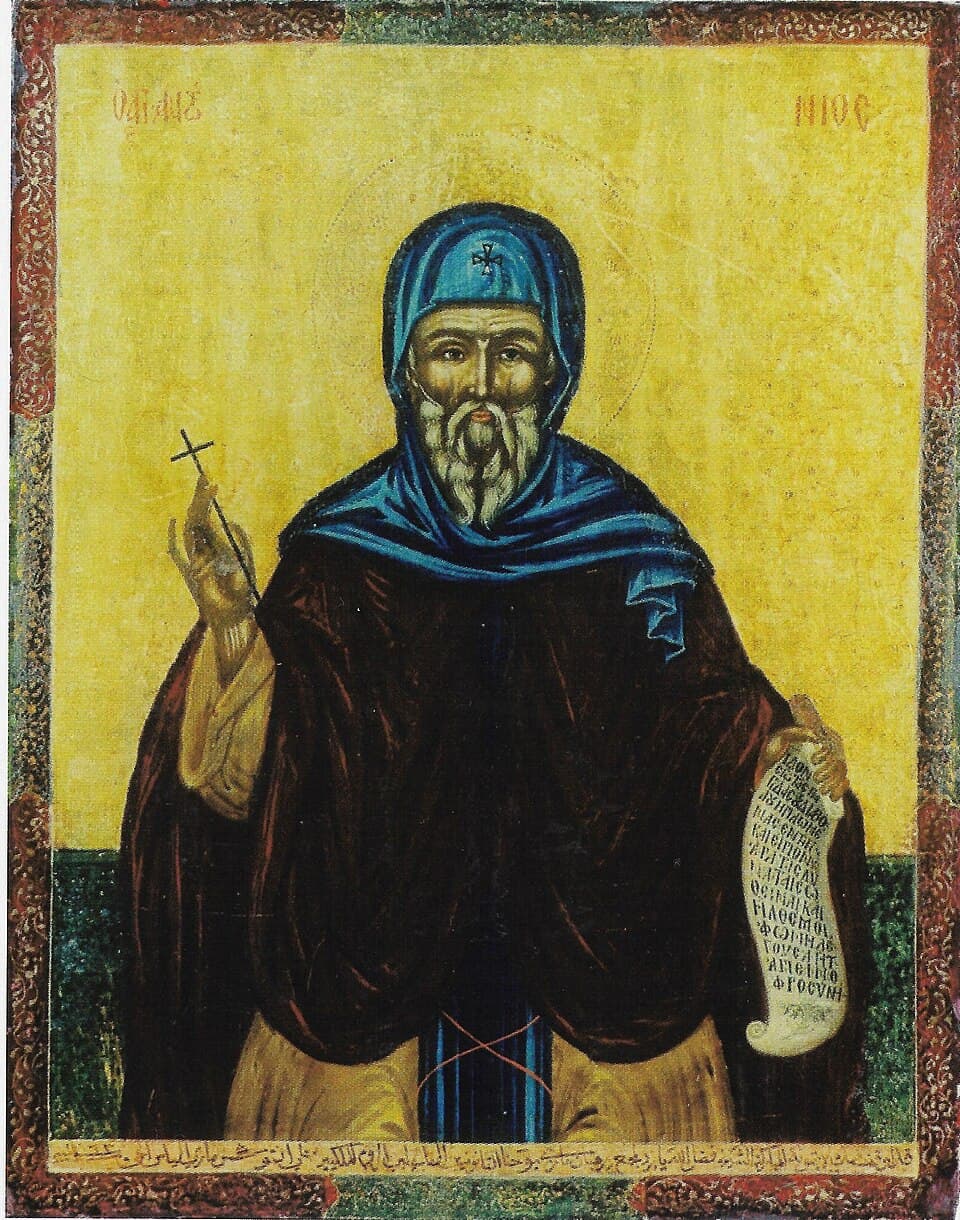
Saint Anthony the Great — Public domain. Via Wikimedia Commons.
Life
Anthony was born around 251 in the village of Coma in middle Egypt, the son of well-to-do Christian Coptic farmers. They died when he was eighteen or twenty, leaving him with a younger sister to raise and an estate of about 300 acres.
Some six months after his parents' death he was walking to church and remembering how the apostles had left everything to follow the Lord. He entered the church just as the gospel was being read: "If thou wilt be perfect, go and sell all that thou hast, and give to the poor, and thou shalt have treasure in heaven; and come and follow Me." He took the words as if they had been spoken directly to him. He sold his fields, gave the proceeds to the poor of the village, placed his sister in the care of a community of virgins, and went out to the edge of his village to apprentice himself to a local ascetic.
After some years he went further, to the abandoned forts on the desert side of the Nile, and lived there alone for twenty years, fighting the demons that came in every form — wild beasts, beautiful women, sons offering money, philosophers asking subtle questions. He fasted, prayed, made baskets to send out for sale through a small hole in the wall, and emerged in his fifties — to the astonishment of those who broke open his door expecting to find a wreck of a man — radiant, healthy in body, calm in soul.
The community of disciples that gathered around his retreat grew into the first organized monastic colony in history. From it spread the way of life that came to be called "monasticism" — solitary cells and a common Liturgy, fasting and constant prayer, manual work and silence. He withdrew at last to the deep desert beyond the Red Sea, to the place still called the Inner Mountain, and there spent his final decades.
He was the friend of Athanasius of Alexandria — Anthony came up to the city in 311 during the great persecution to comfort the confessors and again about 338 to support Athanasius against the Arians. Athanasius, after the saint's death, wrote his Life — the book that, more than any other, gave the desert tradition to the world. Augustine of Hippo would credit it with his own conversion in the garden at Milan.
Anthony died on January 17, 356, in his cave on the Inner Mountain, aged about 105. He had instructed two disciples to bury him secretly so that no one would know where his body lay; they obeyed, and his grave was unknown until the year 561, when relics said to be his were found and translated first to Alexandria and later to Constantinople and to La Motte-Saint-Didier in France. He is the father of all monastic life and is invoked as the patron of pigs (from a medieval misreading of an image), of skin diseases, of basket weavers, and of all who fight the unseen battle of the heart.
Traditions
Feast day
January 17
Topics
Works in library