saint
St. Andrew the First-Called
Brother of Peter and the first of the Twelve, called by the Lord at the Jordan after the witness of John the Baptist. He preached along the Black Sea coast — Pontus, Cappadocia, Bithynia, the Scythians — founding the church at Byzantium and reaching as far as the territory of the Slavs in tradition. He was crucified on a slanted cross at Patras in Achaea.
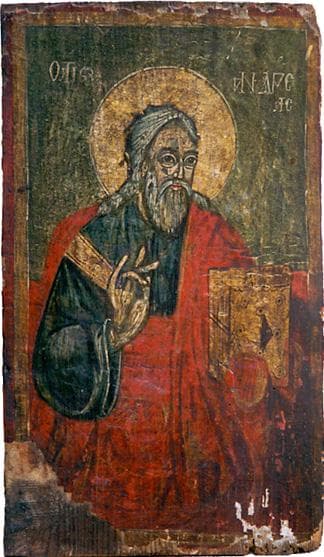
Andrew the First-Called — Public domain. Via Wikimedia Commons.
Life
Andrew, brother of Simon Peter and son of Jonah, was a fisherman of Bethsaida and one of the first disciples of John the Baptist on the banks of the Jordan. When the Forerunner pointed to a passing figure and said, "Behold the Lamb of God," Andrew left him and followed Jesus, spent the rest of that day with Him, and the next morning brought his brother Simon to the Lord. For this priority the Church names him the First-Called.
He stood with the Twelve through the years of public ministry — present at the feeding of the five thousand (where he noted the boy with five loaves and two fish), and at the Greeks' request before the Passion. After Pentecost, tradition sends him into the long mission. The Greek synaxaria carry him around the rim of the Black Sea — through Pontus, Cappadocia, Galatia, and Bithynia — and on as far as Scythia and the territory of the Slavs. He is said to have planted a cross on the hills above the future Kiev and to have foretold that a great city of God would arise there.
Returning at last through Greece, he came to Patras in Achaia, where his preaching led many of the wife and household of the Roman proconsul Aegeates to the faith. For this he was condemned, scourged, and tied — not nailed — to an X-shaped cross of olive wood, on which he lingered for three days continuing to preach to the gathered crowds before he gave up his soul. His relics rest now in part at Patras and in part at the Cathedral of Amalfi.
He is the patron of Russia, of Romania, of Scotland (through whose flag the saltire cross of his passion is borne), and of the Church of Constantinople, which honors him as its founder. His feast falls on November 30, and his apostolic succession at Byzantium is recalled at every visit of the Pope of Rome and the Ecumenical Patriarch by mutual exchange of relics.
Traditions
Feast day
November 30
Topics
Works in library