saint
St. Bartholomew the Apostle
One of the Twelve, often identified with the Nathanael of John's Gospel — the Israelite in whom there was no guile. Tradition sends him preaching as far as India and Armenia, where he translated the Gospel of Matthew into the local tongue and was flayed alive for the faith.
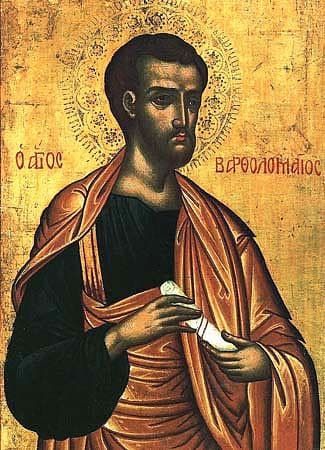
Bartholomew the Apostle — Public domain. Via Wikimedia Commons.
Life
Bartholomew was born around the year 5 in Cana of Galilee, the small village just north of Nazareth where the Lord's first sign — the changing of water into wine — would later take place at a wedding feast. He is almost certainly the Nathanael whom Philip brought to the Lord at the Jordan: when Philip told him "We have found Him of whom Moses in the law, and the prophets, did write — Jesus of Nazareth, the son of Joseph," it was Bartholomew who answered with the famous skeptical line "Can any good thing come out of Nazareth?" When he met the Lord, the Lord greeted him with "Behold an Israelite indeed, in whom is no guile" — and Bartholomew was won.
The two names — Bartholomew in the lists of the Twelve, Nathanael in the Gospel of John — are likely the same man called by two different parts of his full name (Bartholomew = "son of Tolmai," a patronymic, not a personal name). He stood with the Twelve through the public ministry. He was one of the seven by the lake of Tiberias to whom the risen Lord appeared on the morning of the great catch of fish.
After Pentecost he was given the most distant of all the apostolic missions. He went with Philip the Apostle into Asia Minor and labored at Hierapolis, where Philip was crucified; he continued alone into the great mountainous lands east of the empire — Armenia, the Caucasus, and on to India. The Eastern tradition is unusually specific about the regions he reached: by sea down the Persian Gulf to the Indian Ocean, then to the western coast of India, where he founded small Christian communities that would later merge with those Thomas had planted in the south.
His final mission was to Armenia. Around the year 68 — in the reign of the Armenian king Sanatruk — he and the apostle Jude (Thaddaeus) labored together in the mountains around the modern Iranian-Turkish border. They had great success: nearly the whole royal household, including the king's daughter Sandukht, was baptized. The pagan priests of the kingdom and the king's brother Polymius (in another version of the king's name) led the reaction. Bartholomew was arrested at Albanopolis in greater Armenia (modern Başkale in southeastern Turkey).
His death is one of the most distinctive in the apostolic martyrology: he was crucified head-downward (like Peter), and while still alive on the cross was flayed — his skin stripped from his body in long sections — and finally beheaded. His flayed skin became his iconographic attribute: Michelangelo's Last Judgment in the Sistine Chapel famously shows him holding it, with the artist's own face painted into the empty hide.
His relics were translated from Armenia first to Mesopotamia, then to the island of Lipari off Sicily (carried there in a coffin that floated of its own accord across the Mediterranean), and finally to Beneventum on the Italian peninsula and to Rome. The Armenian Apostolic Church remembers him as one of its two founders (with Thaddaeus). The Eastern Orthodox feast is June 11 (joint with Barnabas) and August 25 (translation of relics).
Traditions
Feast day
June 11 and August 25
Topics
Works in library