saint
St. James, son of Zebedee
Brother of John the Theologian, called by the Lord at the Sea of Galilee while mending nets with their father. One of the three taken up to Tabor and to Gethsemane, and the first apostle to be martyred — slain by Herod at Jerusalem in the year 44.
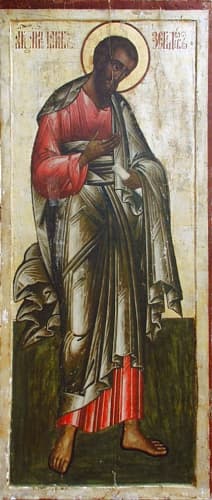
Apostle James the Greater — Public domain. 18 century icon painter. Via Wikimedia Commons.
Life
James was born around the year 3 BC in Bethsaida on the Sea of Galilee, the elder son of Zebedee, a moderately prosperous Galilean fisherman who owned his own boats and employed hired men. His mother Salome was almost certainly the sister of the Mother of God — making James (with his younger brother John) the Lord's first cousin. The family worked the small fishing fleet from Bethsaida and Capernaum together with the brothers Simon and Andrew. James and John were on the lake the day the Lord came along the shore and called Simon and Andrew; the Lord turned at once and called the sons of Zebedee also. They left the boats, their father, and the hired hands and followed.
He was one of the three brought into the inner ring of the Lord's intimacy — with Peter and his own younger brother John. The three were on Mount Tabor at the Transfiguration; they were at the daughter of Jairus when the Lord said "Talitha cumi"; they alone went forward with the Lord into the deep grove at Gethsemane on the night of the betrayal. James and his brother were given by the Lord the Aramaic nickname Boanerges — Sons of Thunder — for the zeal they showed: it was the two of them who once asked permission to call down fire on a Samaritan village that had refused them lodging, and their mother (with their support) who asked the Lord for the seats on his right and left in the kingdom — a request that drew the gentle rebuke "Are ye able to drink of the cup that I shall drink of?" The cup would prove to be martyrdom in earnest for James.
He stood with the Twelve through the years at Jerusalem after Pentecost — labored in the daily work of the new community there, served as one of the elders. About the year 44, twelve years after the Lord's Resurrection, Herod Agrippa I (the grandson of Herod the Great, then king of Judea by Roman appointment) launched a persecution of the Jerusalem church to please the Jewish leadership of the city. He arrested James and had him beheaded with the sword. James was the first of the Twelve to be martyred, and the only one whose death is recorded in the New Testament (Acts 12:1-2).
The man who had brought James to the tribunal — who is unnamed in Scripture but well-attested in early tradition — was so struck by his constancy that he confessed Christ on the spot and was beheaded with him; the two went to their crowns together. James was about 47.
A persistent Western tradition takes James on a missionary journey to Spain before his return to Jerusalem (the Spanish church of Compostela claims the relics of "Sant'Iago" — Santiago, "St. James"); the Eastern tradition holds him in Jerusalem throughout. His relics, in part, are at Santiago de Compostela; the Eastern church remembers him on April 30. He is the patron of Spain, of pilgrims (the scallop shell of the Compostela pilgrimage is his sign), of laborers, and of those who must die suddenly, without the time of preparation that most martyrs receive.
Traditions
Feast day
April 30
Topics
Works in library