saint
St. John the Theologian and Evangelist
The disciple whom Jesus loved, brother of James, who alone of the Twelve stood at the foot of the Cross and received the Mother of God into his keeping. He wrote the fourth Gospel at Ephesus in his old age, three short letters, and the Revelation given to him on Patmos. He alone of the Twelve was not slain by men, but laid himself in his grave at Ephesus and was taken.
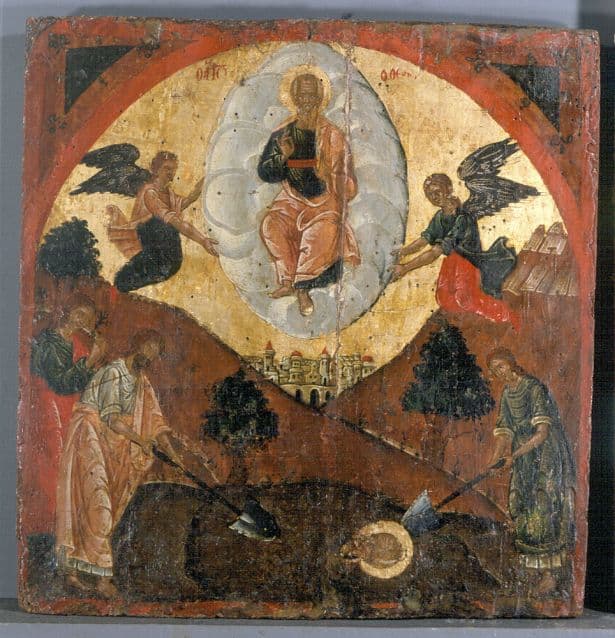
John the Theologian and Evangelist — Public domain. Via Wikimedia Commons.
Life
John, the son of Zebedee and Salome, was a Galilean fisherman like his older brother James, partner with Simon and Andrew in the small fleet that worked the Sea of Tiberias. He was almost certainly the youngest of the Twelve. With his brother he was nicknamed by the Lord Boanerges — Sons of Thunder — for the zeal that once asked permission to call down fire on an inhospitable Samaritan village.
He was the disciple whom Jesus loved. At the Mystical Supper he leaned upon the Master's breast, and at the Cross he alone of the Twelve stood by, with the Mother of God; from there the Lord gave him his Mother for his own. After the Resurrection he ran with Peter to the empty tomb but, seeing more quickly, allowed Peter to enter first. On the lake of Tiberias it was he who recognized the figure on the shore: "It is the Lord."
Tradition takes him to Ephesus, where he served the Mother of God until her dormition and afterward labored as the bishop of Asia Minor through the rest of the first century. Under Domitian he was exiled to the island of Patmos, and there in the cave still shown to pilgrims he received the Revelation. Returning to Ephesus in extreme old age — past ninety years — he dictated his Gospel to his disciple Prochorus, opening it with the words "In the beginning was the Word." Three short epistles followed, the last of them speaking of "Mercy, peace, and love" addressed to a particular small congregation.
He is the only one of the Twelve not slain by men. When at last his hour came, in the reign of Trajan, he asked his disciples to dig him a cross-shaped grave outside Ephesus, lay down in it, and bade them cover him over. When the city came the next day to disinter him, the grave was empty — and from it each year on his feast a fine dust ascended that healed the sick. The Church gives him three feasts: his Repose on September 26, the day of his miraculous dust on May 8, and a third in the Synaxis of the Twelve on June 30. With the apostle John alone among the Fathers does the Church share the name "the Theologian."
Traditions
Feast day
May 8 and September 26
Topics
Works in library