saint
St. Jude, brother of the Lord
One of the Twelve, sometimes called Thaddaeus, kinsman of the Lord and author of the short catholic epistle warning against the apostasy of the last days. He preached through Mesopotamia and Persia and met his end by martyrdom in Armenia.
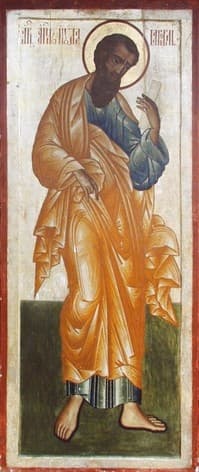
Apostle Jude Thaddeus — Public domain. Via Wikimedia Commons.
Life
Jude — also called Thaddaeus in some of the Gospel lists, and Lebbaeus in others (the Greek translators of the three Aramaic name-variants seem to have been uncertain which to use for "the brother of James") — was born around the year 3 in Galilee, the son of Joseph the Betrothed by his first marriage and therefore one of the four "brothers of the Lord" named in the Gospels: James (later Bishop of Jerusalem), Joses, Simon, and Jude (or Judas, not Iscariot). Their mother was Joseph's first wife, who died well before he was betrothed to the Virgin Mary; the four were thus the Lord's older stepbrothers — older than He was, raised in the same household at Nazareth.
He did not at first follow the Lord. The Gospel of John makes the point explicitly: "For neither did his brethren believe in him." The brothers of the Lord remained outside the inner circle until the Resurrection — but at Pentecost they were all there in the upper room, and by the time the Acts of the Apostles records the first labors of the new community Jude is reckoned among the Twelve.
He is the author of the brief catholic Epistle of Jude that closes the New Testament epistolary collection — twenty-five verses written probably in the 60s, as gnostic teachers were beginning to spread alternative gospels through the churches of Asia Minor and Syria. The letter is a sharp, almost stenographic warning against false teachers, written from the perspective of one who had personally heard the apostolic preaching from the beginning. It contains the only canonical quotation from the apocryphal Book of Enoch and the famous closing doxology read at every Orthodox Compline: "Now unto Him that is able to keep you from falling, and to present you faultless before the presence of His glory with exceeding joy, to the only wise God our Saviour, be glory and majesty, dominion and power, both now and ever."
His apostolic labor was in Syria and Mesopotamia, and finally in Armenia, where he labored with the apostle Bartholomew at the court of King Sanatruk. The two were initially well received; the king's daughter Sandukht was baptized through Jude's preaching. The reaction set in when the pagan priests of the kingdom realized how widely the new faith was spreading among the royal household. Bartholomew was sent away to be flayed at Albanopolis; Jude remained at the capital city of Artaz and was crowned shortly after — clubbed to death with arrows (or, in another account, struck by a hatchet) around the year 70 or 72.
His relics, with those of Simon the Zealot (with whom the Latin tradition pairs him on October 28), are at St. Peter's in Rome — translated there in the eighth century from Armenia by way of Constantinople. The Eastern Orthodox feast is June 19. He is, by an old Latin association built on the similarity of his name to that of the betrayer Judas Iscariot (and the resulting reluctance of medieval Christians to invoke him), the patron of impossible and desperate causes — those situations where Christians, in despair, "ask St. Jude" precisely because they have nowhere else to turn.
Traditions
Feast day
June 19
Topics
Works in library