saint
St. Matthew the Evangelist
The publican Levi called from his receipt of custom by the Lord's word 'Follow Me,' who left his counting-table at once and gave a feast for his old companions of the trade. He wrote his Gospel first of all the four in Hebrew, then labored in Ethiopia, where he was given the crown of martyrdom in his old age.
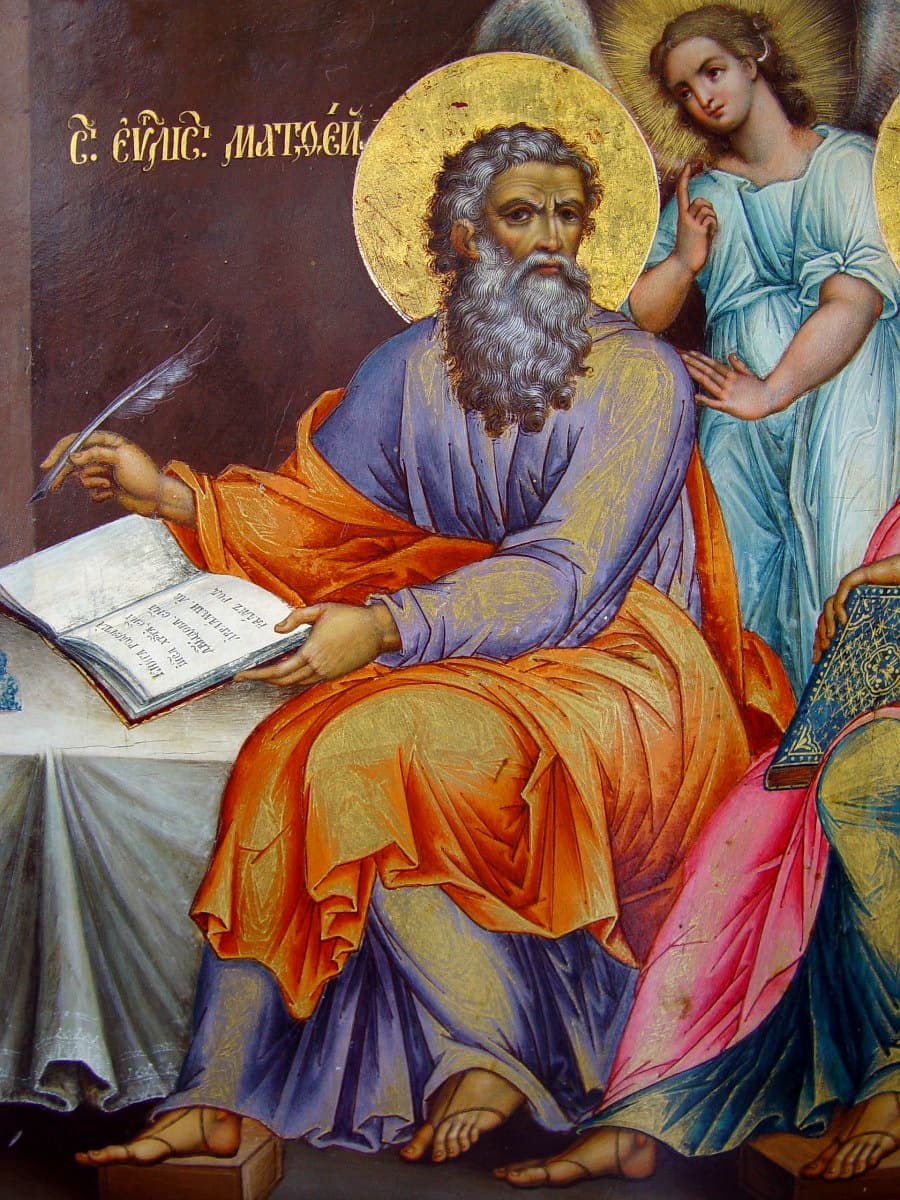
Matthew the Evangelist — Public domain. Via Wikimedia Commons.
Life
Matthew — also called Levi — was a Jew of Galilee employed by the Romans as a tax collector (a publican) at the customs station on the road from Damascus to Acre, where it passed through Capernaum on the north shore of the Sea of Tiberias. The trade made him wealthy and despised — Jewish tax collectors of Roman taxes were universally hated as collaborators with the occupying power, and ranked with public sinners and prostitutes for purposes of the synagogue. The Lord passed his collecting-table one day and said, "Follow Me." Matthew got up at once, left everything, and threw a great farewell banquet at his own house, to which he invited his fellow publicans and many sinners. The scribes complained; the Lord answered, "I came not to call the righteous, but sinners to repentance."
He stood with the Twelve through the public ministry — the Gospels mention him by name in the lists of the apostles, where he occupies the seventh or eighth place. After Pentecost he remained in Palestine for about fifteen years, preaching among his own people. Around the year 50, before going abroad, he wrote his Gospel — first of the four in the order of composition — in Hebrew (or, more likely, the closely related Aramaic that Palestinian Jews spoke). It was a missionary tool he gave the Hebrew-speaking churches as a record of the things he had himself seen. The Gospel was translated into Greek soon after, and the Hebrew original was lost.
The Gospel of Matthew is the most thoroughly Jewish of the four — written for readers who knew the Law and the Prophets and would recognize at every turn how the figure of the Lord fulfilled them. It carries five great discourses (the Sermon on the Mount, the missionary discourse, the parables of the kingdom, the discourse on the Church, the discourse on the end of the age), the genealogy beginning with Abraham, the long story of Joseph the Betrothed, and the only Gospel parable of the sheep and the goats.
After his decades in Palestine, tradition sends him out to evangelize the lands east and south of the empire. He preached in Parthia, in Persia, in Ethiopia — particularly the latter, where he is said to have founded the African churches that survive as the Ethiopian and Eritrean Orthodox communities. In Ethiopia, around the year 75 or so, he was speared and stabbed in the back at the altar of the church he was serving — a martyrdom recorded with some accuracy in the Ethiopic synaxarion. His relics were eventually translated to Salerno in southern Italy, where they remain.
His iconographic symbol — the man, or the winged man — comes from Ezekiel's vision of the four living creatures, the man corresponding to the Gospel that opens with the human genealogy of Christ. His feast is November 16.
Traditions
Feast day
November 16
Topics
Works in library