saint
St. Matthias the Apostle
Chosen by lot in Acts 1 to fill the place of Judas among the Twelve. He preached the Gospel in Judea, Cappadocia, and on the shores of the Caspian Sea, and was stoned and finally beheaded for the faith.
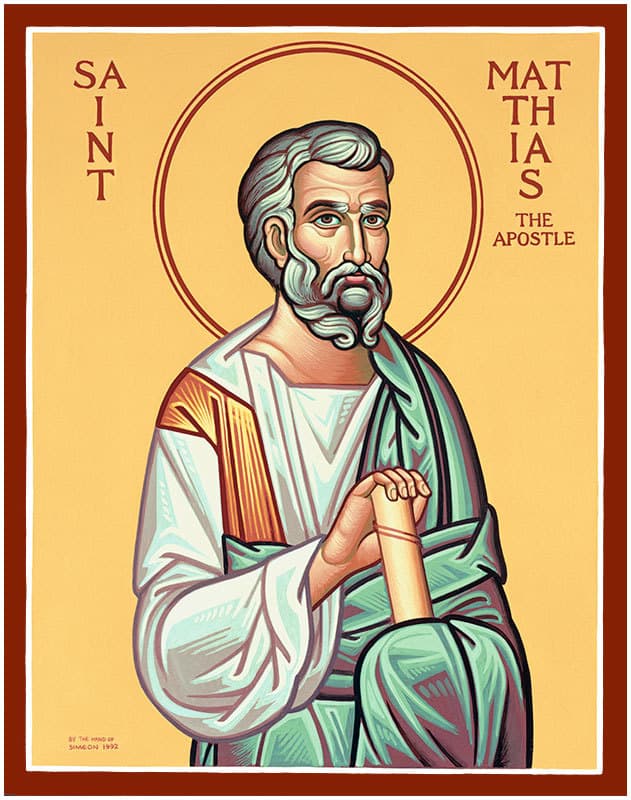
Matthias the Apostle — Hand-curated icon.
Life
Matthias was a disciple of the Lord from the beginning of His public ministry — "from the baptism of John unto that same day that He was taken up from us," as Peter put it. He was one of the wider circle of the Seventy (the seventy-two whom the Lord sent out two by two before His face), but not of the inner Twelve until the events of Acts 1.
After the Ascension, before Pentecost, Peter stood up in the upper room and observed that the rank of Judas was vacant — that the office of the Twelve, the apostolate to the Twelve tribes of Israel, must be filled by one who had been with them from the beginning. Two candidates were put forward: Joseph called Barsabas (surnamed Justus), and Matthias. They prayed: "Thou, Lord, which knowest the hearts of all men, show whether of these two Thou hast chosen, that he may take part of this ministry and apostleship." They cast lots, and the lot fell on Matthias. He was numbered with the Twelve from that day forward.
He received the Holy Spirit with the others at Pentecost and labored thereafter — though Scripture has no further word of him after Acts 1. Tradition is somewhat divided. The Greek synaxaria send him to Cappadocia and to the lands along the Caspian Sea, where the wild tribes of the interior received the gospel through him with great violence. The Acts of Andrew and Matthias (a third-century Greek apocryphon) takes him to a city of cannibals — sometimes identified with Mtskheta in Georgia — where Andrew rescued him from prison and they founded the first Christian community in the Caucasus together. Other versions of his missionary work place him in Ethiopia and Macedonia.
The end of his life is variously reported: stoned to death at Jerusalem on his return there for the apostolic council; crucified at the foot of the Caucasus; beheaded at Sebastopolis on the Black Sea. The Western tradition keeps him on February 24; the Eastern Church on August 9. His relics, in part, are at the abbey of St. Matthias at Trier in Germany, where they were translated by St. Helena in the fourth century. He is the patron of the late-called, of carpenters, of recovering alcoholics, and of those chosen by lot for difficult tasks.
Traditions
Feast day
August 9
Topics
Works in library