saint
St. Philip the Apostle
One of the Twelve, who brought Nathanael to Christ at the Jordan and at the feeding of the five thousand counted the cost. He preached through Phrygia in Asia Minor and was crucified head-downward at Hierapolis with his sister Mariamne by his side.
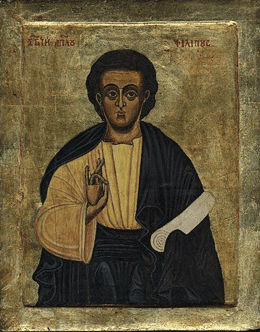
Philip the Apostle — Public domain. Via Wikimedia Commons.
Life
Philip — to distinguish him from Philip the Deacon (one of the Seven, who was a generation later) — was born around 8 BC at Bethsaida on the northeastern shore of the Sea of Galilee, into a family of Greek-speaking Jewish fishermen of the Galilean Jordan-mouth region. The name "Philip" itself is Greek (meaning "horse-lover") and indicates the substantial Hellenistic influence on his family — Bethsaida had been a Greek-speaking commercial town with a significant non-Jewish population, and Philip's family was likely of the bilingual middle-class commercial sort. He was about thirty when the Lord called him, around the year 27 of the Lord's public ministry — older than most of the Twelve, who were younger men.
The call is recorded specifically in John 1:43-46. The Lord found Philip the morning after his own departure from John the Baptist's circle on the Jordan; he was preparing to leave the Jordan country and return north to Galilee. The Lord said simply: "Follow me." Philip followed at once; he then went immediately to find his fellow-townsman Nathanael (the disciple of John 1:45 who is usually identified with the apostle Bartholomew) and brought him to the Lord with the words: "We have found him, of whom Moses in the law, and the prophets, did write, Jesus of Nazareth, the son of Joseph."
Philip appears five times in the Gospel of John (his role is more prominent in John than in the Synoptic Gospels). At the feeding of the five thousand (John 6:5-7) it is to Philip that the Lord turns first with the question "Where shall we buy bread, that these may eat?" Philip's answer — "Two hundred pennyworth of bread is not sufficient for them, that every one of them may take a little" — shows the practical, business-minded cast of his mind. At the visit of the Greeks during Holy Week (John 12:20-22), it is to Philip that the foreign visitors turn first with the request "Sir, we would see Jesus" — the Greek-speaking name and the Hellenistic Galilean background made him the natural intermediary.
At the Last Supper (John 14:8-9) Philip asks the famous question that draws the great Christological response: "Lord, shew us the Father, and it sufficeth us." The Lord answers: "Have I been so long time with you, and yet hast thou not known me, Philip? he that hath seen me hath seen the Father; and how sayest thou then, Shew us the Father?" The exchange is one of the central New Testament passages on the unity of the Father and the Son.
After Pentecost (30) Philip remained with the apostolic community at Jerusalem for some years. He was one of the apostles dispatched to Samaria after the persecution following the death of Stephen (37); he served there for some time at the cities of Samaria-Sebaste and the new town of Caesarea Maritima with the wider apostolic mission. After the apostolic council of 49 he set out on his own mission to the western territories of Asia Minor.
His mission territory was western Phrygia — the inland part of western Asia Minor, between the cities of Smyrna, Sardis, and the upper Maeander valley. He worked through the cities of the region for the next twenty years, accompanied by his sister Mariamne (a missionary in her own right, sometimes identified as the "Mariamne" of the Gospel of Mary in some Gnostic traditions) and by Bartholomew. The trio is recorded by the second-century author Polycrates of Ephesus, who wrote of having met disciples of Philip's daughters during his own youth.
The principal city of Philip's later mission was Hierapolis (modern Pamukkale in Turkey), the substantial Roman city in the upper Lycus valley known for its hot springs and for the great temple of the Phrygian goddess Cybele. The temple of Cybele was the center of a pagan cult that included a giant snake-shrine — the temple housed an enormous serpent considered the manifestation of the goddess and the recipient of the temple's sacrifices. Philip and Bartholomew preached at Hierapolis around 80 AD; their preaching led to the conversion of substantial numbers of Hierapolitans and the political eclipse of the Cybele cult.
The decisive event of his life took place at Hierapolis around 80. The senior priest of the Cybele temple — supported by the local Roman magistrate Nicanor — moved against the apostolic team. Philip was arrested with Bartholomew and Mariamne. The standard escalating tortures were applied: they were flogged, hung up on racks, beaten with rods. Philip and Bartholomew were eventually condemned to crucifixion; Mariamne was condemned to be tortured to death in a separate location.
Philip was crucified head-downward — at his own request, on the model of the apostle Peter, since he did not consider himself worthy to die in the same manner as the Lord. Bartholomew, crucified beside him, survived the initial crucifixion (the sources note that an earthquake during the execution caused his cross to fall and the soldiers to disperse); Bartholomew was eventually able to escape and continue the mission. Philip died on his cross. He was about eighty-eight.
His body was recovered by the local Christian community of Hierapolis and was buried at a small shrine at the site of his martyrdom. The shrine was rebuilt in the fifth century as a substantial pilgrimage church — the Martyrium of Saint Philip — which still stands as the ruined Byzantine octagonal church visible at the modern archaeological site of Hierapolis. Excavations between 2001 and 2011 by an Italian archaeological team uncovered what is now widely accepted as the original first-century tomb of the apostle in the foundation of the church.
His relics were translated in part to Constantinople in the early Byzantine period and to Rome in the medieval period; major portions are at the Basilica of the Holy Apostles in Rome (where they have been venerated since the twelfth century, alongside the relics of James of Zebedee). Substantial portions remain at the Martyrium of Saint Philip at Hierapolis. He is the patron of Hierapolis-Pamukkale, of Greek-Jewish converts, of merchants and businessmen (for his practical-mathematical cast of mind), and of every Christian who would draw their fellows to the Lord with "come and see." His feast is November 14.
Traditions
Feast day
November 14
Topics
Works in library