saint
St. Simon the Zealot
One of the Twelve, called the Zealot in distinction from Simon Peter. Tradition sends him preaching across North Africa and as far as Britain, where he received the crown of martyrdom.
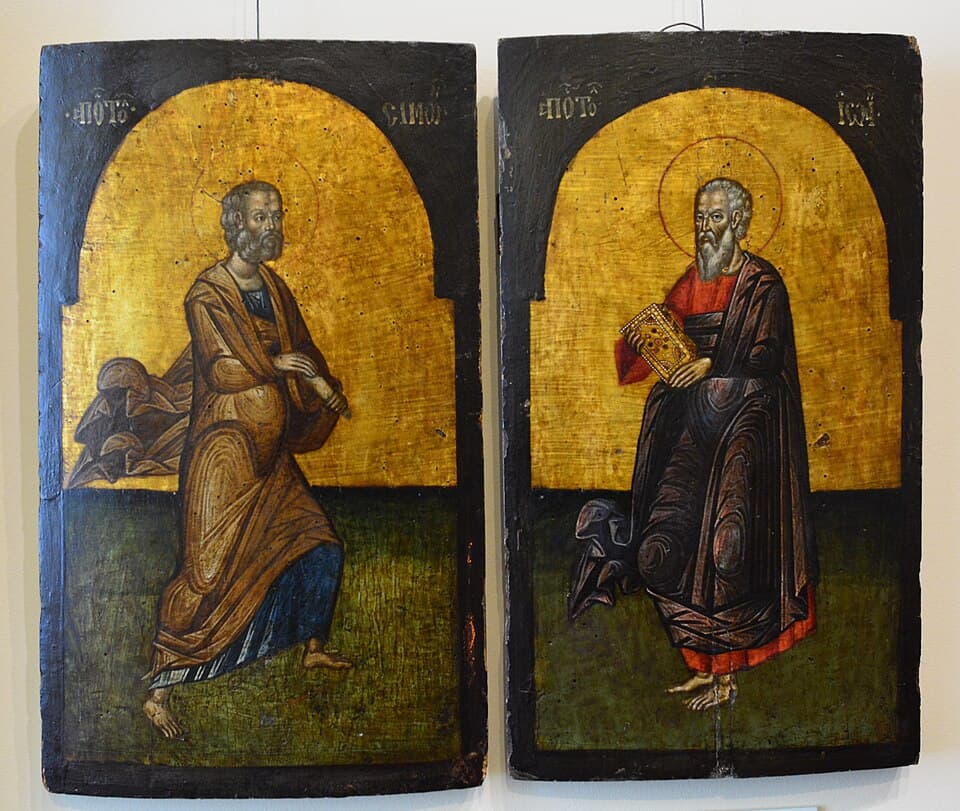
Simon the Zealot — CC BY-SA 4.0. Joe Mabel. Via Wikimedia Commons.
Life
Simon — distinguished by his epithet "the Zealot" (Greek "ho Zelotes," from the militant nationalist party of Second Temple Judaism known as the Zealots) — was born around the year 5 in the Galilean city of Cana, the small town northwest of the Sea of Galilee where the Lord performed his first public miracle. His family was of substantial Jewish landholders in the territory of Zebulun; they were related (according to several early traditions, though the precise degree is uncertain) to the family of Joseph the Betrothed and so were kinsmen of the Lord through Joseph.
He had been associated as a young man with the Zealot party — the political-religious movement of armed resistance to Roman rule that had emerged in Galilee under the leadership of Judas of Galilee around 6 AD (when Quirinius's census triggered the major Galilean revolt that gave the party its name). Simon was perhaps fifteen or sixteen at the time of Judas's revolt and seems to have been a junior member of the surviving Zealot organization through his late teens and twenties. His epithet identifies the affiliation; the Gospel record preserves no other detail.
The decisive event of his life took place at his own wedding feast at Cana, around the year 28. He was about twenty-three; he was marrying a young woman of his hometown; the wedding was a substantial Galilean affair with the standard week of feasting. The Lord — who was Simon's kinsman through Joseph — was invited to the wedding along with his Mother and his early disciples (this is the wedding at Cana of John 2). At the standard week of feasting the wine ran out; the Mother of the Lord, who had been helping with the household arrangements, brought the problem to her Son; he turned the six stone waterpots of purification into wine. The miracle was the Lord's first public sign.
Simon was deeply impressed. He left the wedding bed on the morning after the miracle (his marriage thus brief and apparently never consummated, in the standard tradition), gave his wife the standard Mosaic divorce-bill, and followed the Lord. The wife — who is sometimes named Helena in the Greek tradition, sometimes Pelagia in the Latin — entered the early Christian community in her own right and is said in some traditions to have been one of the women at the foot of the Cross.
Simon was added to the Twelve and is listed (in all three Synoptic accounts of the Twelve, and in Acts 1:13) under the name "Simon the Zealot" or "Simon the Canaanite" (the latter being a translation-variant of the same epithet — "Canaanaios" reflects the Aramaic word for "zealot"). He served with the Twelve through the rest of the Lord's public ministry. He was present at the Last Supper, was scattered with the others at the Crucifixion, gathered with the others at the Resurrection appearances, was filled with the Spirit at Pentecost.
The Pentecost-and-after period saw the Twelve disperse across the known world for the apostolic mission. The standard early Christian record places Simon's mission first at Carthage in Roman North Africa, then westward to Mauretania (modern Morocco), then to Spain, and finally to the British Isles. The British mission is the substantial Western tradition; it is recorded by the second-century author Hippolytus of Rome (who wrote of Simon "preaching the gospel of Christ to the inhabitants of Britain") and by various later British sources.
His final field of mission was Persia. He had returned eastward from Britain around 65 AD and was joining the apostle Jude (Thaddaeus) at the Persian court of Shapur I, where Jude was already established as the chief apostolic figure of the Persian Christian mission. Simon and Jude served together at the Persian court for several years; the Persian sources describe a substantial number of conversions from the Persian nobility, including (in some traditions) a daughter of the king himself.
The decisive event of his final years took place around 70 at the small Persian city of Suanir, in the territory of Persian Armenia. A reaction to the apostolic mission set in among the Persian Magi (the Zoroastrian priestly class), who had grown alarmed at the political effects of the Christian conversions. The Magi succeeded in turning the local Persian governor against the apostles. Simon and Jude were both arrested at Suanir.
The standard escalating tortures were applied. The two apostles were eventually beheaded together at Suanir — Simon by being sawn in half with a great two-handled saw (the most common Persian execution-method for high-ranking foreign prisoners, a deliberately humiliating death). Jude was clubbed to death at the same execution.
Simon was about sixty-five at his death. His body was recovered by the local Persian Christian community and buried at the Christian community's small chapel at Suanir. The relics were translated to Constantinople in the early Byzantine period and to Rome in the eighth century; the principal portion now rests at Saint Peter's Basilica in Rome, in the joint tomb of Simon and Jude that was created at their translation.
He is the patron of Britain (in the Western tradition that takes his preaching there as the apostolic foundation of British Christianity), of Cana of Galilee (his hometown), of those whose conversions take place at moments of public miracle, and of every Christian who has abandoned political militancy for the Lord's peace. His feast in the East is May 10 (which is also the joint feast of Simon and the rest of the Twelve who were not martyred at Pentecost or shortly afterward); in the West he is celebrated jointly with Jude on October 28.
Traditions
Feast day
May 10
Topics
Works in library