saint
St. Thomas the Apostle
Called the Twin, who would not believe without seeing, and seeing cried 'My Lord and my God' — the confession that holds together the eighth-day liturgy of Pascha. Tradition sends him preaching as far as India, where he founded the Church and was pierced through with a spear.
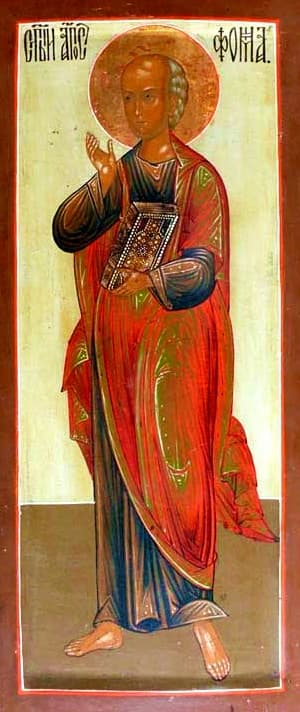
Thomas the Apostle — Public domain. Via Wikimedia Commons.
Life
Thomas — called the Twin (Didymos in Greek) for an unknown reason — was a Galilean, almost certainly a fisherman like most of the Twelve. He appears in the Gospels several times as a man of unsparing realism: when Jesus turns toward Judea after the news of Lazarus's death, knowing the Jews there are seeking to kill Him, it is Thomas who says to his fellow disciples, "Let us also go, that we may die with Him." When at the Last Supper the Lord speaks of going to prepare a place and that the disciples know the way, it is Thomas who answers, "Lord, we know not whither Thou goest; and how can we know the way?" — drawing out the great answer, "I am the way, and the truth, and the life."
He was absent when the risen Lord appeared to the Ten on the evening of Pascha. When the others told him that they had seen the Lord, he answered the famous words: "Except I shall see in His hands the print of the nails, and put my finger into the print of the nails, and thrust my hand into His side, I will not believe." Eight days later, in the same upper room, the doors again shut, the Lord came and stood and turned to Thomas: "Reach hither thy finger, and behold My hands; and reach hither thy hand, and thrust it into My side; and be not faithless, but believing." Thomas answered with the confession that has anchored the eighth-day Sunday of Pascha ever since: "My Lord and my God!"
After Pentecost the apostles cast lots for the regions of the world they would evangelize, and to Thomas fell India. He went unwillingly at first — the Greco-Persian-Indian world was the farthest stretch of the known earth — but tradition is unusually firm in its details. The Acts of Thomas, a third-century apocryphal text but one anchored in older oral tradition, takes him first to the kingdom of Gondaphorus in the upper Indus valley (now Pakistan), where he was given the commission to build a palace and instead built schools and churches; then on by ship around the Indian peninsula to the Malabar coast in Kerala in southern India.
There, in the kingdom of the Cholas, he labored for some twenty years, baptized many of the local Brahmins (whose descendants are the present-day Saint Thomas Christians of Kerala), founded seven churches, and was at last martyred at Mylapore on the southeast coast in about 72 AD — speared through while at prayer on a hill. His relics were brought back, in part, to Edessa in Mesopotamia; from there portions were translated to Ortona in Italy. The Saint Thomas Christians of India have continued, with their own liturgy and tradition, in unbroken descent from his preaching — the longest single line of Christian community outside the Mediterranean basin.
His feast is October 6 (commemorating his martyrdom) and the Sunday after Pascha (commemorating his confession). He is the patron of architects, of doubters wrestling toward faith, and of all of India.
Traditions
Feast day
October 6
Topics
Works in library