saint
St. Athanasius of Mount Athos
Founder of the Great Lavra and father of organized monastic life on the Holy Mountain. He gave the Athonite community its first Typikon and prepared the way for the millennium of Athonite monasticism that has followed.
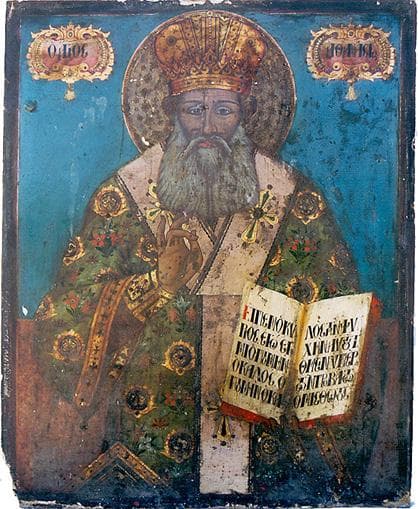
Athanasius of Mount Athos — Public domain. Via Wikimedia Commons.
Life
Abraham was born around 925 in the small Greek town of Trebizond on the southeastern coast of the Black Sea (modern Trabzon in northern Turkey), into a wealthy Byzantine Greek family of the local commercial-military aristocracy. His father — a senior Greek officer of the imperial provincial command — reposed before his birth; his mother died when he was about seven. He was raised by a kinswoman of his family at Trebizond and then sent at twelve to Constantinople for higher studies under the imperial scholar Athanasius (one of the leading classical-Greek scholars of the period).
He completed his upper studies at Constantinople around 945 and entered the imperial civil service at twenty as a junior administrator. He served in the chancery for several years and was on a clear path to senior administrative office when the decisive change of his life took place. He attended a brief visit to the Bithynian monasteries near Constantinople around 952; he was deeply struck by the monastic life he saw there. He resigned his civil service position, distributed his inherited wealth to the poor of Constantinople, and entered the monastic life at the Bithynian monastery of Mount Kyminas under the elder Michael Maleinos (who would become his lifelong spiritual father).
He was tonsured Athanasius at Kyminas, taking the name of his old Constantinople teacher. He served at Kyminas for the next five years (952-957) as a young monk of the standard Bithynian discipline. The principal patron of the Kyminas community at this point was the Byzantine general Nicephorus Phocas — a senior military officer who would shortly become emperor (963-969) and whose family had close connections to Mount Kyminas through the elder Michael Maleinos (Nicephorus's uncle). Athanasius and Nicephorus became friends through their shared connection to Kyminas; the friendship would shape both their subsequent careers.
Athanasius wanted greater solitude than Kyminas could offer. In 958, at thirty-three, he withdrew to Mount Athos — at this point a sparsely populated peninsula in northern Greece with perhaps a few dozen scattered hermits and small cell-monasteries, but no organized monastic community. He spent his first years there in deep solitude at a remote cell on the southeastern side of the mountain.
In 961, his old friend Nicephorus Phocas (now the senior general of the Byzantine army) led a major military expedition to retake the island of Crete from its Saracen-Arab rulers. The reconquest of Crete was the first major Byzantine military success in over a century. Nicephorus, in thanksgiving for the victory, wanted to retire to Mount Athos himself and join Athanasius in the hermit's life. Athanasius came to Crete at Nicephorus's request to discuss the plan.
The two of them planned together to found a substantial monastic community on Athos — not a small hermit-cluster but a fully cenobitic monastery on the standard cenobitic pattern of the imperial centers. Nicephorus committed substantial imperial funds for the project. Athanasius returned to Athos in 962 with the funds and began the work of building.
The Great Lavra of Athanasius — the first of the great Athonite monasteries, and the principal seat of Athanasius's lifelong work — was completed in 963. It was built in stone (Athos had been previously a region of wooden cell-construction only) on the southeastern tip of the peninsula, with a great central cathedral (the katholikon of the Theotokos), a large refectory, an extensive system of monastic cells, fortified walls against the standing threat of Saracen raids from the sea, and substantial agricultural and livestock facilities to support a large community.
Nicephorus Phocas, however, did not retire to the monastery. He was acclaimed Emperor in 963 (the year of the Lavra's completion) and reigned for six years before his assassination in 969. He continued to fund the Lavra's construction and operation through these years; Athanasius continued as the abbot, with the imperial funds enabling the rapid growth of the community.
By 970 the Lavra had about a hundred and twenty monks. By 980 it had three hundred. By the time of Athanasius's death the community had over seven hundred. The institutional pattern Athanasius established — a fully cenobitic monastic discipline within the broader peninsula context of multiple monasteries, each independent under its own abbot but linked through the senior abbot of the Lavra as the coordinating authority — became the standard Athonite pattern for the next thousand years and shapes Athos as it operates today.
The first Typikon of Athos — the document of monastic regulation that has shaped Athonite life ever since — was drafted by Athanasius and approved by the Emperor John Tzimiskes in 972. The Typikon established the basic institutional rules: the senior abbot of the Lavra as the first among the Athonite abbots; the prohibition on women entering the peninsula; the prohibition on the introduction of beardless youths into the community; the standard cenobitic disciplines; the rules for the founding of new monasteries; the relations between the senior abbots in matters of common concern.
Athanasius reposed at the Great Lavra on July 5, 1003 (or perhaps 1001 — the records vary), at about seventy-eight. The manner of his death was unusual: the Lavra was building a new chapel; Athanasius came up to inspect the work; the scaffolding collapsed; he was buried under the falling stones. His body was extracted three days later, when the workers had cleared the debris, and was found incorrupt. He was buried at the Lavra in the great cathedral he had built.
His relics rest at the Great Lavra of Athos, where they have been continuously venerated since his repose. He is the patron of Mount Athos and of its entire millennium of monastic tradition; of military officers who have entered monastic life; of monasteries built with imperial funds; and of every Christian who has founded a substantial institutional community in the wilderness. His feast is July 5.
Traditions
Feast day
July 5
Topics
Works in library