father
St. Athanasius the Great
Defender of Nicene faith whose soteriology anchors later Orthodox teaching on deification.
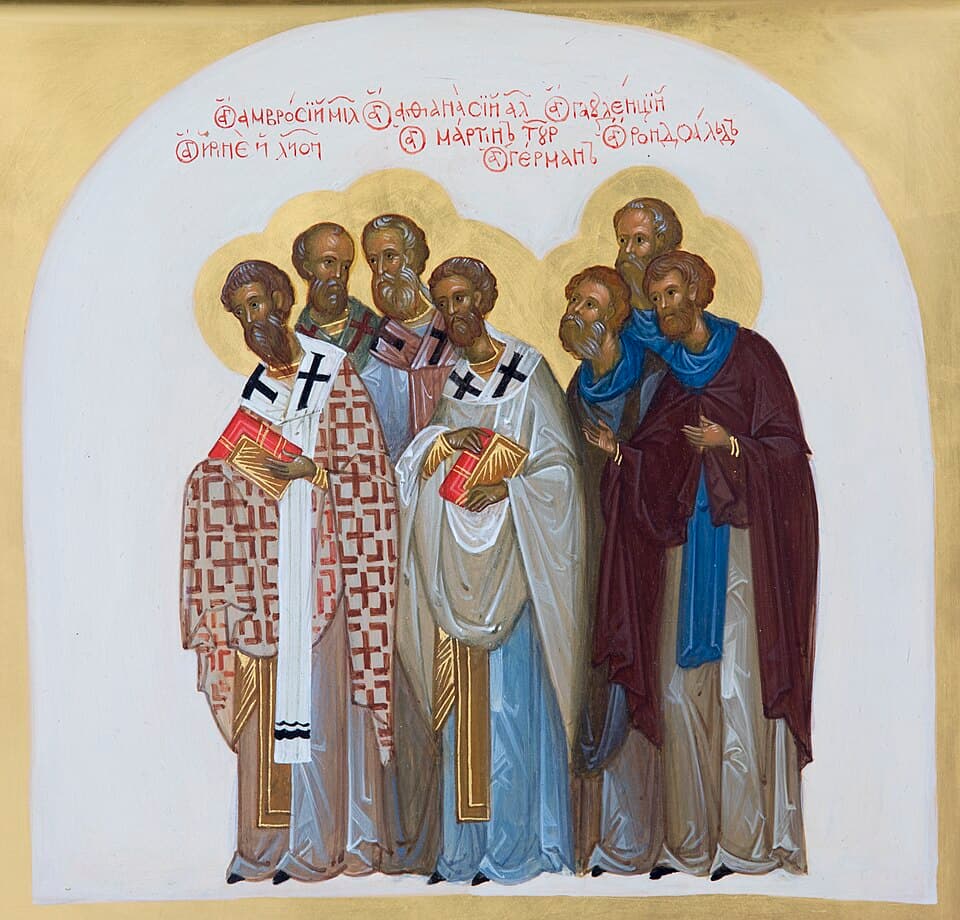
Athanasius the Great — CC BY 4.0. Via Wikimedia Commons.
Life
Athanasius was born around 296 in Alexandria, the great Christian and Greek city of Roman Egypt. As a boy — the story is well attested — he played at "baptizing" his friends on the seashore with such gravity that the Patriarch Alexander, watching from a window, sent for the children and decided the boy was destined for the Church. He was educated in the catechetical school of Alexandria under Alexander's tutelage, ordained deacon by him, and served at his side at the First Ecumenical Council at Nicaea in 325, where Athanasius — not yet thirty — was the most penetrating opponent of Arius.
In 328, on Alexander's death, the people of Alexandria carried Athanasius into the cathedral and acclaimed him bishop. He was thirty-three. For the next forty-five years he held the see through five separate exiles totaling seventeen years away from it — driven out four times by Arian emperors (Constantine the Great, Constantius II twice, Julian the Apostate, Valens) and once by an imperial commission. Three times he was sentenced to death and three times escaped. He went into hiding in the Egyptian desert with Anthony's monks and in the cellars of his own city; he went on writing the whole time.
His writings shaped the Christology of the entire later Church. On the Incarnation, written in his twenties, contains the famous sentence "The Word became man that we might become god" — the heart of the Orthodox doctrine of theosis. Against the Arians, in four books, gave the East the vocabulary it needed for the Trinity. His Life of Anthony, written in his seventies, single-handedly created the Western monastic tradition; Augustine of Hippo at Milan wept over it and through it was converted.
He reposed in his own city, finally at peace under the Emperor Valens's brief truce, on May 2, 373. He had spent his whole adult life defending the consubstantiality of the Son with the Father. The Church gave him his title — Athanasius the Great — almost at once, and reckons him among the four great doctors of the Eastern tradition together with Basil, the two Gregories, and Chrysostom.
Traditions
Feast day
January 18
Topics
Works in library
Readings and commentaries
Ad Afros Epistola Synodica
Letter to the African bishops reaffirming the authority of Nicaea against later compromise creeds.
Ad Episcopos Aegypti et Libyae
Pastoral encyclical to the Egyptian and Libyan bishops warning against Arian apologetic strategies and reaffirming the Nicene confession.
Against the Heathen (Contra Gentes)
The first half of Athanasius's apologetic diptych. A philosophical and biblical critique of pagan polytheism that prepares the ground for On the Incarnation.
Apologia ad Constantium
Self-defense addressed to the Emperor Constantius, responding to charges of disloyalty and treating the relationship between bishop and emperor with grave courtesy.
Apologia Contra Arianos (Defence Against the Arians)
Athanasius's long self-defense against Arian charges, weaving together synodal acts, episcopal letters, and personal narrative to establish the legal and ecclesiastical record of his case.
Apologia de Fuga (Defence of His Flight)
Defense of Athanasius's flight from his enemies during the persecutions — biblical precedents from the Patriarchs, Elijah, and Christ himself for withdrawing to preserve the witness.
Circular Letter
Encyclical to the wider church reporting an Arian incursion on the see of Alexandria and appealing for solidarity from the bishops abroad.
De Decretis (Defence of the Nicene Definition)
Defense of the Nicene Creed's controversial term homoousios, arguing that its substance is biblical even though its exact wording is not.
De Sententia Dionysii (On the Opinion of Dionysius)
A defense of Dionysius of Alexandria's third-century orthodoxy against Arian appropriations of his writings on the Son's distinctness from the Father.
De Synodis (On the Councils of Ariminum and Seleucia)
Synodal history with sustained Trinitarian argument — chronicling the councils called by Constantius and comparing their creeds against the Nicene standard.
Deposition of Arius
Synodal document from the Alexandrian council that condemned Arius, preserved within the Athanasian corpus as a primary record of the controversy's earliest documentary phase.
Four Discourses Against the Arians
Four sustained discourses against Arian Christology — the most extensive Trinitarian and Christological argument in Athanasius's corpus, including his celebrated reading of Proverbs 8:22.
Historia Acephala
Anonymous "Headless History" — a contemporary chronicle of Athanasius's exiles preserved in the manuscripts and edited into NPNF Vol. 4 for its primary-source value.
Historia Arianorum (History of the Arians)
Eight-part historical-polemical narrative of the Arian persecution, addressed to the monks — a primary witness for the church's experience under Constantius II.
Letter on the Council of Nicaea
Eusebius of Caesarea's letter to his diocese explaining the creed of Nicaea. Included in the NPNF Athanasius volume because of its bearing on the controversy Athanasius would inherit.
Letters
Forty-three festal and doctrinal letters spanning Athanasius's forty-six years as bishop — including the festal letters that announced the date of Pascha to the Egyptian churches.
Life of St. Anthony
The founding text of Christian monastic hagiography — ninety-four episodes from the life of Anthony the Great whose example would draw Augustine, the desert monastics, and the entire monastic tradition.
On Luke 10:22 and Matthew 11:27
The only direct Scripture commentary in Athanasius's corpus — five short sections expounding "All things are delivered to me of my Father" as a Trinitarian, not subordinationist, declaration.
On the Incarnation of the Word
The foundational Orthodox treatise on the Word made flesh — fifty-seven chapters arguing that the Son of God became human "that we might be made god," restoring the image of God in fallen humanity.
Statement of Faith
A concise doctrinal statement — the genuinely Athanasian creed-text, distinct from the later Western Quicunque vult attributed to him by tradition but not by authorship.
Tomus ad Antiochenos
Synodal letter from the Council of Alexandria (362) addressing the Antiochene schism — a remarkable irenic effort to receive returning semi-Arians without compromising the Nicene confession.