saint
St. Barbara the Great-martyr
A noble maiden of Heliopolis whose pagan father, finding she had been baptized in his absence, denounced her himself and beheaded her with his own hand. He was struck dead by lightning on his way down the mountain. Patron of artillerymen, miners, firefighters, and those facing sudden death.
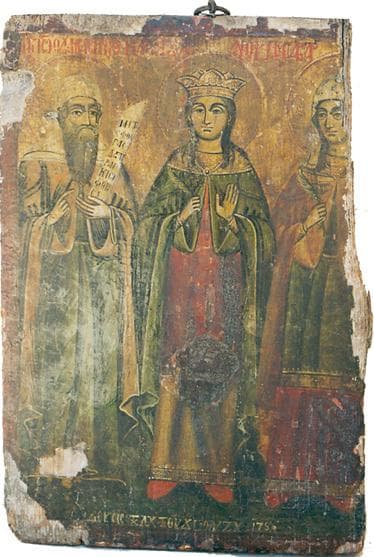
Barbara the Great-martyr — Public domain. Via Wikimedia Commons.
Life
Barbara was born around 280 in Heliopolis in Phoenicia (Lebanon), the only daughter of a wealthy and ferocious pagan named Dioscorus. Her father, possessive of her beauty and education, kept her in a tower with only a few servants, planning to choose her husband himself. From the high windows of her tower she looked out on the world and reasoned her way to a single Creator behind the visible heavens — and refused, when her father returned, to accept the betrothal he had arranged.
While Dioscorus was away on a journey she ordered the construction of a bathhouse in the courtyard of the tower. The builders had set two windows by his instruction; on her order they cut a third in honor of the Holy Trinity. She traced the sign of the Cross on the marble of the bath; the print of her finger remained in the stone. She received Christian baptism from a priest disguised as a merchant; she gave away her dowry to the poor.
When Dioscorus returned and found what she had done, he flew into a rage and denounced her himself before the Roman governor Martianus. The governor pressed her with promises, then with the rack; she did not yield. She was scourged, her flesh torn with iron combs, her sides burned with torches. A Christian woman named Juliana, watching her ordeal, cried out from the crowd in her support and was seized to share her suffering. The two were paraded naked through the city; the saints prayed and a cloud of light shielded them.
At last the governor commanded her father to behead her himself. He took her up the hill outside the town and struck off her head with his own sword. Coming down again he was struck dead by lightning — divine retribution, the Christians of the city said, for daring to lay hands on her — and his body was burned to ashes by the heavenly fire.
She is invoked against sudden and unprovided-for death, especially in storms, lightning, mining accidents, and gunpowder; she is the patroness of artillerymen, miners, architects, firefighters, and ships at sea. Many soldiers in the Eastern Christian armies have died with her name on their lips. Her relics rest in the Vladimir cathedral at Kiev. Her feast is December 4.
Traditions
Feast day
December 4
Topics
Works in library