father
St. Basil the Great
Bishop, ascetic, and preacher whose creation homilies remain a model of theological exposition.
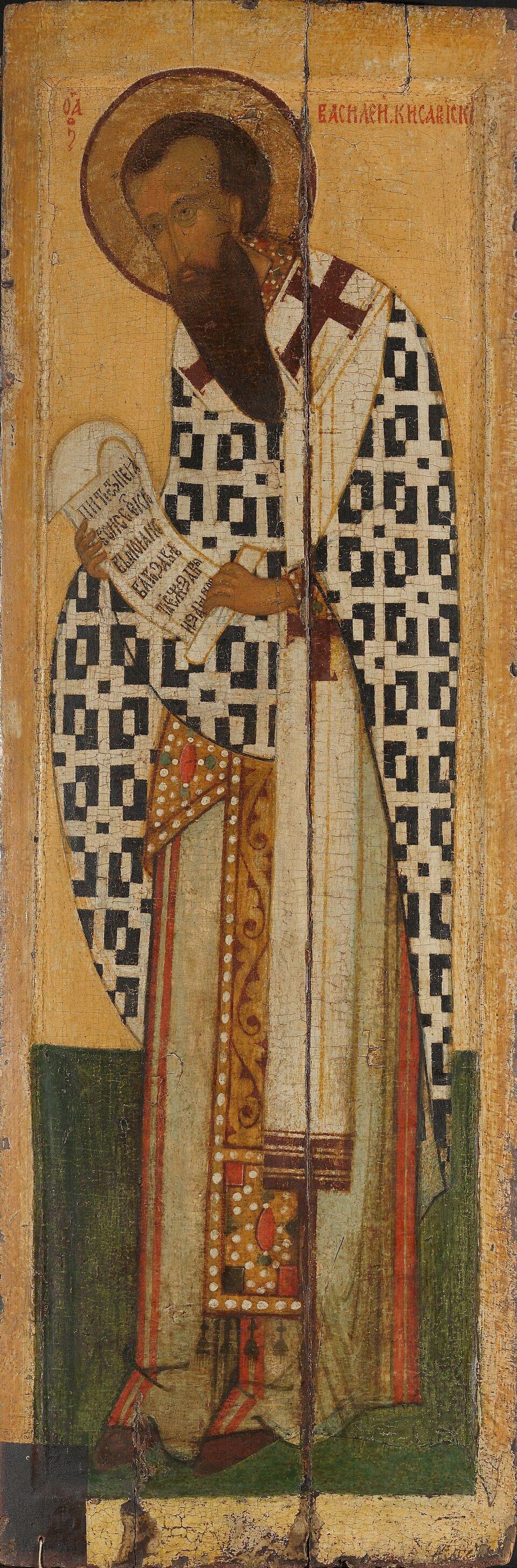
Saint Basil the Great — Public domain. Novgorod school. Via Wikimedia Commons.
Life
Basil was born around 330 in Caesarea in Cappadocia, into a family already conspicuous for its saints — his grandmother Macrina the Elder, his parents Basil and Emmelia, his brothers Gregory of Nyssa and Peter of Sebaste, his sister Macrina the Younger. From boyhood he was given the best Greek education the empire offered: schools at Caesarea, Constantinople, and finally Athens, where he and his friend Gregory of Nazianzus (later "the Theologian") devoted themselves so single-mindedly to study that they knew only two roads in the city — the one to the academy and the one to the church.
Returning home around 356 he received baptism — his family had wished him to receive it as an adult, the common Christian practice of that age — and went out to inspect the new monastic communities of Egypt, Syria, and Palestine. Settling at a riverside retreat at Annisi on the family estate, he and Gregory composed the Philokalia of Origen and the two Rules — the long and the short — that would shape the Eastern monastic tradition decisively.
In 364 he was ordained priest, and in 370 chosen archbishop of Caesarea. The eight years of his episcopate fell almost entirely within the reign of the Arian emperor Valens. Three times the imperial commissioners came to demand his signature on the Arian formula; three times he refused. To the prefect Modestus, who threatened him with confiscation, exile, torture, and death, he answered: "Confiscation has no terror for one who has nothing; exile cannot reach a man whose true home is heaven; torture has no power over a body whose flesh has been worn through with fasting; and as for death, it is to me a kindness — it takes me sooner to the One I love." Modestus told the emperor: "Sire, we are defeated."
He founded at Caesarea a complex of hospitals, hostels, and almonries — the Basileias — that became the model for the great Christian charity-cities of later antiquity. He wrote treatises on the Holy Spirit and against Eunomius that prepared the way for the Second Ecumenical Council; he gave the Greek Liturgy the anaphora that bears his name and is still served on the Sundays of Great Lent and on his feast.
He reposed on January 1, 379, worn out by his austerities at not yet fifty years old. The whole city — Christian, Jew, and pagan together — accompanied his body to the grave. The Church gave him his title "the Great" and joins him to his friend Gregory and to John Chrysostom in the joint feast of the Three Hierarchs on January 30.
Traditions
Feast day
January 1
Topics
Works in library
Readings and commentaries
Nine Homilies of the Hexaemeron
Nine Lenten homilies preached at Caesarea expounding Genesis 1:1–26 — the foundational patristic creation commentary, paired with his brother Gregory of Nyssa's On the Making of Man which takes up Genesis 1:26–27 where Basil's death left off.
Letters
Three hundred twenty-five letters spanning Basil's bishopric — pastoral correspondence, doctrinal arguments, and the canonical epistles to Amphilochius that became the basis of Orthodox canon law.
On the Holy Spirit (De Spiritu Sancto)
Thirty chapters addressed to Amphilochius of Iconium on the doxological honor of the Holy Spirit — the foundational Orthodox pneumatology, defending the Spirit's full divinity from the doxology and from the Trinitarian baptismal formula.