saint
Sts. Martyrs Boniface and Righteous Aglaida of Rome
A pagan steward sent by his mistress Aglaida to bring back the relics of the martyrs; he turned in Tarsus to confess Christ himself, was killed, and his body returned to her. She abandoned her wealth and her old life and was buried beside him. Patrons of those who pray for the conversion of those in lustful sins.
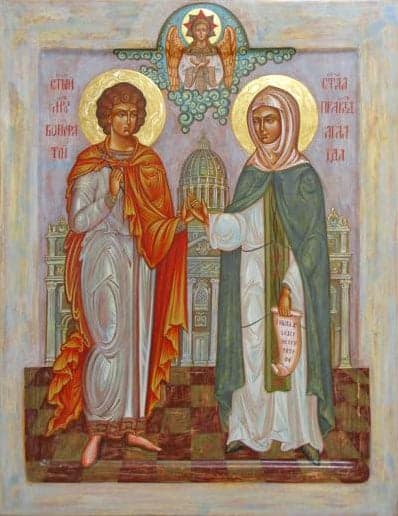
Saints Boniface and Aglaida — Hand-curated icon.
Life
Aglaida was born around 270 in Rome, into the wealthy senatorial family of the Acilii Glabriones (one of the older Roman senatorial families with substantial estates in Italy and the eastern provinces). Her father, Acilius Glabrio, was a senior member of the senate; her mother was of similar rank. Aglaida was educated at the family palace on the Aventine Hill in Rome with the standard education of a wealthy Roman daughter: Latin and Greek literature, mathematics, the basics of philosophy, the household arts. She was married young to a Roman noble whose name has not survived; the marriage was childless and ended in her husband's early death, leaving her a widow at perhaps twenty-five with substantial inherited wealth.
She lived alone after her widowhood at the family palace, supervising the family estates. Her household included substantial numbers of slaves and free retainers — perhaps four hundred souls of various ranks and conditions. Among them, by the year 290, was Boniface, a free Italian man of about thirty who had been employed as Aglaida's chief estate-steward — a position that combined the practical management of the household with personal access to the household's mistress.
The relationship between Aglaida and Boniface was, by the standards of late-third-century Roman noble households, irregular but not unusual. Boniface was Aglaida's manager and her lover; the two were not married (Roman senatorial families did not permit marriage with persons below their rank), but they lived together as if married. Boniface had a reputation in the household for excessive drinking and other personal habits common to his class and station; Aglaida's wealth and beauty had been celebrated in the literary circles of senatorial Rome.
The decisive event of their lives came around 290, in their thirties. Aglaida, increasingly troubled by the moral irregularity of her life, had come into contact with the underground Christian community of Rome. She had begun to attend Christian services secretly at the houses of friends; she had been catechized; she was about to be baptized. The catechist who instructed her — a senior priest of the Roman community whose name has not survived — recommended that she take some concrete public action of penitence before her baptism, to make the conversion visible and irreversible.
She decided on a particular act of devotion: the acquisition of the relics of one of the martyrs of the eastern persecutions that were then raging under the Emperors Diocletian and Maximian. The bringing of the relics back to Rome would be both a public Christian declaration and a substantial financial commitment. She sent Boniface, with his household-steward authority and her ample funds, to the eastern provinces — specifically to the major persecution centers of Cappadocia and Cilicia — to find and recover relics suitable for translation to Rome.
Boniface accepted the commission. He set out with a small expedition (a half-dozen servants, considerable gold) eastward from Rome around 290. He traveled through the standard route — Brindisi, Athens, Smyrna — and arrived at Tarsus in Cilicia, where the local persecution was particularly intense. At Tarsus he found himself, on the morning after his arrival, witnessing a public examination of Christians at the city's forum. The forum's crowd was thick; the standard tortures were being applied; the Christians being examined were enduring with the standard Christian steadiness.
Boniface — by all the surviving accounts, against his own intention — was so moved by the spectacle that he stepped forward into the crowd, identified himself as a Christian, and confessed Christ before the governor. The confession was unplanned; he had not intended any public act; the conversion happened (the sources say) in a single moment of recognition. He was arrested on the spot.
He was given the standard escalating tortures over the course of the next day. He was flogged; his sides were combed with iron hooks; molten lead was poured into his throat. He continued to confess. He was beheaded on the morning of his second day in Tarsus, around the year 290 or 291.
His head was severed; his body fell in the forum where he had confessed Christ. His attendant servants — who had been waiting at the gate of the forum, watching the execution from a distance — recovered the body and the severed head. They had no idea how they were to explain the situation to Aglaida back in Rome. They embalmed the body with the spices Aglaida had given them for the planned translation of foreign relics, packed it in a sealed casket, and brought it back to Rome with them.
They arrived at Rome perhaps eight months later. Aglaida — who had been waiting at her palace for the planned relics-shipment — was deeply affected at the news. The casket was opened in her presence; she recognized her steward immediately. She received the Christian last rites that night; she was baptized within a few weeks. She spent the rest of her life as a Christian widow at a small estate outside Rome, distributing her remaining wealth among the poor and the imprisoned Christians of the city.
She reposed about fifteen years later (around 305 or 306) and was buried at the small chapel she had built at her country estate, beside the relics of Boniface that she had been venerating there. The two graves remained continuously venerated through the next several centuries.
The principal church of their cult is the church of Saint Boniface and Saint Alessio (an alternative Western form of Aglaida's name; the connection between the two saints is preserved in the church's dedication) on the Aventine Hill in Rome — built on the foundations of Aglaida's old senatorial palace. Their relics rest there. They are the joint patrons of those who pray for the conversion of partners or family members involved in lustful or addictive sins, of those addicted to alcohol (Boniface's pre-conversion habit), of unconventional conversion-stories, and of every Christian whose conversion was unforeseen and decisive. Their feast is December 19 in the East (June 5 for the Latin Boniface; July 17 for the Latin Aglaida-Alessio).
Traditions
Feast day
December 19
Topics
Works in library