saint
Sts. Holy Passion-Bearers Boris and Gleb
Sons of Great Prince Vladimir, who at his death refused to take up arms against their elder brother Sviatopolk for fear of shedding kindred blood. Both were murdered by Sviatopolk's men. The first canonized saints of the Russian Church and the icon of non-resistance to evil.
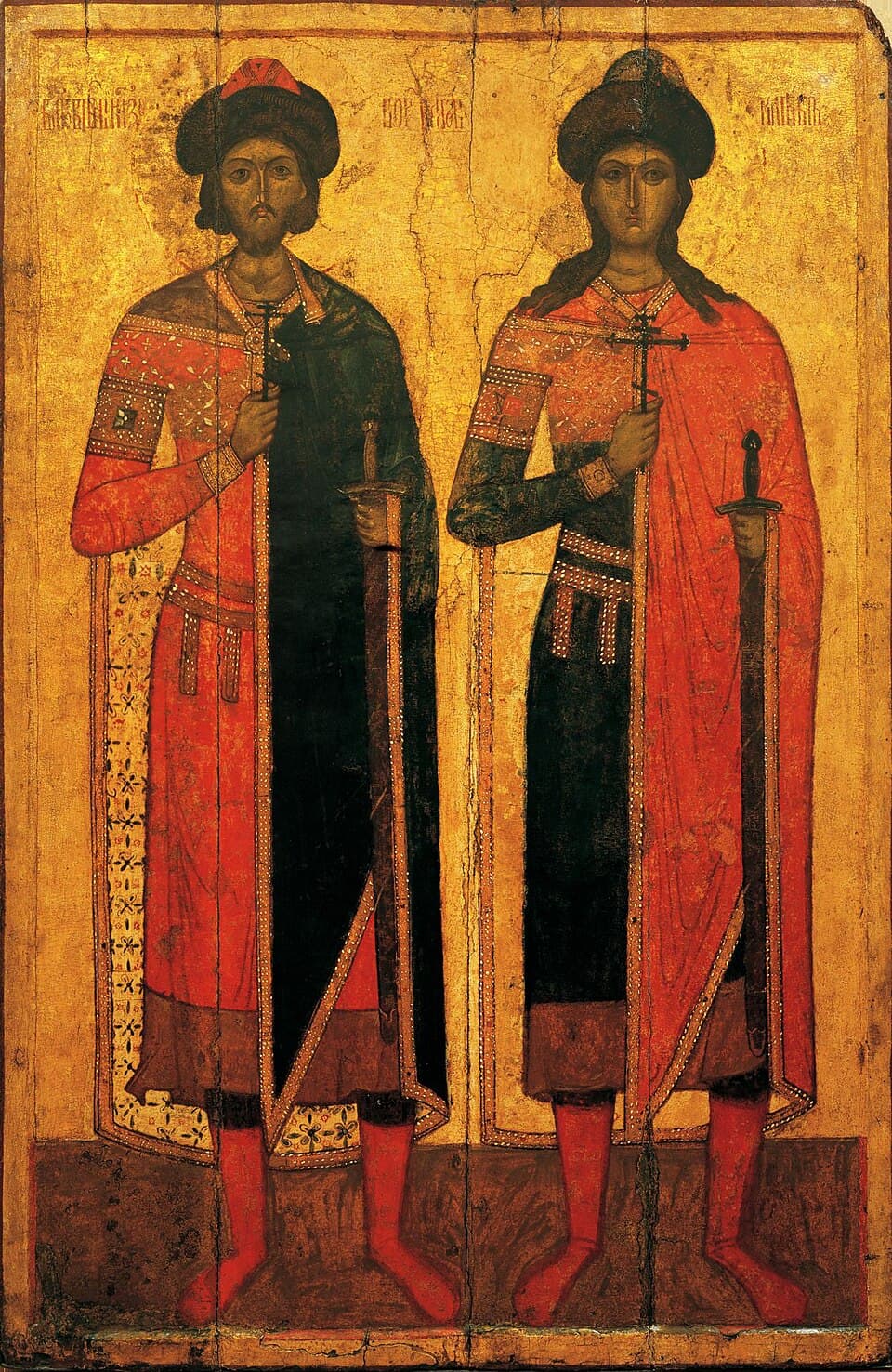
Passion-Bearers Boris and Gleb — Public domain. anonimus. Via Wikimedia Commons.
Life
Boris and Gleb were the youngest sons of the holy Great Prince Vladimir of Kiev by his Christian wife Anna of Constantinople. Brought up in the new faith of their father, they were given as patrimony the cities of Rostov (Boris) and Murom (Gleb). They were still young men when Vladimir died in July 1015.
The succession passed by murder. The eldest surviving son, Sviatopolk — already known to the people as "the Accursed" — was at Kiev at the time of his father's death and seized the throne. Knowing that Boris was returning from a campaign against the Pechenegs with a loyal army that could easily have set him aside, Sviatopolk sent assassins to meet him on the road.
Boris's commanders urged him to march on Kiev and take the throne by force; he refused. To raise the sword against an elder brother, he said, would be to repeat the crime of Cain — and he would not begin the Christian rule of Russia with kindred blood. He dismissed his army, kept a vigil through the night reading the Psalter and the Gospel, and waited. The assassins fell upon him at dawn on the banks of the Alta and ran him through with their spears; a faithful servant who threw himself over Boris's body was killed with him.
Gleb, summoned from Murom on a false report that his father lay sick at Kiev, set out by river. Word of his brother's murder reached him on the way, but he kept on. On the Dnieper near Smolensk his boat was overtaken by Sviatopolk's hired men. As they boarded, his own cook — bribed against him — drew a knife and slew him with it. He died as Boris had: praying for his murderers, refusing to defend himself.
The crime did Sviatopolk no good. Within a year another brother, Yaroslav the Wise, defeated him and drove him into exile. The bodies of Boris and Gleb were brought to the church of St. Basil at Vyshhorod above Kiev, where miracles began at their tomb. Yaroslav had a wooden church built over their relics in 1021; a stone church succeeded it; and on July 24, 1072, with the metropolitan and the abbots of the Kiev Caves present, their bodies were translated with great solemnity into the new building. That day became their feast.
They are the first canonized saints of the Russian Church and the icon of a uniquely Russian kind of holiness — the Passion-Bearer, one who suffers innocent and voluntary death not for confession of the faith in court (the older martyrdom of the Mediterranean) but for refusal to defend himself against a kindred sword. Their pattern is repeated through Russian history in figures from Mikhail of Chernigov to the Royal Martyrs of 1918.
Traditions
Feast day
July 24 and May 2
Topics
Works in library