saint
St. Catherine the Great-martyr
A noble maiden of Alexandria, peerless in learning, who at eighteen confounded fifty pagan philosophers gathered by Emperor Maximin to dispute with her — they were all baptized and burned. Beheaded after the wheel of her torture was shattered by angels. Patron of philosophers, students, and unmarried women.
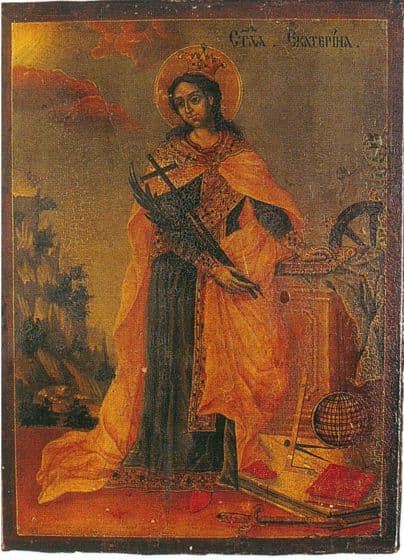
Saint Catherine of Alexandria — Public domain. Toma Vishanov. Via Wikimedia Commons.
Life
Catherine was born around 287 in Alexandria, the only daughter of a noble pagan family of the imperial city. She was educated, by all accounts, with extraordinary thoroughness for a woman of her time — rhetoric, philosophy, mathematics, and the Hebrew Scriptures with the Greek translation. By her late teens she was known across Alexandria for her learning, her wealth, and her beauty.
A Christian elder she met by some accident — versions of the story name him as a hermit on the outskirts of the city — gave her an icon of the Theotokos with the Child and explained to her that this was the only Bridegroom her gifts could not measure. She was baptized soon afterward, around the year 305.
In 305 or 306 the Emperor Maximin (Maximinus Daia) was in Alexandria and ordered a great public sacrifice in his honor. Catherine, eighteen years old, went to him at the temple and stood before the emperor at the height of the ceremony to denounce the sacrifices and proclaim the gospel. Maximin, struck by her rank and her beauty, treated her at first with respect: he summoned the fifty best pagan philosophers of the city to debate her in his presence and bring her back.
In the debate she demolished them, one after another, on their own ground — the eternity of the Logos against Plato's myth of creation, the freedom of God against the necessity of Stoic fate, the resurrection of the body against the gnostic contempt for matter. Most of the fifty were converted by her arguments and confessed Christ on the spot. The emperor had all fifty burned alive.
Catherine he kept in prison, hoping to break her by hunger and the secret visits of the empress Augusta and the captain of his guard, Porphyrion — both of whom were instead converted by the saint and joined her in the prison. The empress and Porphyrion were beheaded.
The emperor at last sentenced Catherine to the breaking wheel — a torture machine of four spiked wheels rotating in opposite directions. At the moment she was placed on it, the wheel shattered: an angel of the Lord broke it apart and the flying spikes killed many of the watching soldiers. She was then beheaded.
A second tradition, current in the Sinai monastery from the eighth century, says that her body was carried by angels to the summit of Mount Sinai, where in the time of Justinian it was found by the monks of the great monastery at the foot of the mountain — the monastery that has borne her name from then to now. Her relics, in part, remain there.
She is the patroness of philosophers, of scholars, of unmarried young women, of teachers, of nurses, and of any soul that finds itself overmatched and must speak from grace alone. Her wheel, broken, is her iconographic mark. The Church keeps her feast on November 24.
Traditions
Feast day
November 24
Topics
Works in library