saint
St. Charalampias the Wonderworker
A hundred-and-thirteen-year-old bishop of Magnesia in Thessaly under Septimius Severus, who under torture with iron combs converted his executioners and the emperor's own daughter before being beheaded. Patron against plague and contagion.
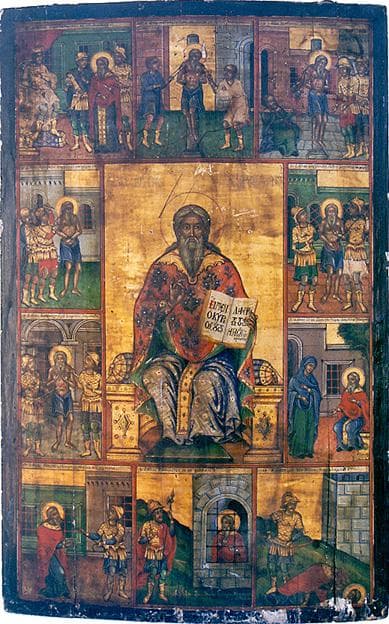
Saint Charalampias — Public domain. Stavrakis Margaritis. Via Wikimedia Commons.
Life
Charalampias was born around 89 in the Roman province of Thessaly (in central Greece), in the small city of Magnesia. His parents — both deeply pious Christians of the second-generation Greek Christian community of Thessaly — gave him an unusually careful catechesis from his childhood. He was educated locally; he was ordained to the diaconate at twenty in 109, the priesthood at twenty-five, and was consecrated bishop of Magnesia in 118 at the age of twenty-nine. He served as bishop of his small city for the next eighty-five years — a length of episcopal service unprecedented in the Christian record of the period.
The eight decades of his episcopate spanned the reigns of seven Roman emperors: Trajan, Hadrian, Antoninus Pius, Marcus Aurelius, Commodus, Pertinax, Septimius Severus. He saw the Christian Church grow from a small minority of perhaps a few hundred families in Thessaly to a recognized community of perhaps fifty thousand members in his province alone. He produced a number of pastoral works (mostly lost; we know of them only through citations in Eusebius and later authors), but his principal work was the patient pastoral care of his diocese through the long succession of imperial policies that ranged from indifference to persecution.
The decisive event of his life came at the very end of his episcopate. The Emperor Septimius Severus (193-211) had begun a major persecution of Christians in 202, ordering provincial governors to enforce the existing anti-Christian laws with new vigor. The Roman governor of Thessaly, Lucian, summoned the senior Christian clergy of the province to Magnesia in October 202 to require their public sacrifice to the imperial gods. Charalampias — by then a hundred and thirteen years old, unable to walk except with the support of two deacons — was brought before Lucian at the city's praetorium.
Lucian had not expected the principal Christian bishop of his province to be in such extreme old age. He was momentarily inclined to dismiss the case on the grounds of incompetence. Charalampias, however, addressed the governor at length in a vigorous defense of the Christian faith (the sources preserve a substantial portion of the speech) and made it clear that despite his physical infirmity he remained the senior Christian leader of his province. Lucian, recognizing that political dismissal would be misread by the watching Christian community as weakness, ordered the standard tortures applied.
Charalampias was hung up on a rack and beaten with rods. His sides were combed with iron hooks — a particularly cruel torture that stripped away the flesh in long strips, intended to produce a death that would not be immediate. The torture was applied to him for several hours. The sources note that the executioners — astonished by the old man's endurance — were the first to be converted; two of them fell at Charalampias's feet at the end of the day and proclaimed themselves Christians. They were beheaded on the spot.
Lucian, increasingly desperate to break Charalampias, escalated the tortures. The bishop was burned with torches; his joints were dislocated; he was thrown into the prison overnight with his wounds untreated. The next morning, when he was brought back for further examination, his body was visibly healed — the wounds of the previous day had closed.
The miracle was witnessed by Lucian's own daughter Galene, who had come down to see the spectacle, and she was converted on the spot. The conversion of the governor's daughter was a political problem for Lucian; he wrote to the Emperor Septimius Severus directly to ask for guidance. Severus, who was at Antioch at the time, came to Magnesia in person to handle the case.
The interview between the Emperor and the hundred-thirteen-year-old bishop is recorded at length in the surviving Acts. Severus tried persuasion, then offers of imperial favor, then progressive coercion. Charalampias remained calm and continued to confess Christ. Severus, finally, ordered him beheaded.
The execution was scheduled for the next morning. Charalampias, who had been allowed an interval of prayer in the prison, gave up his soul in the night — going to the Lord ahead of the executioner's sword. He was a hundred and thirteen years old. His body was recovered by Galene and the local Christian community; she gave it the most expensive Roman burial-rites she could arrange.
His relics rest at the Holy Monastery of Saint Stephen at Meteora in central Greece (where they were translated in the medieval period and have been continuously venerated). Substantial portions are at the cathedral of Magnesia (modern Manisa in Turkey), at the Cathedral of Charalampias in Athens, and at the church of San Carlo al Corso in Rome. He is the patron of those facing plague (a particular Greek tradition that arose because of his episcopate's having spanned several major plague years), of the very elderly, of bishops who serve unusually long terms in difficult circumstances, and of every Christian whose witness is the patience of many decades. His feast is February 10.
Traditions
Feast day
February 10
Topics
Works in library