saint
St. Martyr Christopher
An enormous Canaanite of fearsome aspect, converted and baptized Christopher — Christ-bearer — who according to tradition carried the Christ Child across a river on his shoulders. Beheaded for his witness in the persecution of Decius. Patron of travelers.
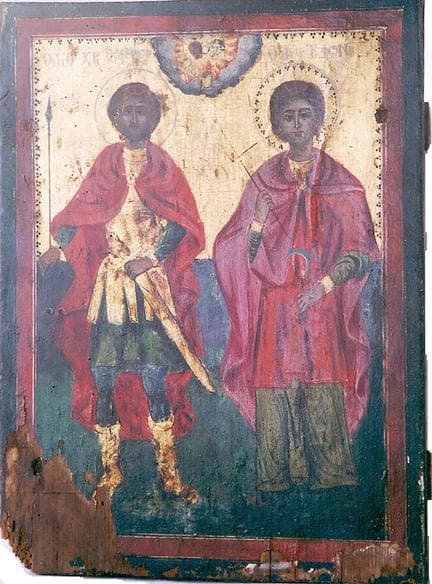
Christopher — Public domain. Via Wikimedia Commons.
Life
Christopher — Reprobus before his baptism, "the Reprobate" — was born around 220 in one of the wilder regions of the Roman Empire, traditionally identified as Marmaritania (the Maremma country of north-central Africa, in modern Libya), to a people the late Roman sources call the "Marmaritae" or "Cynocephali" — a small Berber tribal grouping. He was a giant of a man, more than seven feet tall, of formidable strength and (the legend would have it) a coarse, animal-like appearance — the dog-headed Christopher of the more extravagant icons of the East. He was a pagan and, until his conversion, lived by serving as a mercenary soldier in the army of whichever Roman magnate would pay him.
Like the parable of the merchant who goes seeking the great pearl, the young Reprobus had a single ambition: to serve the greatest king on earth. He served first the kings of his own people, but they were small chieftains; he served then the local Roman magnates, but they bowed in turn to Rome itself. He went to Rome and offered himself to the Emperor — Decius (249-251) — who readily accepted such a man into the imperial bodyguard. Reprobus served at the imperial palace through Decius's reign and into the reigns of his successors.
He observed in time that even the Emperor, when he saw a cross drawn on the ground, made the sign of warding off evil and stepped over it. He asked the Emperor why. The Emperor explained that there was a man, hung on such a cross some two centuries before, of whom the priests of the Christians said wonderful things and whose followers refused to fear the Emperor. Reprobus concluded that the man on the cross must be the greater king. He left the palace and went looking for Christ.
He came at length to a hermitage in the Roman province of Lycia in southern Asia Minor, where an elderly Christian priest received him. The priest tried to give him the standard catechumenical discipline — long prayer, long fasting — but Reprobus, being a man of action, was not built for it. The priest, considering his frame and his energy, suggested an alternative: there was a swift river crossing the road south from the hermitage, dangerous for travelers in flood; he should go there and serve the poor by carrying them across the river on his shoulders.
This Reprobus did. He built himself a small hut on the bank, cut a palm tree to use as a walking-staff against the current, and for some years carried travelers across the river — refusing payment, asking only what they could spare for the bread he would buy in the local village. He grew in the discipline of bearing burdens for others.
One night a small child came to the hut and asked to be carried across. Reprobus took the child on his shoulder, took up his staff, and walked into the river. Halfway across the water rose unaccountably and the child became unbearably heavy — heavier with each step. Reprobus, gasping for breath, demanded of the child who he was. The child answered: "I am Christ thy King, whom thou hast sought; and on my shoulders thou carriest the weight of the whole world that I myself bear up." When they reached the other bank the child was gone, and Reprobus's palm staff, planted in the ground at the place, sprouted leaves and fruit overnight. He had received his name in the moment of the crossing: Christopher, "Christ-bearer."
He was baptized at the hermitage on the next day and went back to his ministry at the river, now openly a Christian. He served there for some time more, then took up an itinerant ministry in Lycia, preaching the gospel in the rough Greek and Berber dialects he knew. He was eventually arrested under the Emperor Decius (or Decius's successor; the dating in the Acts is unclear) and brought before the local governor at Lycia.
The governor, an attractive and politically ambitious man named Bagor, attempted to win him over by sending two prostitutes to his cell — two named Niceta and Aquilina. The two were converted on the spot by Christopher's preaching and became martyrs themselves. The governor then ordered Christopher to be hung up on a heated iron grate, the flesh stripped from his sides with hooks, his head crowned with a red-hot iron helmet, and finally arrows shot into him. The arrows would not strike him. One of the arrows, deflected by the air around him, struck the governor in the eye. Christopher told the governor that if he believed and was baptized he would be healed; the governor (with great reluctance) believed, was baptized, was healed, and ordered Christopher beheaded as the final means of execution. Christopher gave thanks for the favor.
He reposed around 250. His relics were brought eventually to Constantinople and from there to many places in the Christian world. He is the patron of travelers (every Orthodox driver still carries a small medallion of him in the car), of those who carry heavy burdens for others, and of all converts who come to the Lord from outside the cradle Christian tradition. The Eastern Church remembers him on May 9; the Latin West on July 25.
Traditions
Feast day
May 9
Topics
Works in library