father
St. Clement of Rome
Third bishop of Rome and Apostolic Father whose letter to the Corinthians, written around AD 96, is the earliest extant Christian document outside the New Testament and a witness to collegial authority in the primitive Church.
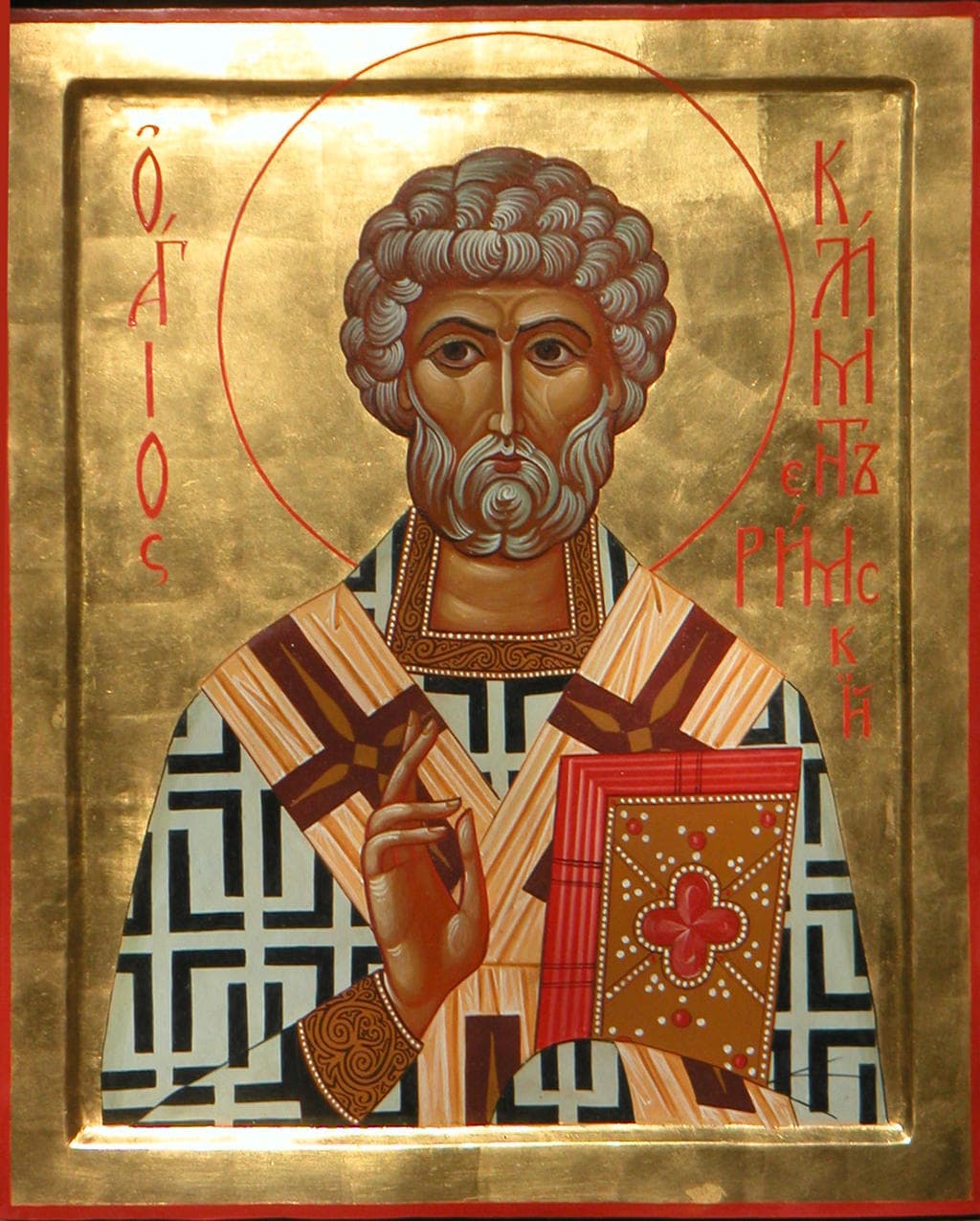
Saint Clement of Rome — Hand-curated icon.
Life
Clement, the third bishop of Rome after the apostles, stood at the boundary between the apostolic age and the age that followed. Origen and others among the Fathers identify him with the Clement whose name appears in Paul's letter to the Philippians as a fellow-worker "whose name is in the book of life." The tradition of the Church is unanimous in placing him among those who had received the faith from the apostles themselves.
His one surviving genuine letter — known as First Clement or the Epistle to the Corinthians — was written from the church of Rome to the church of Corinth around the year 96, when a faction within the Corinthian church had expelled its own presbyters. Clement writes with gentle but unmistakable authority: urging the Corinthians to restore the ejected officers, drawing on a rich treasury of Old Testament examples of obedience and humility, and articulating for what may be the first time in Christian literature the principle that the valid ordination of church offices traces its authority back through a continuous chain of appointment to the apostles and through them to God. It is the most important extra-canonical early Christian letter we possess, and it was read aloud in some churches alongside the Scriptures for several centuries.
A body of later writings circulated under his name — two Epistles to Virgins (certainly not his), and the elaborate Pseudo-Clementine Recognitions and Homilies, which are third-century theological novels in which Clement follows the apostle Peter and records his discourses. None of these is his work. Clement is venerated as a martyr; tradition places his death around the year 99. His feast falls on November 25 in the Orthodox Church.
Traditions
Feast day
November 25
Topics
Works in library
Readings and commentaries
Clementine Homilies
Pseudonymous. The parallel Greek recension of the Pseudo-Clementine literature — 20 homilies cast as Peter's sermons, plus introductory epistles. Like the Recognitions, a 4th-century Jewish-Christian novel preserving distinctive theological traditions.
First Epistle to the Corinthians
Clement's authentic letter to the Corinthian church, written from Rome around 96 AD to address a factional schism that had deposed the legitimate presbyters. The earliest extant non-canonical Christian writing — read publicly in some early churches and (per Bishop Dionysius of Corinth, c. 170) still being read at Corinth in the late 2nd century.
Two Epistles Concerning Virginity (Spurious)
Pseudonymous. A pair of letters on the discipline of celibacy preserved under Clement's name but generally considered a 3rd-century Syrian composition.
Recognitions
Pseudonymous. A 4th-century Jewish-Christian novel cast as Clement's autobiography — his philosophical seeking, his discipleship under Peter, and his eventual reunion ("recognition") with his lost family. A major textual artifact of late-antique Christian fiction, transmitting traditions otherwise lost about Peter's preaching and disputes with Simon Magus.
Second Epistle to the Corinthians (Spurious)
Pseudonymous. Not by Clement of Rome — modern scholarship identifies this as an anonymous mid-2nd-century homily, the oldest surviving Christian sermon outside the New Testament. Included in the Clementine corpus by tradition.