saint
St. Constantine the Great, Equal-to-the-Apostles
The emperor who saw the sign of the Cross of light in the sky before the Milvian Bridge and conquered under that sign in 312, granted peace to the Church by the Edict of Milan, summoned the First Ecumenical Council at Nicaea in 325, and founded the new Rome on the Bosphorus. Commemorated together with his mother Helena.
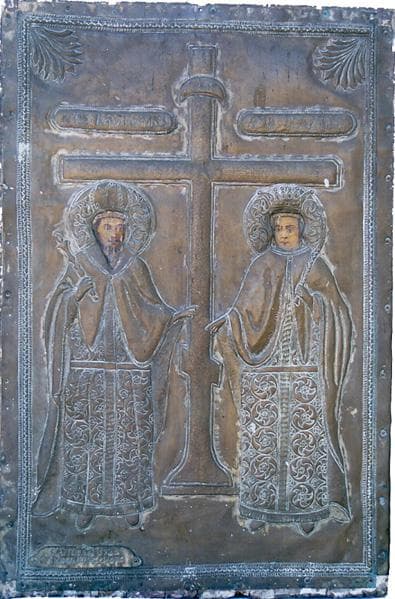
Saints Constantine and Helen — Public domain. Via Wikimedia Commons.
Life
Constantine was born around 272 in Naissus in Roman Moesia (today Niš in Serbia), the son of the Roman officer Constantius Chlorus and his concubine Helena. His father rose to be Caesar of the West in 293 and Augustus in 305; Constantine spent his teens at the imperial court of Diocletian at Nicomedia, as effectively a hostage to ensure his father's loyalty. There he witnessed the launch of the Great Persecution against the Christians in 303.
He escaped from the court in 306 — riding hard west across Europe, killing his post horses behind him so he could not be pursued — and reached his father in Britain just in time for the campaign. When Constantius died at York that summer, the British legions acclaimed Constantine emperor on the spot. The Roman tetrarchic system, with its four co-rulers, splintered. Over the next eighteen years Constantine fought his way to sole rule of the whole empire.
The decisive moment came in October 312, on his march into Italy against his rival Maxentius. The night before the battle of the Milvian Bridge over the Tiber outside Rome, he saw in the sky above the setting sun a great Cross of light with the words "By this, conquer" inscribed around it. That night Christ appeared to him in a dream and bid him bear the sign on the standards of his army. In the morning he had the Christogram — the Greek chi-rho — emblazoned on every shield. He won the battle and entered Rome.
In 313 he issued (with his eastern colleague Licinius) the Edict of Milan, which granted toleration to Christianity throughout the empire and restored confiscated church property. In 325 he convened the First Ecumenical Council at Nicaea — opening it in person — to settle the Arian controversy. In 330 he founded a new capital at Byzantium on the Bosphorus and named it for himself: Constantinople, the New Rome. He invited his mother Helena to undertake the great expedition to the Holy Land that recovered the True Cross and identified the holy places.
He was baptized only at the end of his life, on his deathbed at Nicomedia in May 337, by the bishop Eusebius. He had postponed baptism — as did many lay Christians of his time — partly from a belief that the sins of imperial office should not be borne by the baptized. Eastern Orthodoxy receives him as Equal-to-the-Apostles, ranking him with the very first converters of nations; the Latin Church gives him no liturgical commemoration. His feast is joint with his mother Helena on May 21.
Traditions
Feast day
May 21
Topics
Works in library