saint
Sts. Cosmas and Damian, Unmercenaries of Asia
Two brothers and physicians of Asia Minor, raised by their Christian mother Theodota, who received the gift of healing and freely gave to all who came. They reposed in peace at Pheremma after long labors. With the unmercenaries Cyrus and John, the principal saints of unrewarded medical care.
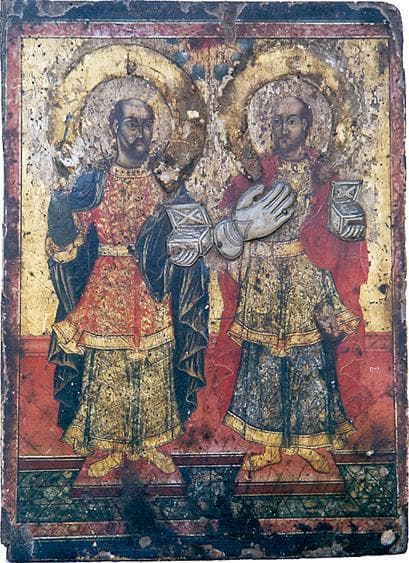
Saints Cosmas and Damian — Public domain. Via Wikimedia Commons.
Life
Cosmas and Damian were twin brothers born around 270 in the Roman province of Asia (western Asia Minor, near the modern Turkish city of Konya), to wealthy parents whose father — a pagan — died young and whose mother, Theodota, raised the boys herself in deep Christian piety. The Eastern Church distinguishes three pairs of unmercenary physicians named Cosmas and Damian; these two — sometimes called "the Asians" — are the eldest and the principal pair, the brothers who set the form of the unmercenary calling.
The brothers were educated together at one of the medical schools of Asia Minor (probably the school at Pergamon, which had inherited the tradition of Galen and remained one of the leading medical centers of the Greek East). They practiced together in their home province from their early twenties — moving on a regular circuit between the towns of Aegae, Asia, and their home village. They never accepted payment for their services, taking literally the Gospel command "freely ye have received, freely give" (Matthew 10:8). They prescribed remedies, performed surgeries, set bones, and treated mental and spiritual maladies — and in many cases, when natural remedies were unavailing, they worked miraculous healings by the name of Christ.
The earliest stories of their lives concern the gradual recognition of the brothers' identity by their patients. They worked anonymously where they could and were known across the region simply as "the silver-less ones" (the anargyroi — the Greek title that has stuck to them ever since). They treated cattle as well as men; they healed Saracen and Jew and pagan as well as Christian. They each had small farms of their own (which provided their living) and traveled when they were called.
The crisis of their lives came over a single coin. A woman named Palladia, whom Damian had healed of a serious illness, brought to his house three eggs as a thanksgiving offering. Damian initially refused; the woman wept and begged him to accept them in the name of the Holy Trinity, and he at last accepted. Cosmas, when he heard of it, was angry: their vow had been to take nothing whatever from those they healed. He left instructions that he was not to be buried beside his brother after their deaths. The brothers were reconciled later (the Lord appeared to Cosmas to explain that Damian had accepted in the name of God and not for himself), but the small story preserved the standard of the unmercenary calling at its strictest.
They worked their healings into their old age. Both reposed peacefully in the same year, around 303 — they had been physicians together for some forty-five years. Tradition gives the place as the village of Pheremma (also called Pheriman) in northwestern Mesopotamia, near the modern Turkish-Syrian border. They were buried beside each other (their final reconciliation having undone Cosmas's earlier wish for separation), and at the place of their burial a substantial Christian community grew up that became, in the Byzantine period, a major pilgrimage center.
Their relics, or substantial portions of them, were translated in part to Constantinople (where the church of Cosmas and Damian at the gate of Drungarios served as the principal Constantinople site through the Byzantine period), in part to Rome (where the basilica of Cosmas and Damian on the Roman Forum, built in the sixth century by Pope Felix IV out of the old library of the Temple of Peace, still stands), and in part to other major sites. The brothers became the patrons of physicians throughout the Christian world — the unmercenary calling in medicine bears their name in every Orthodox land — and the patrons especially of those who suffer in body and have no means to pay for their treatment.
The Asian Cosmas and Damian are commemorated by the Eastern Church on November 1 (the date traditionally given for their joint repose). The other two pairs of physicians named Cosmas and Damian — the Arabs (martyred at Aegae in Cilicia under Diocletian, feast October 17) and the Romans (martyred at Rome in the third century, feast July 1) — have their own feasts in the Eastern calendar; in the West only the Arab pair is commonly remembered, on September 26.
Traditions
Feast day
November 1
Topics
Works in library