father
St. Cyprian, Bishop and Martyr of Carthage
Lawyer and rhetorician of Carthage converted in middle life and made bishop within two years, who guided the African Church through the Decian persecution and the question of the lapsed. Beheaded under Valerian in 258, the first African bishop to be martyred.
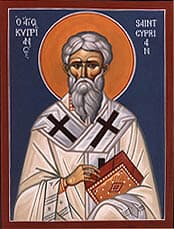
Saint Cyprian of Carthage — Public domain. Via Wikimedia Commons.
Life
Thascius Caecilius Cyprianus was born around 200 in the Roman city of Carthage (the rebuilt Punic city on the coast of modern Tunisia, by then for two centuries the principal Roman city of the African province). His parents were wealthy pagans of senatorial rank — he was raised in privilege, given the best classical education the African provinces offered, and trained as a rhetorician. By his early thirties he had become a successful public lawyer at Carthage, with a notable practice and a large estate in the country.
He was about forty-five when, around 246, he came under the spiritual direction of an elderly Carthaginian priest named Caecilius (after whom he took the new name Caecilianus on his baptism). His conversion was a serious one. He sold a substantial portion of his estate (including, by tradition, his gardens — which the early Christian community of Carthage maintained as the gardens of Saint Cyprian for many years afterward) and distributed the proceeds to the poor. He was baptized in 246 at the age of about forty-five and made a vow of perpetual continence. He was ordained presbyter within a year.
The Bishop of Carthage, Donatus, died perhaps in 248 or 249. The community, by acclamation of the lay faithful — the standard procedure of the African Church of the period — chose Cyprian as the new bishop. A small group of the older presbyters of the city opposed the choice, since Cyprian was a recent convert and they had expected the office themselves; they would form the nucleus of the schismatic party that troubled Cyprian's whole episcopate.
He was consecrated bishop in 249. Within months the Decian persecution broke over the empire — the first systematic empire-wide persecution of Christians, ordered by the Emperor Decius as part of his program for restoring the old Roman virtues. The persecution at Carthage in 250-251 was severe: many of the faithful were martyred, many more apostatized or purchased certificates of sacrifice from corrupt officials (the "libellatici," who got the document without actually performing the sacrifice). Cyprian himself withdrew to a country retreat outside the city — a decision criticized at the time, particularly by the Roman clergy who took it as a flight from danger, but defended by Cyprian himself as a measure of pastoral responsibility (he could not lead his flock effectively from prison).
The persecution ended with Decius's death in 251. The next two years were occupied by the question of how to receive back into the Church those who had lapsed — the "lapsi." Cyprian's policy was a middle one: those who had purchased certificates were to be received back after a fixed period of public penance; those who had actually offered sacrifice were to be received back only on their deathbed, unless they showed exceptional signs of repentance. The policy was contested by two groups: the rigorists, who demanded permanent exclusion (their faction at Rome was led by the antipope Novatian), and the laxists, who demanded immediate restoration on the strength of a confessor's certificate of admission. Cyprian wrote at length against both extremes in On the Unity of the Catholic Church and On the Lapsed.
The treatise On the Unity of the Catholic Church (251) is his most famous theological work and one of the foundational texts of Christian ecclesiology. He argued for the unity of the Church as a single visible body, headed by the bishops in communion with one another, with the bishop of Rome holding a particular primacy of unity (a phrase he used in two different forms — one acknowledging a Roman primacy, one specifying a primacy that did not extend to jurisdictional supremacy over other bishops, the second probably revised in light of his later dispute with the Roman bishop). The text was particularly influential in shaping medieval Western ecclesiology, though the East also received it.
The dispute with Rome over the validity of baptism by heretics broke out in 255-256. The Roman bishop Stephen I held that baptism by heretics was valid if administered with proper form; Cyprian held that there was no true baptism outside the visible Church and that heretics returning to the Church should be re-baptized. Three African councils under Cyprian's leadership endorsed his position; Stephen excommunicated Cyprian and the African Church; the dispute was unresolved at Stephen's death in 257.
A second and final persecution broke over the empire in 257 under the Emperor Valerian. Cyprian was arrested in August of that year, brought before the proconsul Aspasius Paternus, and sentenced to exile at the coastal town of Curubis. A new edict in 258 ordered the execution of bishops, presbyters, and deacons. Cyprian was brought back to Carthage and tried by the new proconsul Galerius Maximus. He was condemned to be beheaded.
He was led out to a small clearing outside the city on September 14, 258. He took off his outer mantle himself, gave it as a final gift to the attendant deacons, knelt in prayer, and was beheaded. The Christians of Carthage carried his body in a torchlight procession back to the city for burial. He was fifty-eight.
His relics rest at Carthage, with substantial portions at Lyons, Compiègne, and other French Carolingian sites. He is one of the four great Fathers of the African Church (with Tertullian, Augustine, and the much later Fulgentius). His feast in the West is September 16; the East commemorates him on August 31, the date of the Patriarchal procession of his relics. He is the patron of those who must navigate ecclesiastical disputes in faithfulness to the unity of the Church.
Traditions
Feast day
August 31
Topics
Works in library
Readings and commentaries
The Epistles of Cyprian
Cyprian's surviving correspondence — eighty-two letters covering his pastoral oversight of the Carthaginian church during the Decian persecution, the controversy over the lapsed, the rebaptism dispute with Pope Stephen, and the pastoral life of the mid-3rd-century North African Church.
The Life and Passion of Cyprian
Contemporary hagiography of Cyprian by his deacon Pontius — the earliest surviving Christian biography. Recounts Cyprian's conversion, episcopal ministry, flight during the Decian persecution, return, and martyrdom under Valerian (Sept 14, 258).
The Seventh Council of Carthage
Acts of the Seventh Council of Carthage (256), at which Cyprian and eighty-six other African bishops affirmed that baptisms performed by heretics are invalid — the position at the center of the rebaptism controversy with Pope Stephen of Rome. Each bishop's individual vote is preserved.
The Treatises of Cyprian
Cyprian's pastoral and theological treatises. Includes the foundational ecclesiological text De Unitate Ecclesiae (On the Unity of the Church), expositions On the Lord's Prayer, On the Lapsed (on the question of post-persecution reconciliation), On Mortality (composed during the plague of 252), and a series of practical-moral treatises (works and almsgiving, patience, jealousy and envy, the Lord's Prayer, the dress of virgins).