saint
St. Cyril, Equal-to-the-Apostles
The younger of two brothers from Thessalonica, called 'the Philosopher' for the love of learning he brought from the imperial schools. With his brother Methodius he was sent to the Slavs of Moravia, where together they devised the alphabet that bears his name and translated the Scriptures and the liturgy into Slavonic. He reposed at Rome at the age of forty-two.
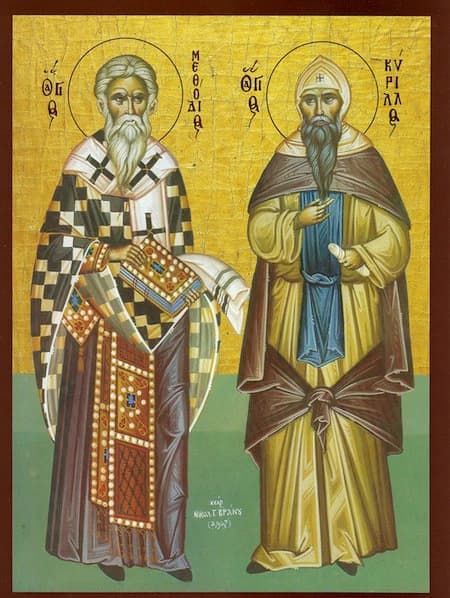
Cyril, Equal-to-the-Apostles — Hand-curated icon.
Life
Constantine — the saint's baptismal name, changed to Cyril only just before his death — was born around 826 or 827 in Thessalonica, the youngest of seven children of a high official of the Byzantine military government in that great Slavic-Greek border city. The family was Greek but the children grew up bilingual; the Slavs of the hinterland came down to the city for trade, and the boy spoke their tongue from childhood.
He was sent up to Constantinople for his education at fourteen and was placed with the imperial Caesar Bardas's school under the patronage of Patriarch Photios. He proved a prodigy in everything — philosophy, mathematics, astronomy, languages (he learned Hebrew and Syriac at the school, and later Arabic). He was given the chair of philosophy at the imperial university while still in his twenties, and earned the surname "the Philosopher" by which he was thereafter always known.
His older brother Methodius — twelve years his senior — had served as a regional governor of a Slavic district before withdrawing to a monastery on Mount Olympus in Bithynia. Around 860 the brothers were sent together as missionaries to the Khazar kaganate north of the Caucasus, where Cyril held a famous debate against a Jewish and a Muslim opponent at the khan's court.
In 862 a delegation arrived at Constantinople from Prince Rastislav of Great Moravia, asking for missionaries who could teach the people in their own Slavic tongue. The patriarch and emperor sent the brothers. Before they left, Cyril devised the Glagolitic alphabet — the first alphabet ever designed specifically for Slavic — to record the sounds of the language. He and Methodius translated the Gospels, the Psalter, and the principal liturgical services into Slavonic, and arrived in Moravia in 863.
For three years they labored among the people there, founded schools, ordained Slavic-speaking priests, and answered the bitter Latin-speaking opposition of the German bishops of the region. In 868 they came up to Rome to defend their work; Pope Adrian II approved the Slavic liturgy, ordained their disciples to the priesthood, and laid the translated books on the altar of St. Mary Major as a sign of their consecration. While they were still in Rome, Cyril fell ill. He made his monastic profession (taking the name Cyril for the first time), gave Methodius the charge of the mission, and died on February 14, 869, at the age of forty-two. He was buried in the church of San Clemente in Rome, where his relics remain.
His brother Methodius lived another sixteen years, was consecrated archbishop of Pannonia, and finished the translation of the Old Testament. The alphabet Cyril gave his people would later be supplanted by Cyrillic — named for him by his disciples after his death — which is today the alphabet of all the Eastern Slavs, of Serbs, Bulgarians, and Macedonians, and of every people they evangelized in turn.
Traditions
Feast day
February 14 and May 11
Topics
Works in library