father
St. Cyril of Alexandria
A major Christological voice whose commentary keeps the person of Christ at the center of exegesis.
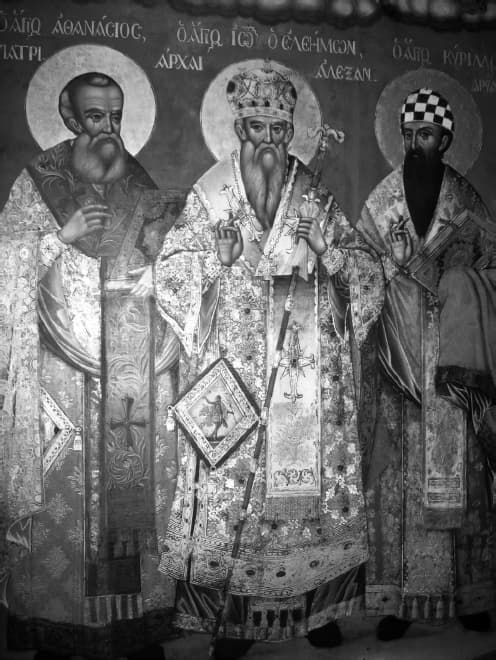
Cyril of Alexandria — Public domain. Veniamin of Galatista. Via Wikimedia Commons.
Life
Cyril was born around 378 in Alexandria in Egypt, into a family deeply embedded in the church of that great city. His uncle Theophilus, who had served as patriarch of Alexandria since 384, took charge of his education and trained him in Scripture, Greek philosophy, and the polemic skill the see of Mark would need from him. In 403 he traveled with his uncle to the Synod of the Oak that condemned John Chrysostom — an episode he would later regret, and which would mark his nephew Cyril for the controversies of his maturity.
In 412 Theophilus died and Cyril, despite some opposition, was acclaimed patriarch of Alexandria. He was about thirty-four. His first sixteen years as patriarch were occupied with the internal life of his enormous diocese — Egypt was at that time still half pagan in the countryside, and the catechetical school of Alexandria (the school of Origen and Athanasius) under his guidance produced a generation of monastic and parish clergy.
The great conflict came in 428, when Nestorius of Antioch was made patriarch of Constantinople. Nestorius — anxious to defend the Lord's true humanity — had begun teaching that the Virgin Mary should not be called Theotokos (Mother of God) but only Christotokos (Mother of Christ), since (he said) what was born of her was the man Jesus, not the divine Word. Cyril saw at once that this divided the one Christ into two persons. He wrote three increasingly forceful letters to Nestorius, then summoned a synod of his own Egyptian bishops, and in 430 sent Nestorius twelve famous anathemas — points that Nestorius must accept or be condemned.
The Emperor Theodosius II summoned an ecumenical council at Ephesus in June 431. Cyril, presiding, opened the council before the Antiochene party (who supported Nestorius) had arrived; Nestorius was condemned and deposed. The Antiochenes, arriving, held a counter-synod and condemned Cyril. Theodosius, confused, deposed everyone; cooler heads prevailed, the Antiochenes accepted the orthodox formula in a famous "Formula of Reunion" in 433, and Cyril was confirmed in office. The title Theotokos — "she who gave birth to God" — was forever established as Orthodox doctrine.
His writings shape every subsequent Christological synthesis. The Twelve Chapters, the Five Books Against Nestorius, the Commentary on John, the Festal Letters, and especially the great phrase "one nature of the divine Word incarnate" — used cautiously by Cyril, abused by later Monophysites — are the major monuments. He reposed on June 27, 444. The Eastern Church remembers him on June 9 and on January 18 (together with Athanasius), reckoning him among the four great doctors of the Eastern Church together with Athanasius, the two Gregories, Basil, and Chrysostom.
Traditions
Feast day
June 9
Topics
Works in library
Readings and commentaries
Commentary on the Gospel of John
Cyril reads John through the unity of Christ's person and the saving purpose of the Incarnation.
Commentary on the Gospel of John
St. Cyril's monumental verse-by-verse commentary on the Gospel of John in twelve books — the longest patristic commentary on John extant, and Cyril's central exegetical statement of his Christology in the years before the Nestorian controversy. The defining ancient Christian reading of John, particularly of the Prologue and the High-Priestly Prayer.
Festal Letters 1–12
The first twelve of Cyril's 29 annual Festal Letters — Paschal pastoral epistles sent by the Patriarch of Alexandria each year announcing the date of Pascha and treating one or more theological or pastoral themes for the season of the Great Fast. Written in the first decade of his episcopate (414-425), these letters reveal Cyril's exegetical method, his early Christology, and his pastoral voice before the Nestorian controversy.
On the Unity of Christ (Quod Unus Sit Christus)
St. Cyril's late mature dialogue on Christology — a vindication of the one-subject Christology of Ephesus and the Formula of Reunion against the Antiochene exegetes who continued to read the unity of Christ in two-subject terms. The dialogue form, set between Cyril and an unnamed interlocutor (often presumed to be Hermias of Edessa), allows Cyril to gather and refine his christological language in the years between Ephesus (431) and Chalcedon (451). The single most influential summary of Cyril's mature Christology, beloved of both Chalcedonian and non-Chalcedonian traditions.