father
St. Cyril of Jerusalem
The fourth-century catechist of the newly baptized whose lectures from the Anastasis preserve the rites and teaching of the Jerusalem church; exiled three times by Arian opposition, restored by the Second Ecumenical Council.
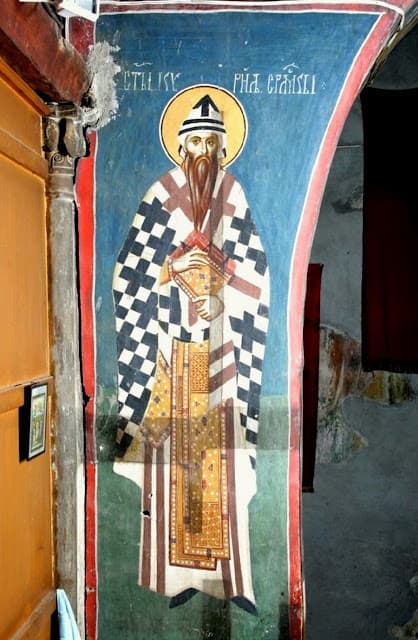
Cyril of Jerusalem — Public domain. Via Wikimedia Commons.
Life
Cyril was born around 313 — the year of Constantine's Edict of Milan that granted toleration to the Christian Church — in or near Jerusalem in the Roman province of Palestine. He grew up in the city in the years immediately after the discovery of the True Cross by the Empress Helena (around 326) and the building of the great church of the Holy Sepulchre that Constantine commissioned in commemoration of the find. The new Constantinian basilica was completed in 335; Cyril was about twenty-two and was probably a young deacon at the time.
He was ordained presbyter shortly after the dedication of the Holy Sepulchre, perhaps around 343, by Maximus, the bishop of Jerusalem. Maximus put him in charge of the catechetical instruction of the catechumens of the city — the Christians-to-be who came to Jerusalem for baptism each Pascha. The job was a significant one: the volume of catechumens at Jerusalem was unusually high (since pilgrims throughout the Roman East often came to Jerusalem to be baptized at the Holy Sepulchre itself), and the catechesis had to be theologically thorough. Cyril produced for his lectures a series of twenty-three Catechetical Discourses — eighteen preparatory ones given throughout Great Lent, and five Mystagogical Discourses given to the newly-baptized during Bright Week — which have been preserved in stenographic transcripts taken by hearers in the audience.
The Catecheses are one of the great theological monuments of the fourth century. They walk catechumens systematically through the Apostles' Creed, with extended discussions of the moral life, the canonical Scriptures, and the principal feasts. The five Mystagogical Discourses are the most detailed surviving fourth-century explanations of the rites of Christian initiation: the catechesis of the baptismal anointing, the renunciations and confessions at the font, the giving of the Spirit at chrismation, and the eucharistic prayer. They have been a foundational text for every later Christian understanding of how the early Church baptized its adult converts.
Cyril was consecrated bishop of Jerusalem in 350, on the death of Maximus. He held the see for thirty-five years (350-386), with several substantial interruptions. The Arian-Nicene struggle was at its height through these years, and Jerusalem — far from the imperial court but a city of great symbolic weight — was contested by both sides. Cyril was a moderate Nicene who preferred the formula "of like essence" (homoiousios) to the Nicene "of the same essence" (homoousios), in the hope that the formula would be more acceptable to the moderate Arians who dominated the Eastern episcopate under Constantius II. The position was theologically suspect to the stricter Nicenes and politically unhelpful with the strict Arians.
He was exiled three times for his moderation. The first exile (357-359) followed a dispute with his ecclesiastical superior Acacius of Caesarea over the limits of the patriarchal jurisdiction of Caesarea over Jerusalem (Acacius held the metropolitan see; Cyril held the more famous one). The second exile (360-361) followed his condemnation at the Council of Constantinople of 360, when the Arian party in Constantinople pushed him out for refusing the full Arian formula. The third exile (367-378) followed the policy of the Emperor Valens, a confirmed Arian, who exiled the Eastern Nicenes wherever he could.
The accession of Theodosius the Great in 379 brought him home. He attended the Second Ecumenical Council at Constantinople in 381, where his moderate Nicene position was vindicated and the Council of Constantinople adopted the Nicene-Constantinopolitan Creed (the long version of the Creed we still recite). The Council's letter to Pope Damasus explicitly defended Cyril as orthodox, against the lingering Western suspicions of his earlier Eastern moderation.
He served his last seven years quietly at Jerusalem. He reposed on March 18, 386, at about seventy-three. He was buried in the Holy Sepulchre church he had served his whole life; his relics, when the church was rebuilt by the Crusaders, were translated to a chapel within the new basilica where they remain. His Catechetical Discourses have been the principal manual of Christian initiation in both the Eastern and Western Churches for sixteen centuries. His feast is March 18.
Traditions
Feast day
March 18
Topics
Works in library
Readings and commentaries
Catechetical Lectures
The complete catechetical-liturgical cycle: a Procatechesis (pre-Lenten introduction), eighteen pre-baptismal lectures delivered to catechumens during Great Lent, and five Mystagogical Lectures preached during Bright Week to the newly-baptized, explaining the sacraments they had just received (Baptism, Chrismation, and the Eucharist). The foundational text of the Christian catechumenate.