saint
Sts. Cyrus and John, Unmercenaries of Egypt
A physician of Alexandria and a soldier of Edessa who lived as monks in the Egyptian desert, freely healing body and soul. Beheaded with the matron Athanasia and her three daughters under Diocletian. With Cosmas and Damian, the principal saints of unrewarded medical care.
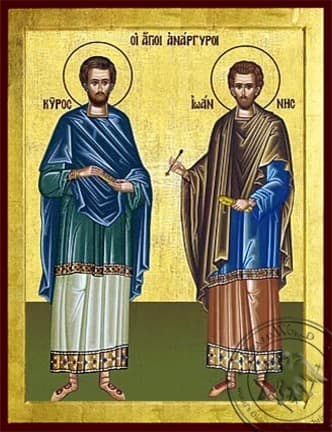
Saints Cyrus and John the Unmercenaries — Hand-curated icon.
Life
Cyrus was born around 250 at the great Egyptian city of Alexandria, into a wealthy Greek-Egyptian family of moderate civil rank. His father was a customs official of the Roman Egyptian provincial government; his mother was the daughter of a senior Alexandrian merchant. He was educated at the renowned Greek medical school of Alexandria — the principal medical school of the Roman East, with traditions going back to the Ptolemaic period — and emerged in his early twenties as a fully qualified physician of the high Galenic-Hippocratic school.
He practiced medicine at Alexandria from his early twenties (around 275) until his late thirties. His practice was, by the standards of his class, financially successful: he saw the wealthy patrons of the great Alexandrian houses, charged the standard senior physician's fees, and lived comfortably at his own house in the Greek quarter of the city. His Christianity was, at this period, a private matter — he had been baptized as a young man and continued the practice of the Liturgy at the small Christian church of his quarter, but his medical practice was conducted in the standard Roman professional terms.
The decisive event of his life came around 290. The Diocletianic persecution was beginning to reach Alexandria; the small Christian community was under intensifying pressure. Cyrus, who had been increasingly troubled by what he saw as the deep moral compromise of practicing medicine for fees in a way that excluded the Christian poor of the city, made a decision: he closed his medical practice, distributed his accumulated wealth among the poor of Alexandria, and withdrew to a small hermitage at Pelusium on the eastern edge of the Egyptian Delta — about a hundred miles east of the city.
He lived at Pelusium for several years as a private hermit, with the standard ascetic disciplines of fasting, manual labor, and the daily monastic offices. The reputation of his medical knowledge, however, followed him; people of the local Pelusian region began to come to his hermitage with their illnesses. Cyrus, who had vowed never to charge for medical care again, treated them without payment. He prescribed simple remedies from local plants; he set bones; he treated the wounds of farmers and laborers who could not afford the high fees of the city physicians.
His reputation as an "unmercenary physician" — a doctor who would not accept payment for his services — spread across the Egyptian Delta. By around 295 he had attracted the attention of John, a young Egyptian Christian soldier of Edessa (the great Syrian-Mesopotamian city on the upper Euphrates) who had heard of Cyrus's practice and traveled across the eastern empire to meet him.
John was about twenty when he arrived at Pelusium. He was, by the surviving accounts, a quiet and serious young soldier who had been struggling with the moral problems of military service during the increasing persecution of Christians. He had heard of Cyrus's practice through Christian travelers; he had come to learn from Cyrus and, if possible, to join him in the unmercenary medical work.
Cyrus accepted him. The two became close companions; John, who had no medical training, learned from Cyrus the basics of physical medicine over the next several years and added the spiritual gifts that he had developed through his military prayer-life (he had a particular gift, the sources note, for the diagnosis of demonic possession and for prayer over those troubled by mental illness). The two worked together at Pelusium for the next few years, treating the sick of the Delta entirely without payment, supporting themselves by manual labor at the local Christian community.
The persecution under Diocletian intensified through the 290s. The principal Christian leaders of the Egyptian Delta were arrested and executed in the early 300s. In 303 the Roman governor of Alexandria, Syrianus, came to Pelusium personally to suppress the Christian community there. He arrested Cyrus and John on the standard charge of refusing to sacrifice to the imperial gods.
The arrest of Cyrus and John was complicated by a second case. A noble Christian woman of Alexandria named Athanasia, with her three young daughters Theodota, Theoctista, and Eudoxia (ages fifteen, thirteen, and eleven), had been arrested at the same time on a related charge. Syrianus, knowing of the affection that Cyrus and John had for the local Christian community, brought all five prisoners to a single trial — calculating that the threat to the women would break the men's resistance.
It did not. Cyrus and John continued to confess Christ openly; they encouraged Athanasia and her daughters to do the same. The standard escalating tortures were applied to all five prisoners over the course of several weeks. The three daughters were tortured separately, in ascending order of age; the mother Athanasia was forced to watch. The two men were tortured separately. None of the five recanted. The five were eventually beheaded together on January 31, 303, at the Roman amphitheater of Alexandria.
The bodies of the five were claimed by the local Christian community of Alexandria and were buried at the Christian cemetery near the Serapeum. Their relics were translated in 412 by the Patriarch Cyril of Alexandria (no relation) to the church of Saint Mark in Alexandria. Substantial portions are now at the Coptic Cathedral of Saint Mark in Cairo (where the bulk of the relics have been since the seventh century) and at the Cathedral of Saint Mark in Alexandria.
Cyrus and John are honored together as the principal pair of Egyptian unmercenary physicians, the second pair (after Cosmas and Damian of Asia, who are slightly older). They are the patrons of physicians who do not charge their patients, of military personnel who entered medical practice, of those who treat the mentally ill, and of every Christian household that has chosen to forgo income for the sake of Christian charity. Their feast is January 31 (and June 28, the day of the translation of their relics).
Traditions
Feast day
January 31 and June 28
Topics
Works in library