father
St. Demetrius of Rostov
Metropolitan of Rostov in the time of Peter the Great, who compiled the great twelve-volume Lives of the Saints that has shaped Russian hagiographical reading ever since. A meek hierarch in a difficult age, found at his repose kneeling at his desk over an unfinished sermon.
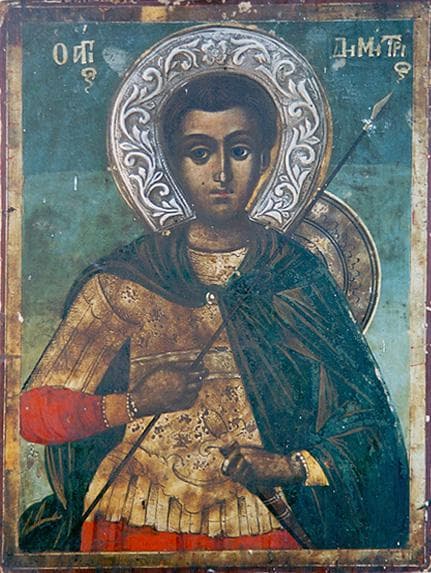
Demetrius of Rostov — Public domain. Via Wikimedia Commons.
Life
Daniel Savvich Tuptalo was born on December 11, 1651, in the small Ukrainian town of Makarov, in the Cossack hetmanate (then under Polish-Lithuanian sovereignty), into a Cossack military family. His father, Savva Tuptalo, was a senior officer of the Cossack host who would later play a role in the negotiations transferring the Kievan metropolitanate to Moscow's jurisdiction. The boy was educated at the Mogila Collegium in Kiev — the principal Orthodox theological school of the seventeenth-century Eastern Slavic world, founded by Metropolitan Peter Mogila in 1632.
He was tonsured a monk in 1668 at the Kiev Caves Lavra with the name Demetrius. The Lavra of his time was the leading center of Orthodox scholarship in the Russian-Polish lands. He was ordained hieromonk in 1675 by the Metropolitan of Kiev, Lazar Baranovich. From the late 1670s onward he held a succession of abbacies in Ukrainian monasteries: Chernigov, Maximov, the Annunciation Monastery at Nezhin, the holy hieromartyrdom of Macarius at Pereyaslav, the Cyril Monastery at Kiev.
The work that made his name was the writing of the great Lives of the Saints. The project was assigned to him by Metropolitan Lazar in 1684: to compile a complete Slavonic-Russian collection of saints' lives for every day of the calendar, drawing on the Greek, Latin, and earlier Slavonic sources. The work eventually filled four large folio volumes (Cheti-Minei — "Reading Menaia"), one for each season of the year, and ran to over four million words. He worked on it for twenty years (1684-1705), occupying every spare hour of his abbacies and the bishopric that followed.
The four volumes were published successively in Kiev (1689, 1695, 1700, 1705). They became and remained the standard Russian-Slavonic hagiographic collection for the next three centuries, replacing the older twelve-volume Velikie Chetii-Minei of Metropolitan Makarii (sixteenth century) as the principal household reading text of Russian Christian piety. Until the early twentieth century there was scarcely a Russian Christian household without a copy of "Dmitri Rostovsky."
In 1700 Tsar Peter the Great (in the midst of his westernizing reforms and reorganization of the Russian Church) summoned Demetrius to Moscow. Peter wanted him for the Siberian metropolitanate at Tobolsk — an enormous diocese covering the entire Russian territory east of the Urals, of which Peter intended to make a missionary center for the evangelization of the Siberian peoples. Demetrius accepted reluctantly and traveled toward Siberia in 1701.
He fell seriously ill on the way and could not continue. The illness was real but also providential — Peter, accepting the situation, transferred him in 1702 to the much smaller see of Rostov, far closer to Moscow. Demetrius served as Metropolitan of Rostov and Yaroslavl for the next seven years (1702-1709), continuing his Lives project in his spare time and laboring through the schism with the Old Believers and the increasing Petrine pressure on the Russian Church.
He reposed in his cell at Rostov on October 28, 1709, at fifty-seven. The story of his death has been preserved in detail. He had been working at his desk on the final volume of the Lives — the entry for some saint or other, the records do not specify whom. He felt unwell, completed the entry, set the manuscript aside, and went to his cell to pray. He died kneeling at his prie-dieu, the final sentence of his manuscript unfinished on his desk. He was found in the morning.
He was glorified by the Russian Church in 1757 — the first new Russian saint glorified in over a century, the lull having been caused by Peter's reorganization of the synod. His relics were uncovered then and found incorrupt; they rest at the Dormition Cathedral of Rostov, which he had restored. He is the patron of writers, of biographers, of those who labor at long systematic projects, and of every Russian household that has read his Lives. His feast is October 28 (repose) and September 21 (uncovering of relics).
Traditions
Feast day
September 21 (uncovering of relics) and October 28
Topics
Works in library