saint
St. Demetrius the Myrrh-streamer
A young proconsul of Thessalonica under Galerius who openly catechized the people of his city and was speared in the bathhouse where he had been imprisoned. His tomb has streamed fragrant myrrh ever since, and he is the principal patron of the great city of Thessalonica.
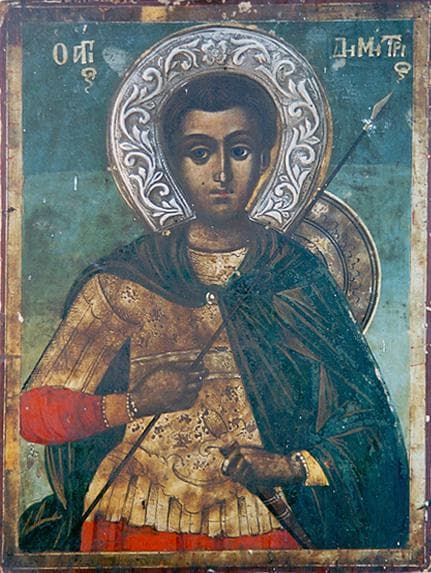
Demetrius the Myrrh-streamer — Public domain. Via Wikimedia Commons.
Life
Demetrius was born around 270 in Thessalonica in Macedonia, the son of a Roman senator-rank official of the city. The family was secretly Christian. When his father died, the Emperor Maximian (Diocletian's co-Augustus and son-in-law) appointed the young Demetrius — perhaps twenty — proconsul of Thessalonica and gave him the charge of suppressing Christianity throughout Thessaly and Achaea. He did the opposite. He taught Christ openly in the streets and at the city's fora; his governorship became famous through Greece as the place where Christians were safe.
When Maximian, on his way back from a campaign on the Danube, learned what was happening, he had Demetrius arrested and taken to a public bath next to the imperial stadium of the city, where he was held in a cell awaiting trial. The emperor that week was sponsoring gladiatorial games. A favored Vandal champion of his named Lyaeus had been defeating one Christian challenger after another from the high platform above the arena — pushing them down upon spears set point-upward at the foot of his stand.
A young man of Thessalonica named Nestor came to Demetrius in the cell and asked his blessing to fight Lyaeus. The saint gave the blessing, with the words "Defeat Lyaeus, and witness for Christ." Nestor went out, cried out at the foot of the platform "God of Demetrius, help me!", climbed up, and threw the Vandal down onto his own spears. The crowd was astonished; the emperor, beside himself with rage, sent soldiers down to the cell. They pierced Demetrius through with their spears as he stood at prayer with his arms raised in the form of a cross. He was about thirty.
His body, hidden by Christians of the city, was uncovered under Constantine, and a small chapel was built over the place where the bath had stood. In the fifth century the prefect Leontius — healed of paralysis at the tomb — raised the great basilica that still stands at Thessalonica. From the early Byzantine period myrrh issued from the tomb in such quantity that the saint earned his title: the Myrrh-streamer. The relics were eventually removed (twice in the city's various sieges) but the chapel of his cell — the place of his martyrdom — has continued, and ampules of myrrh continue to be drawn from below the iconostasis on his feast.
He is the principal patron of Thessalonica and of all the Christian East against barbarian invasion; he appeared on horseback above the walls of the city more than once in its long history to defend it. His feast is October 26.
Traditions
Feast day
October 26
Topics
Works in library