father
St. Dionysius the Areopagite
Traditionally identified with the Athenian convert of Acts 17:34 and venerated in the Orthodox calendar on October 3; modern critical scholarship dates the Corpus Dionysiacum to around the year 500 and treats the apostolic attribution as a pseudonymous literary convention. Whoever the author was, the four treatises (The Divine Names, The Mystic Theology, The Heavenly Hierarchy, The Ecclesiastical Hierarchy) and the ten Letters became the foundational text of Christian apophatic theology — the single deepest patristic influence on Maximus the Confessor, John of Damascus, Symeon the New Theologian, and Gregory Palamas, and through them on the whole hesychast and Philokalic tradition.
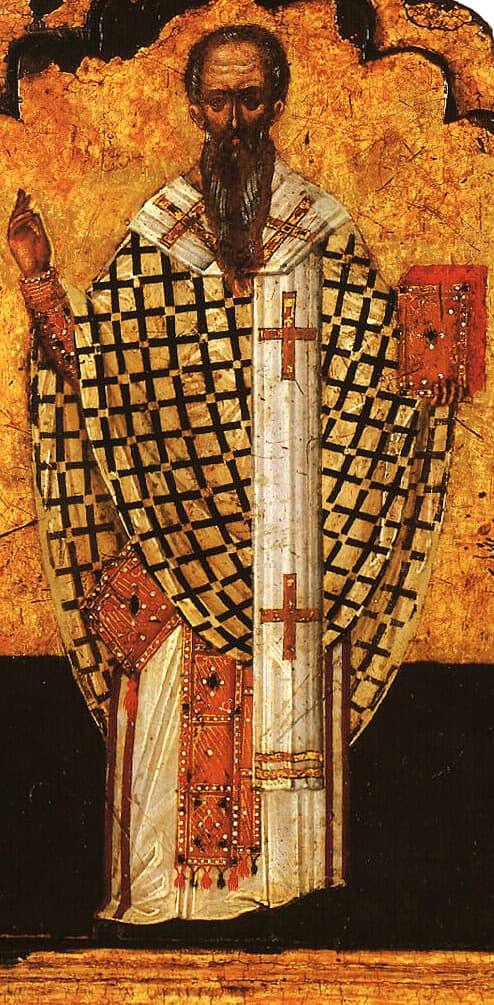
Dionysius the Areopagite — Public domain. Via Wikimedia Commons.
Life
Dionysius the Areopagite — distinct from the later Syrian monk who wrote under his name — was a member of the Areopagus, the supreme council of Athens, in the middle of the first century. He was present in the agora on the day the Apostle Paul came to Athens (Acts 17), heard Paul's sermon at the Areopagus on the unknown God, and was one of the few Athenians to receive the message — "Howbeit certain men clave unto him, and believed: among the which was Dionysius the Areopagite, and a woman named Damaris."
Paul instructed him further, baptized him, and consecrated him the first bishop of the church at Athens. With his colleague Hierotheos he served the small Athenian congregation through the years that followed. According to the tradition, both Dionysius and Hierotheos were present at the Dormition of the Theotokos, having traveled to Jerusalem with the apostles whom the Holy Spirit gathered for that mystery.
After the death of Hierotheos he continued as bishop of Athens. The later Western tradition makes him a missionary to Gaul who served as the first bishop of Paris and was beheaded under Domitian at the place that bears his name (Saint-Denis). The Eastern tradition keeps him at Athens to the end of his days, martyred under Domitian or Trajan. His feast is kept on October 3. The fifth- or sixth-century Dionysian corpus written under his name — the Divine Names, the Mystical Theology, the Celestial and Ecclesiastical Hierarchies — is honored as his legacy, though modern scholarship attributes its composition to a later writer of the Syrian church.
Traditions
Feast day
October 3
Topics
Works in library
Readings and commentaries
On the Divine Names
The longest of the four treatises — thirteen chapters on the names given to God in Scripture (Good, Being, Life, Wisdom, Power, Justice, Salvation, &c.) and what each reveals about the divine nature. The foundational text of apophatic-cataphatic theology.
On the Ecclesiastical Hierarchy
Seven chapters on the visible Church as the image of the heavenly hierarchy — baptism, the Eucharist, the chrism, the orders of clergy, the rites of monastic profession and burial. Foundational text for Eastern Orthodox sacramental and ecclesiological theology.
On the Heavenly Hierarchy
Fifteen chapters on the angelic orders — the source of the classical Christian doxological angelology in three triads (Seraphim, Cherubim, Thrones; Dominions, Virtues, Powers; Principalities, Archangels, Angels). The text that shaped both the Eastern and Western imagination of the heavenly host.
The Letters
Ten letters (with one supernumerary) — to Caius the Monk on the unknowable God, to Dorotheus the Liturgist on divine darkness, to Polycarp on the eclipse at the Crucifixion, to Demophilus on monastic order, to Titus the Hierarch on symbolic theology, and most famously to John the Theologian on Patmos — the pseudonymous frame that purports to set the corpus in the first century.
The Mystic Theology
The shortest and most influential of the treatises — five brief chapters on the apophatic ascent into the divine darkness, the "unknowing knowledge" that surpasses every name and image. The single most cited text in the Christian mystical tradition.