saint
Holy Elizabeth, Mother of the Forerunner
Daughter of Aaron, wife of the priest Zacharias, kinswoman of the Theotokos. In her old age she conceived the Forerunner of the Lord, and was the first to call the Mother of God 'blessed among women.' She fled with her infant son into the wilderness to save him from Herod's slaughter.
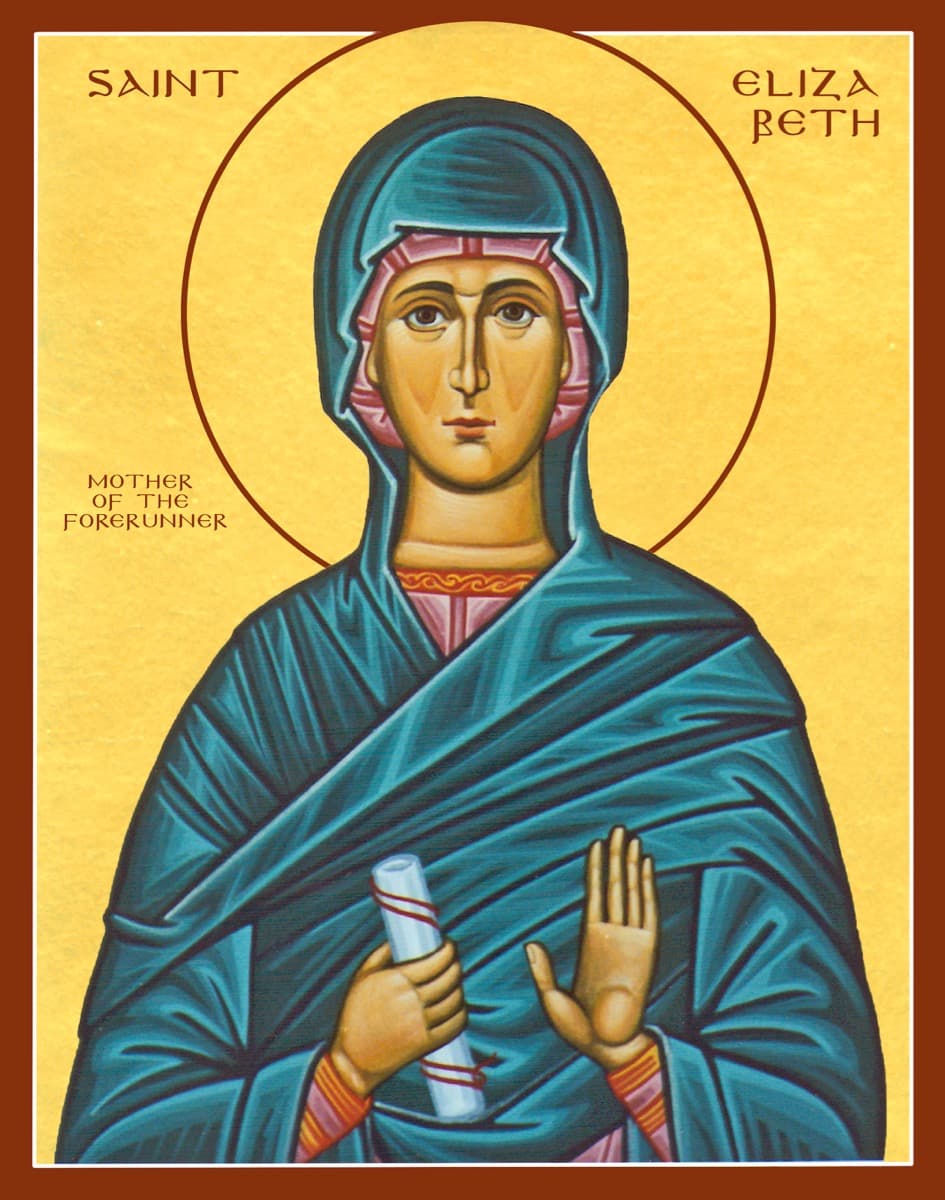
Elizabeth, Mother of the Forerunner — Hand-curated icon.
Life
Elizabeth was born around 50 BC in the hill country of Judea, in a small priestly village near Hebron called Yutta (the site is still pointed out as the place of the birth of John the Forerunner). She was a daughter of the tribe of Levi, of the priestly house of Aaron, and a kinswoman — the Gospel uses the term "cousin" loosely; the precise degree of kinship is uncertain — of the holy Theotokos, whose mother Anna was also probably of the priestly line. Elizabeth and Mary therefore belonged to the same extended family.
She married young, in her late teens, the priest Zacharias — a senior priest of the priestly course of Abijah (the eighth of the twenty-four orders of the Jerusalem Temple priesthood). The marriage was, in the Jewish reckoning of the period, well-arranged and well-suited: priest and priestess, both of long faithfulness, both of comfortable means. They settled at Yutta and waited for children. The children did not come. Elizabeth was barren — the great shame of a Jewish marriage and the symbolic figure of the long failure of Israel to bring forth her Messiah.
They lived together for some sixty years in the patient acceptance of the disappointment. Elizabeth was perhaps seventy when, in the year approximately 6 BC, her husband Zacharias drew the lot to enter the inner sanctuary of the Temple at Jerusalem to offer the incense at the daily evening sacrifice. He was in his seventieth or so year as well; the lot fell on him perhaps for the only time in his life. He went into the inner court alone, as the prescribed ritual required, while the people prayed outside.
The archangel Gabriel appeared to him at the altar of incense — standing at the right of the altar, in the place reserved for senior priests. He told Zacharias that his prayer (which had been silently uttered through six decades) was heard, that Elizabeth would conceive a son in her old age, and that the son would be the prophet of the Most High who would prepare the way of the Lord. Zacharias asked for a sign. Gabriel told him that the sign was that he would be struck dumb until the child should be born.
Zacharias came out of the sanctuary unable to speak. He gestured to the assembled congregation that he had seen a vision. He went home to Yutta in silence. Elizabeth conceived. She did not appear in public during the first six months of her pregnancy, hiding herself in the house — out of joy at the lifting of her long shame, the Gospel implies — but also out of the cautious self-keeping of an elderly pregnant woman.
In the sixth month of her pregnancy, the Virgin Mary came up from Nazareth to visit her, having herself just received from Gabriel the word of the Annunciation. The meeting at the door of Elizabeth's house — the Visitation, celebrated by the Western Church on May 31 and by the Eastern Church on March 30 — is one of the great icons of the New Testament. Elizabeth, by the Spirit, knew at once that her cousin had conceived the Lord; the unborn John leaped in her womb (the Gospel of Luke specifies). Elizabeth cried out in the words still used at every Roman rosary and every Akathist: "Blessed art thou among women, and blessed is the fruit of thy womb." Mary answered with the Magnificat.
Mary stayed with Elizabeth for three months until the birth of John. Elizabeth bore the Forerunner at perhaps her seventy-first or seventy-second year. She had been the first to recognize the Lord and the first to give the Theotokos her title of blessedness. On the eighth day at the circumcision the neighbors were ready to name the boy after his father, but Zacharias (still dumb) wrote on a tablet "His name is John" and his speech was restored. He sang the Benedictus prophecy over the infant.
Some six months later, perhaps a year after John's birth, came Herod's slaughter of the innocents at Bethlehem. The slaughter was extended (by the early Christian tradition) to the territory of the priestly families, since the prophets Zacharias and Elizabeth were known by the imperial intelligence to have a son who fit the description of the messianic infant. Herod's soldiers came to Yutta. Elizabeth, by some accounts taking warning in advance, fled with the infant John into the desert hills east of the village. She is said to have prayed at a cleft in the rocks; the rocks opened and concealed her and the child. The site is still marked by a small Christian shrine called St. John the Hidden, on the road from Hebron to Beersheba.
Tradition places Elizabeth's repose at the cave shortly afterward — perhaps two or three years later, when she was about seventy-five — leaving the small boy John to be raised by an angel in the wilderness until his coming forth from the desert at thirty. Her relics rest near the cave at the shrine of St. John the Hidden in the West Bank; smaller portions are at the Russian convent of the Visitation at Ein Kerem in Jerusalem, on the site identified by the Russian Imperial Palestinian Society in the nineteenth century as the place of the Visitation.
She is the patron of women who have despaired of childbearing, of barren wives, of late-born children, and of all who carry a quiet hope through long years of patience. Her feast is September 5.
Traditions
Feast day
September 5
Topics
Works in library