saint
St. Holy New Martyr Grand Duchess Elizabeth
Granddaughter of Queen Victoria, sister of the Tsarina Alexandra, who after her husband's assassination founded the Convent of Martha and Mary in Moscow to serve the poor. Cast alive into a mine-shaft by the Bolsheviks at Alapayevsk in July 1918, singing hymns until her death.
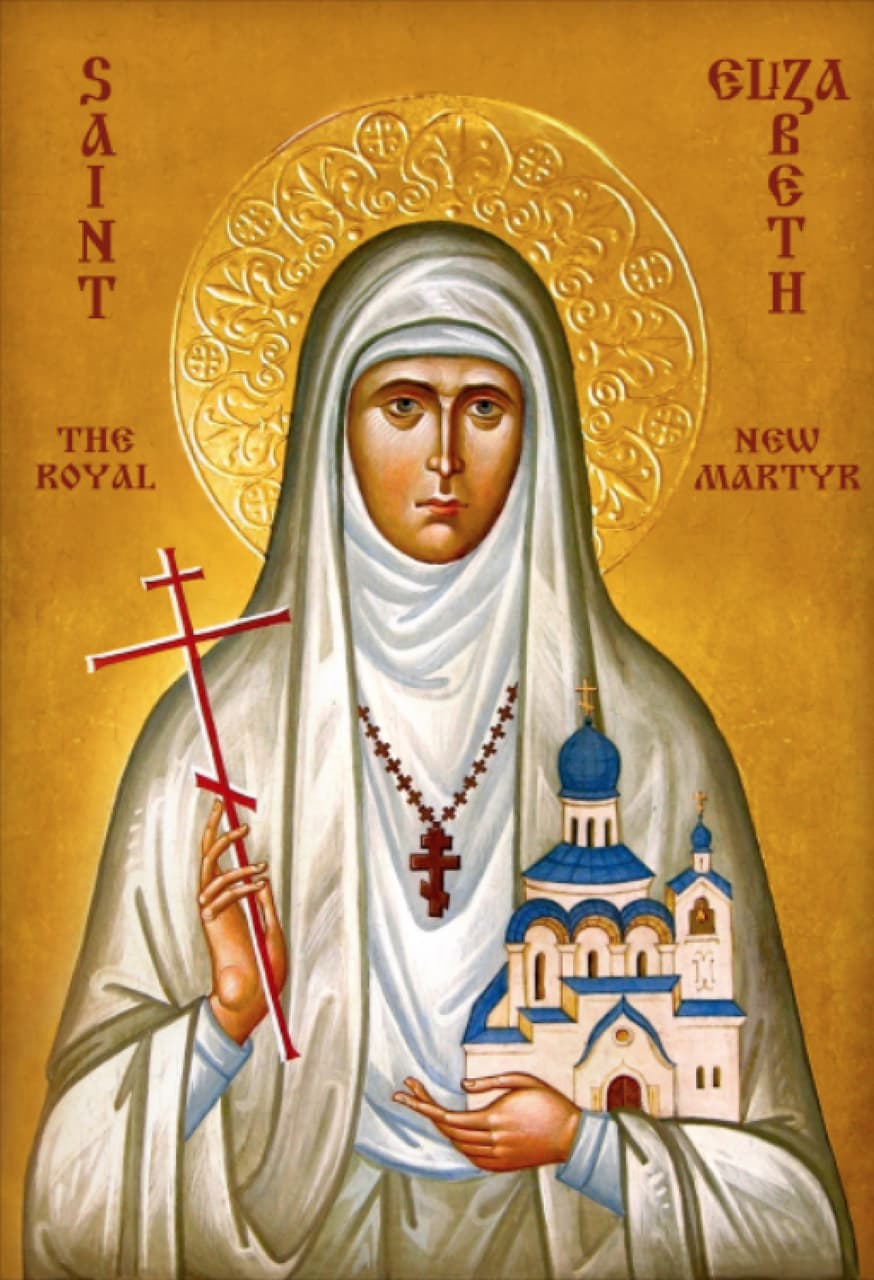
Saint Elizabeth the New-martyr — Hand-curated icon.
Life
Elizabeth Alexandra Louise Alice was born on November 1, 1864, at the New Palace at Darmstadt in the Grand Duchy of Hesse-Darmstadt (modern Germany), the second daughter of Grand Duke Ludwig IV of Hesse and Princess Alice of the United Kingdom, who was the second daughter of Queen Victoria of England. She was thus a granddaughter of Queen Victoria, and a child of one of the most pious of Victoria's children — Princess Alice was a serious Protestant Christian who raised her seven children in deep faith. Elizabeth — "Ella" in the family — was the closest of the children to her mother.
Her mother died of diphtheria in 1878 when Ella was thirteen, leaving her and her siblings essentially under Queen Victoria's distant supervision. Ella grew up at Darmstadt and at the Queen's various residences. She was tall, beautiful (one of the more striking women of her generation), and was given the careful Lutheran education her mother had begun. Her younger sister Alix — six years her junior — would become the Tsarina Alexandra Feodorovna of Russia.
In 1884, at the age of nineteen, Ella married the Grand Duke Sergei Alexandrovich of Russia — the fifth son of the Tsar Alexander II, twenty-seven at the time of the marriage, an austere, somewhat melancholic man who was deeply devoted to the Russian Orthodox faith. The marriage was childless. Ella initially remained Lutheran, but the impression of the Orthodox faith on her — through Sergei's prayer life, through the public devotion of the Russian people at the great feasts, and through her own quiet observation — was decisive. In 1891 she converted to Orthodoxy of her own choice (her father, the Grand Duke of Hesse, was sharply opposed to it, but Queen Victoria gave her blessing). She took no new name — she was already named for the saint who had been the mother of John the Forerunner.
Sergei was appointed Governor-General of Moscow in 1891, and the couple moved to the old capital. Ella served at his side for the next fourteen years, with the unobtrusive seriousness that had marked her life: she founded charitable societies for the poor of Moscow, served as the patron of orphanages and schools, visited prisons, and worked through the long Russian Christmas season distributing baskets of food and clothing to the poor of the city. She was particularly devoted to the unmarried mothers of the city, whose case she pleaded with her husband and with the imperial bureaucracy.
On February 4, 1905 — Sergei was assassinated by a Socialist Revolutionary terrorist named Ivan Kalyayev. The bomb destroyed the carriage Sergei was riding in; the Grand Duchess ran out to the place of the explosion and gathered the body parts of her husband from the snow. She visited Kalyayev in prison three days later, brought him a small icon and a Bible, and forgave him to his face. He refused her offer of intercession to spare him from execution but accepted her forgiveness and her gifts.
After Sergei's death she withdrew from court life. She gave away her jewels and her court robes, dissolved the household, sold what she could, and devoted the proceeds — and the rest of her time — to the founding of a religious community. In 1909 she opened the Convent of Martha and Mary in Moscow, dedicated to the two sisters of Lazarus as the patterns of the two halves of Christian life (the active and contemplative). The sisters of the community, of whom Elizabeth was the abbess (taking no monastic vows herself but living as a "Sister of the Convent" in a habit of grey), served the poor of Moscow — the hospital wing of the convent treated thousands of patients in its first years, and the convent's homeless shelter and orphanage cared for hundreds of children. She wore a white nurse's habit when she worked in the hospital and a grey monastic habit at prayer.
The convent flourished through the war years. In 1916, with the food shortages and political crisis intensifying, Rasputin (the wandering staretz whose presence at the imperial court Elizabeth despised) was assassinated by her niece-by-marriage's husband and others; she sent a public telegram of congratulation to the assassins, which made her permanent enemies among the imperial loyalists who continued to support Rasputin's legacy.
After the Bolshevik seizure of power in October 1917, the convent's work continued for several months but the situation deteriorated rapidly. In April 1918, on the third day of Pascha, agents of the Cheka arrived to arrest the Grand Duchess. She was given two hours to prepare. She left with two sisters of her convent — Sister Varvara (Yakovleva) and Sister Ekaterina — and was taken to the Urals city of Yekaterinburg, where her sister the Tsarina was already imprisoned.
She was transferred to the small mining town of Alapayevsk, north of Yekaterinburg. There she was held with five other Romanov relatives — Grand Dukes Sergei Mikhailovich, Ioann Konstantinovich, Konstantin Konstantinovich, Igor Konstantinovich, and Prince Vladimir Paley (a young poet) — at a former school building on the edge of the town. They were held under increasingly harsh conditions through May and June 1918. On the night of July 17-18, 1918 — the night following the murder of the Tsar and his family at Yekaterinburg — the eight prisoners (including Sister Varvara, who had refused to be separated from Elizabeth) were taken into the woods outside Alapayevsk, brought to the edge of an abandoned mine-shaft sixty feet deep, and thrown alive into it. Hand grenades were thrown after them.
The shaft was not deep enough to kill them outright. Witnesses among the local peasants reported hearing the prisoners singing the Cherubic hymn from the bottom of the shaft for some hours before the last voices fell silent. When the bodies were recovered three months later (after the White army drove the Bolsheviks out of the Urals), Grand Duke Ioann had had his head bound up with Elizabeth's wimple — she had survived the fall, broken-armed, and had spent her last hours nursing him.
Her relics were taken out by the White army through China to Jerusalem. They rest at the Russian convent of St. Mary Magdalene on the Mount of Olives, just across the valley from the place of the Lord's Crucifixion. She was canonized by the Russian Orthodox Church Outside Russia in 1981 as a New Martyr and by the Moscow Patriarchate in 1992. Her feast is July 18.
Traditions
Feast day
July 18
Topics
Works in library