father
St. Ephraim the Syrian
Deacon of Edessa whose hymns gave the Syriac-speaking world its theology in verse, and whose Lenten prayer — 'O Lord and Master of my life, take from me the spirit of sloth…' — still bows the Orthodox to the ground each weekday of Great Lent.
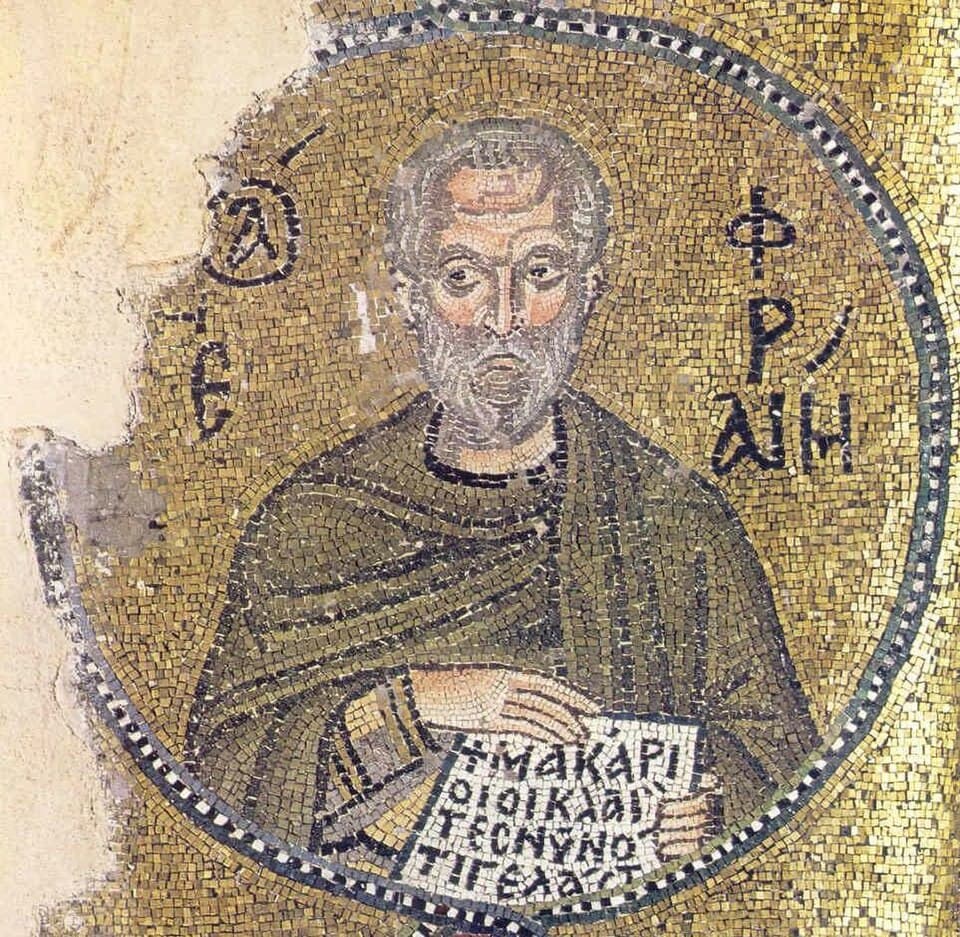
Ephraim the Syrian — Public domain. Via Wikimedia Commons.
Life
Ephraim was born around 306 in Nisibis, then a Roman frontier city in upper Mesopotamia (today southeastern Turkey). His family was Christian. As a young man he attached himself to the great bishop of Nisibis, James — one of the fathers of the First Ecumenical Council in 325 — and through long years served the small school of Christian learning that James had founded.
He was ordained deacon by James's successor and refused all higher orders, remaining a deacon through his whole life. From this minor station he gave the Syriac-speaking East almost the whole of its theology — but in hymns, not in treatises. The Greek and Latin Fathers wrote in prose; Ephraim wrote in verse, in stanzas of varying meter set to music for the choirs of Nisibis and later of Edessa. His hymns on the Nativity, on the Resurrection, on the virginity of Mary, on Paradise, on faith and on the Church entered the Syriac liturgy at once and have remained.
In 363, after the catastrophic defeat of the Emperor Julian in his Persian war, Nisibis was ceded to the Persians under the treaty signed by his successor Jovian. Ephraim joined the Christian refugees who poured out of the city and settled finally at Edessa, where he founded a new school and lived in a cave on a hill outside the town. He continued writing — sermons in prose now as well as hymns — and in his old age organized the relief efforts during a great famine that devastated the region in 373.
He reposed at Edessa during that famine, on June 9, 373, at the age of about sixty-seven. The Greek world received his hymns in translation almost at once — Jerome speaks of them being chanted in Greek-speaking churches in his own day — and one of his Syriac sermons, the Lenten prayer "O Lord and Master of my life, take from me the spirit of sloth, faintheartedness, lust of power, and idle talk," became the universal Lenten prayer of the Orthodox Church, bowed to the ground at every weekday service of the Great Fast. His feast is January 28.
Traditions
Feast day
January 28
Topics
Works in library
Readings and commentaries
Hymns for the Feast of the Epiphany
Hymns for the Feast of the Theophany — the baptism of Christ in the Jordan, the descent of the Spirit, and the meaning of Christian baptism.
Hymns on the Nativity of Christ in the Flesh
Christmas hymns saturated with biblical typology — Ephraim weaves Old Testament figures (Adam, Moses, the prophets) into the celebration of the Word made flesh.
The Nisibene Hymns
Hymns composed during the Persian sieges of Nisibis under Shapur II — Ephraim's poetic theology of providence, the city's deliverance, and the church under threat.
Hymns on Admonition and Repentance
Penitential hymns — pastoral exhortations to repentance and amendment of life, central to the Syriac ascetic tradition that shaped later Orthodox spirituality.
On Our Lord
Christological prose-poetry — Ephraim's sustained reflection on the person of Christ, his work, and the typology by which the Old Testament prefigures him.
Homily on the Sinful Woman
A poetic homily on Luke 7:36–50 — the woman who anointed Jesus's feet, read as the archetype of repentance and the love that flows from forgiveness.
The Pearl: Seven Hymns on the Faith
Seven hymns meditating on the pearl as the figure of Christ — among Ephraim's most beloved theological poems, drawing the Christological mystery out of the natural image of the pearl forming in the deep.
The Book of the Cave of Treasures
A compendious history of the world from the Creation to the Crucifixion of Christ, organized as five 'Thousand Years' covering Adam through the Babylonian Captivity, plus a closing section on the five hundred years from Cyrus to the Nativity. Threads the patriarchal genealogies through a recurring symbol — the cave on Mount Eden where Adam was buried with the gold, frankincense, and myrrh he carried from Paradise, from which the Magi later drew the gifts they brought to Bethlehem. Traditionally attributed in the Syriac manuscripts to St. Ephrem the Syrian; modern scholarship dates the present form to the 6th century, hence the conventional 'Pseudo-Ephrem' designation. Read for its window into Syriac biblical-historical typology rather than for strict historicity — Budge's preface warns the work contains 'idle stories' and 'vain fables' grafted onto its historical framework.