saint
St. Great-martyr Eustathius Placidas
A Roman general under Trajan converted by the vision of a Cross of light between the antlers of a stag on the hunt. Reduced to poverty, separated from his family, then restored to command, he and his household were finally roasted alive in a brazen bull. The patron of hunters and of those given to sudden reversals.
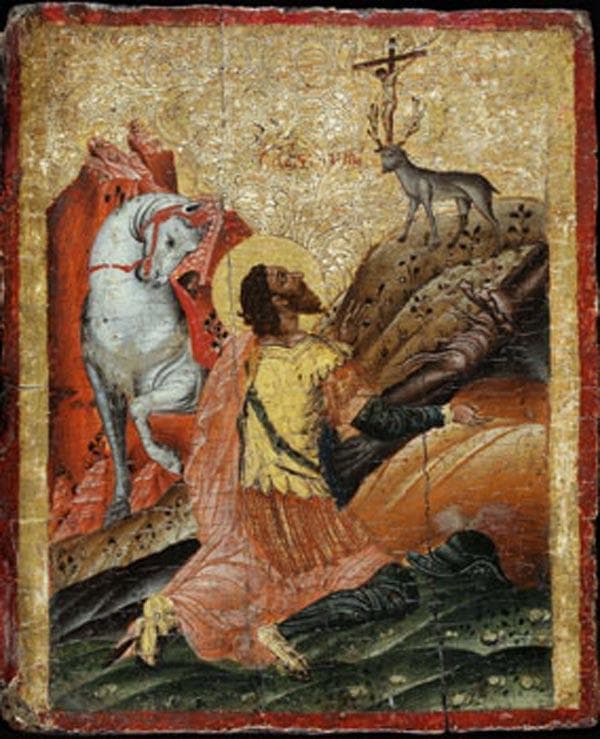
Eustathius Placidas — Public domain. Cretan School. Via Wikimedia Commons.
Life
Placidas was born around 75 in the Roman province of Italia, into a noble pagan Roman family of the equestrian rank. He entered the Roman army as a young man and rose quickly through the centurion grades. By his thirties he was a senior officer of the imperial army under the Emperor Titus, and by the reign of Trajan (98-117) he had become a general (the Roman title was magister militum) commanding several legions. He was widely respected for his military skill, for his great wealth, and — unusually for a Roman general of his rank — for the consistent kindness he showed toward the soldiers under his command and the populations of the provinces he governed.
Placidas was unmarried until middle age. His wife Tatiana (called Theopiste in the Greek Acts) was a noblewoman of comparable family; they had two sons, Agapius and Theopistus. The family was deeply attached to the old Roman gods and the imperial cult — Placidas served particularly the gods of war.
The decisive event of his life was a hunt in the wooded country of central Italy around the year 100. He had pursued a great stag for some hours through the forest; the stag took refuge at last on the top of a rocky outcrop. As Placidas raised his bow to take the shot, the stag turned and a Cross of light appeared between its antlers. The figure of the Crucified Lord was visible at the center of the Cross. A voice — recognizable as the voice of Christ — addressed him: "Placidas, why dost thou persecute me? I am Jesus whom thou knowest not, but whom thou dost honor with thy deeds of mercy."
He fell from his horse. The Lord told him to go down into the city and to find a Christian priest, who would catechize him and his household. He did so. The priest of the nearby church — tradition gives his name as Hilary — baptized Placidas as Eustathius, his wife as Theopiste, and the two boys as Agapius and Theopistus. They returned to their estate as Christians.
The next day Eustathius went hunting again at the same place. The Lord appeared to him at the same outcrop and told him that the years of his testing were about to begin. He should remember that he was now serving Christ and not the emperor, and that the Lord would be with him through every trial.
The trial began at once. A plague descended on his household — all the servants died. The slaves, learning that the master had become a Christian, began to plunder the estate. Eustathius and his family fled by sea to Egypt, where the captain of the ship, recognizing Theopiste's beauty, demanded her in payment of the passage and put Eustathius and his sons ashore. Crossing a river on foot, Eustathius was carrying one son across when a lion seized the other from the bank; he ran back with the first son and a wolf seized that one. He was left alone, weeping, in the wilderness of upper Egypt. He stopped at the small town of Badyssus and took service as a day-laborer in the fields. He lived there for fifteen years.
The Emperor Trajan died and was succeeded by Hadrian; Hadrian was succeeded by Antoninus Pius. Antoninus had a frontier problem with the Persians on the eastern border of the empire and could not find a general of the rank his predecessors had had under Placidas. He sent agents through the empire to find the lost general. The agents came at last to Badyssus, found Eustathius working in the fields, and brought him back to Rome. The emperor restored his commission.
On his way east to take command of the eastern army, he stopped overnight at an inn. Two young soldiers were lodged at the same inn and were heard to discuss in the night their lost parents — they were Agapius and Theopistus, who had been adopted as boys by the peasants who had rescued them from the wild animals and had now grown up and enlisted in the imperial army. Eustathius overheard them and found his lost sons. The hostess of the inn was Theopiste — the slave captain had reposed before he could touch her, and she had been brought to that town and lived there for fifteen years. The whole family was reunited at the inn.
Eustathius fought a successful campaign against the Persians and returned to Rome in triumph. The emperor, in thanksgiving, ordered the senior generals of the army to offer sacrifice to the gods. Eustathius and his family refused. The full extent of his Christianity, now public, was understood. They were ordered to recant; they did not. The Emperor (Hadrian, in the most common version of the story — the dating is uncertain) ordered them thrown to the lions in the arena. The lions would not touch them. He then ordered them roasted alive inside a brazen bull. They went into the bull singing psalms and gave up their souls together; their bodies were found the next morning unconsumed.
Their relics rest at the church of Sant'Eustachio in Rome and at several Orthodox sites. Eustathius is the principal patron of hunters (whence the appearance of a Cross of light between the antlers of stags in heraldic imagery across Europe), of those who suffer sudden reversals of fortune, and of large families who have been separated by force of circumstance. His feast is September 20.
Traditions
Feast day
September 20
Topics
Works in library