saint
St. Euthymius the Great
Father of Palestinian monasticism in the wilderness east of Jerusalem, teacher of Sabbas the Sanctified. His lavra in the Judean desert and his disciples gave the Holy Land its monastic shape for ages to come.
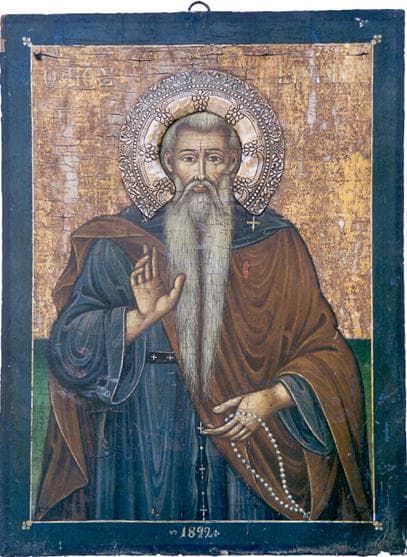
Euthymius the Great — Public domain. Via Wikimedia Commons.
Life
Euthymius was born in 377 in the city of Melitene in the Roman province of Armenia (modern Malatya in eastern Turkey), the only child of an aristocratic Armenian Christian family. His parents — by the family record — had been childless for many years and had vowed at the shrine of the local martyr Polyeuctus to dedicate any child they might be given to the service of the Church. He was named Euthymius ("Cheerfulness") in keeping with the joyful conditions of his birth.
He was educated at the cathedral school of Melitene from age three under Bishop Otreius, who took him into his own household and raised him there. He was ordained reader at six, deacon at twenty, and priest at twenty-eight. His early adulthood was given to the standard work of a cathedral cleric — teaching the catechumens, supervising the choir, administering the small charitable works that the cathedral maintained for the city's poor.
In 405, at twenty-nine, he left Melitene for Jerusalem. He spent some time at the lavras of the Judean Desert under various elders, then settled at the small cenobitic monastery of Pharan (about six miles east of Jerusalem near the modern Ein Fara) under the abbot Theoctistus. He served at Pharan for five years (405-411).
In 411, at thirty-four, he and Theoctistus moved together into deeper solitude — a cave in the Wadi Mukallik east of Pharan, where the two of them lived as anchorites in the strictest discipline. Disciples gradually gathered. Within a few years the cave-community had become large enough to be a recognized lavra, with Theoctistus serving as the abbot of a daughter cenobitic community below the lavra cliffs and Euthymius continuing as the spiritual father of the upper lavra.
The lavra at Wadi Mukallik became one of the most famous of the Palestinian monastic communities through the fifth century. It eventually housed some hundred and twenty monks at any given time — Greeks, Armenians, Cappadocians, and a smaller number of Latin-speakers from Roman Africa. Euthymius supervised it for the next fifty years (411-473). The monastic discipline he established — a five-day-a-week regime of strict solitary prayer in individual caves, with Saturday and Sunday gathered in the lavra church for the common Liturgy and the weekly Eucharistic meal — became the basis of the broader Palestinian lavra-system that would shape Eastern Christian monasticism through the next millennium.
His influence extended beyond his own community. He served as the principal spiritual father of a small but exceptionally consequential group of younger monks whose own lavras would form the next generation of Palestinian monasticism. Among them were: Sabbas the Sanctified (who would found the Great Lavra in the Kidron valley south of Bethlehem, the most famous of all Palestinian monasteries), Theodosius the Cenobiarch (who would found the great cenobitic monastery between Jerusalem and Bethlehem), Cyriacus (the long-lived hesychast of Souka), and Gerasimus (founder of the lavra of Saint Gerasimus on the Jordan, who legend places in the company of a tame lion). All of them — and several lesser figures — were Euthymius's spiritual children. He was, in this respect, the actual founder of the Palestinian monastic tradition; everyone after him traces his discipleship back to Euthymius.
He was deeply involved in the Christological controversies of the fifth century. He was at the Council of Ephesus (431) as a senior advisor to the Patriarch Juvenal of Jerusalem and was thoroughly engaged in the long debate over the two natures of Christ. The Empress Eudocia — wife of Theodosius II, who in her widowhood spent her last years at Jerusalem and was inclined toward the monophysite party — came to Euthymius on his mountain on several occasions to seek his counsel. He held her firm to the two-natures formula of Chalcedon (451). After her death (460) he was the principal monastic voice in Palestine for the strict reception of the Council of Chalcedon; the orthodox party in Jerusalem owed much of its survival to him.
He reposed at the lavra of Wadi Mukallik on January 20, 473, at the age of ninety-six. He had been at his lavra continuously for sixty-two years. The funeral was attended by the Patriarch Martyrius of Jerusalem and by Sabbas the Sanctified (then about thirty-four) and by a great procession of monks and pilgrims from across Palestine. He was buried in the church of his lavra. The lavra continued in continuous occupation until the Persian-Arab invasions of the seventh century; the ruins are still visible at Wadi Mukallik.
His relics — small portions — were recovered by the medieval Greek Church and rest at several Athonite monasteries and at the Holy Sepulchre in Jerusalem. He is the foundational father of Palestinian monasticism, the spiritual father of Sabbas the Sanctified and the entire later Palestinian tradition, and the patron of solitary contemplatives. His feast is January 20.
Traditions
Feast day
January 20
Topics
Works in library