saint
Holy The Forty Martyrs of Sebaste
Roman soldiers martyred together after refusing to renounce Christ, remembered for steadfast confession and mutual courage.
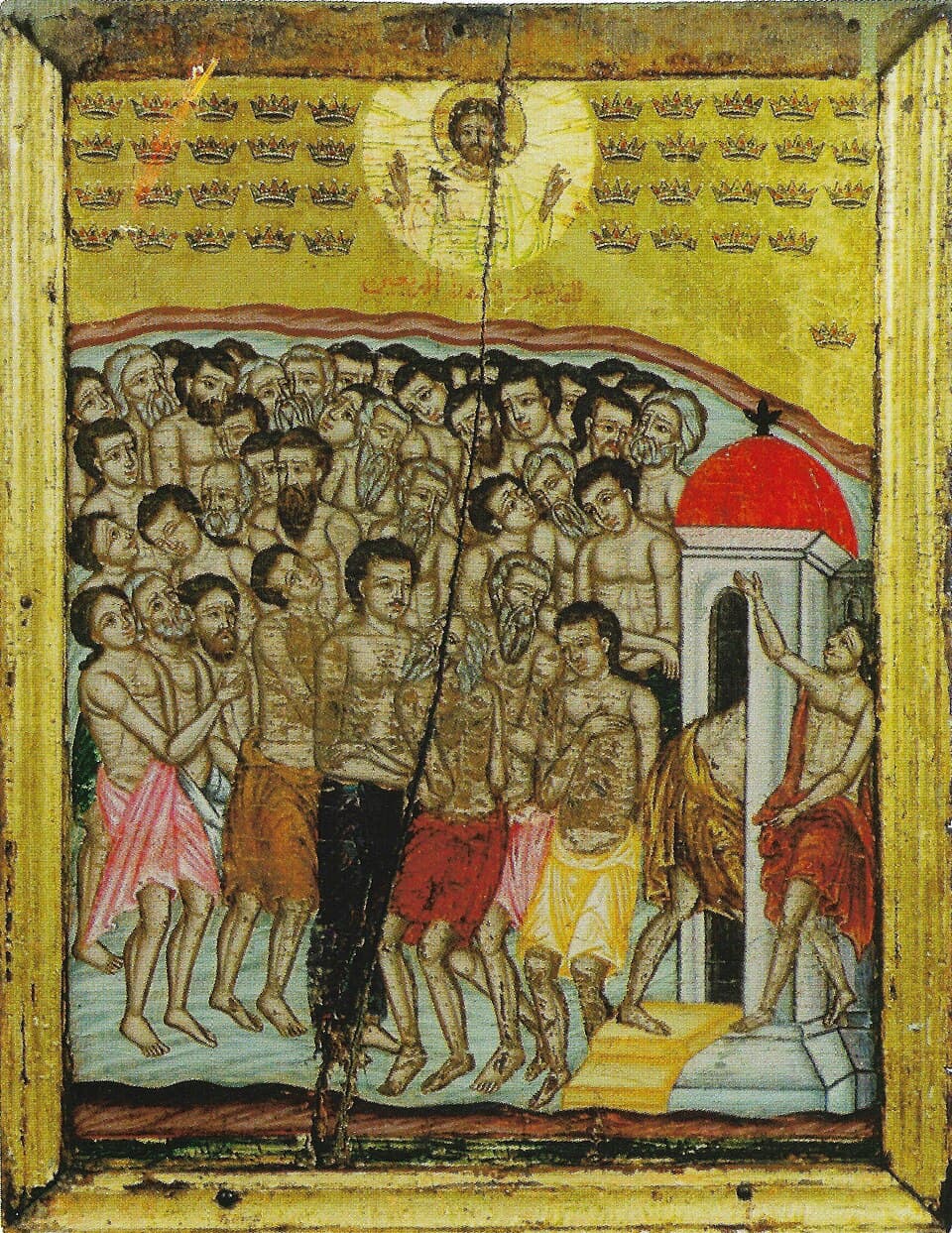
Forty Martyrs of Sebaste — Public domain. Via Wikimedia Commons.
Life
The Forty Martyrs were a company of Roman soldiers — by tradition all members of the Twelfth Legion (Legio XII Fulminata) — stationed at Sebaste in Armenia (today Sivas in Turkey) in the year 320. Their company was unusual: every man in it was a baptized Christian. They had served together for some years; their faith was known to their commanders.
In 320 the eastern Augustus Licinius — Constantine's brother-in-law and co-emperor, who would soon turn against him — issued an edict requiring every soldier of his army to sacrifice publicly to the Roman gods or be discharged in dishonor. The garrison commander Agricolaus called the Forty before him and laid the choice in front of them. They refused.
Several days of interrogations followed — first Agricolaus, then the local governor Lysias. The Forty answered with what would become the famous defining sentence of their witness: "We are Christian soldiers, and our King is in heaven." They were stripped of their offices and sentenced to a particular and calculated death. The garrison commanded an exposed lake just outside Sebaste; in early March the surface was still frozen. The Forty were stripped naked and driven out onto the ice, with the warning that warm baths and food were waiting on the shore for anyone who would turn back and sacrifice.
A bathhouse was set up at the lake's edge, fully heated, with fresh towels and food. Guards watched all night to count the Forty in case any tried to flee, and to ensure none died unwitnessed. The men prayed and supported one another. Through the night one of the Forty broke, ran to the shore, and plunged into the warm water — and died on the spot of the shock to his frozen body. At that same moment one of the guards (a soldier named Aglaius, who had been watching) saw a vision of thirty-nine bright crowns descending from heaven over the men still on the ice, and one crown remaining suspended above the empty place. He stripped off his own armor, cried "I am also a Christian!" and ran out to take the empty crown. The Forty were complete.
By dawn the bodies on the ice had begun to die. The youngest, Meletius, was still alive when the soldiers came to break their legs with iron bars — the customary execution of soldiers — and his mother, who had walked from her village through the night to be with him, carried him in her own arms on the cart to the funeral pyre rather than let him be separated from his companions. All forty bodies were burned to ashes and the ashes thrown into a nearby river.
A community of monks downstream gathered the floating relics, and the bones of the Forty have been scattered through the East for sixteen centuries as some of the most-loved relics of the early martyrs. Basil the Great wrote a panegyric on them; Gregory of Nyssa preached on them; the Slavic and Greek traditions keep their feast on March 9 with particular solemnity — it is one of the only fixed feasts in Lent at which the Liturgy is celebrated, breaking the otherwise unbroken weekday austerity of the season. They are the icon of comradeship in confession, of every soldier who has stood with his fellow soldiers for Christ.
Traditions
Feast day
March 9
Topics
Works in library