saint
St. George the Great-martyr
A young Cappadocian officer of the Roman army under Diocletian whose endurance through every kind of torture and his final beheading made him the icon of the soldier-saint of the East. His cult spread from Lydda through every land of Christian witness; he is patron of warriors, of England, of Georgia, and of every Christian facing the dragon.
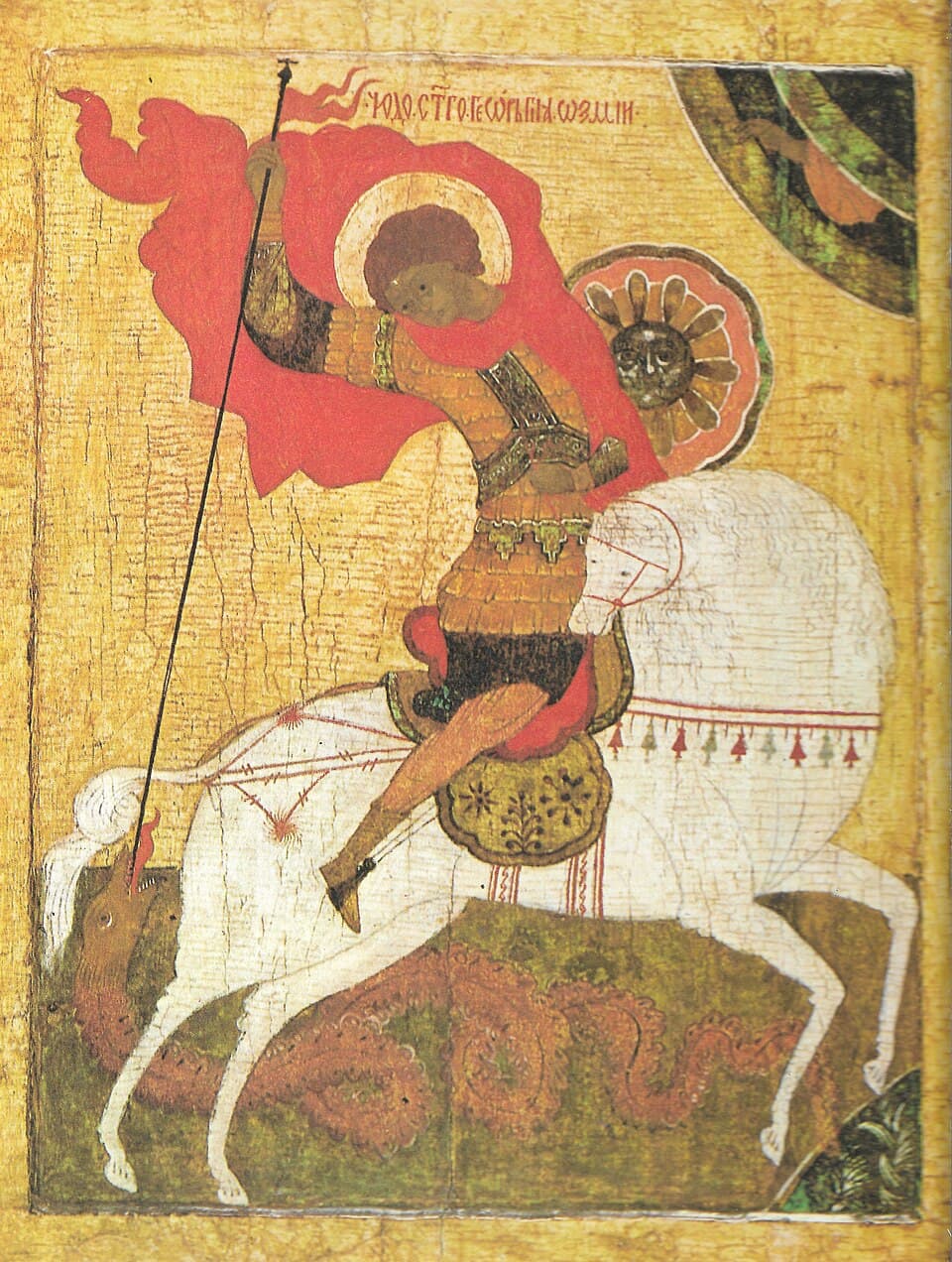
Saint George the Trophy-Bearer — Public domain. Via Wikimedia Commons.
Life
George was born around 275 in Cappadocia to noble Greek Christian parents — his father a Roman officer of the eparchy of Cappadocia, his mother a Palestinian Christian from the region of Lydda. His father died for the faith when George was about ten; his mother took him back to her own people in Lydda, where he was raised in the Church and in the discipline of a Roman officer's son.
He entered the army of Emperor Diocletian in his late teens and rose quickly. By his early twenties he was tribune of one of the imperial legions and a trusted member of the emperor's personal guard. Diocletian honored him. There is no reliable record of George's military exploits — the army of the East under Diocletian fought campaigns in Persia, in Egypt, and on the Danube during his years of service, and George was certainly with the emperor in some of them.
In February 303 Diocletian launched the last great persecution of the Roman Christians — an edict that ordered the destruction of every Christian church in the empire, the burning of every Bible, the dismissal from the army of every Christian soldier who would not sacrifice. George was at the imperial court in Nicomedia. He saw the edict posted, tore it down with his own hand, and went directly to the emperor to renounce his commission and confess Christ.
Diocletian, who had favored George, tried first by argument and then by torture to bring him back. Over eight days the saint endured the wheel of swords, the lime pit, the iron boots heated red and walked in, the molten lead, and finally a poisoned cup — through it all unbroken and frequently restored to wholeness by the appearing of the Lord at his side. His witness converted the empress Alexandra and many others among the court. At last, on April 23, 303, he was beheaded outside the walls of Nicomedia. He was about twenty-eight years old.
His mother brought his body home to Lydda in Palestine, where his shrine became one of the great pilgrim destinations of the early Church. Under Constantine the basilica over his tomb was built; restored under Justinian; destroyed and rebuilt many times since. The relic of his head is at Rome.
The dragon-slaying legend with which his image is forever associated — the saint on horseback piercing a dragon to deliver a princess — is medieval, but its spiritual content is right. In every fight against the great serpent George is invoked. He is the patron of soldiers, of horsemen, of the city of Moscow, of England, of Georgia, of Catalonia, of Portugal, of Bavaria, and of half of Christian Europe.
The Eastern Church names him the Trophy-Bearer (the Tropaiophoros) for the trophies of victory he bears in heaven. His feast is April 23, except when that falls within Holy Week or Bright Week, in which case it is transferred to Bright Monday.
Traditions
Feast day
April 23
Topics
Works in library