father
St. Gregory of Nyssa
Younger brother of Basil the Great and of Macrina, bishop of Nyssa, whose meditations on the soul's ascent to God remain among the deepest in the Christian tradition. His Life of Moses reads the patriarch's exodus as the figure of every soul's journey into God.
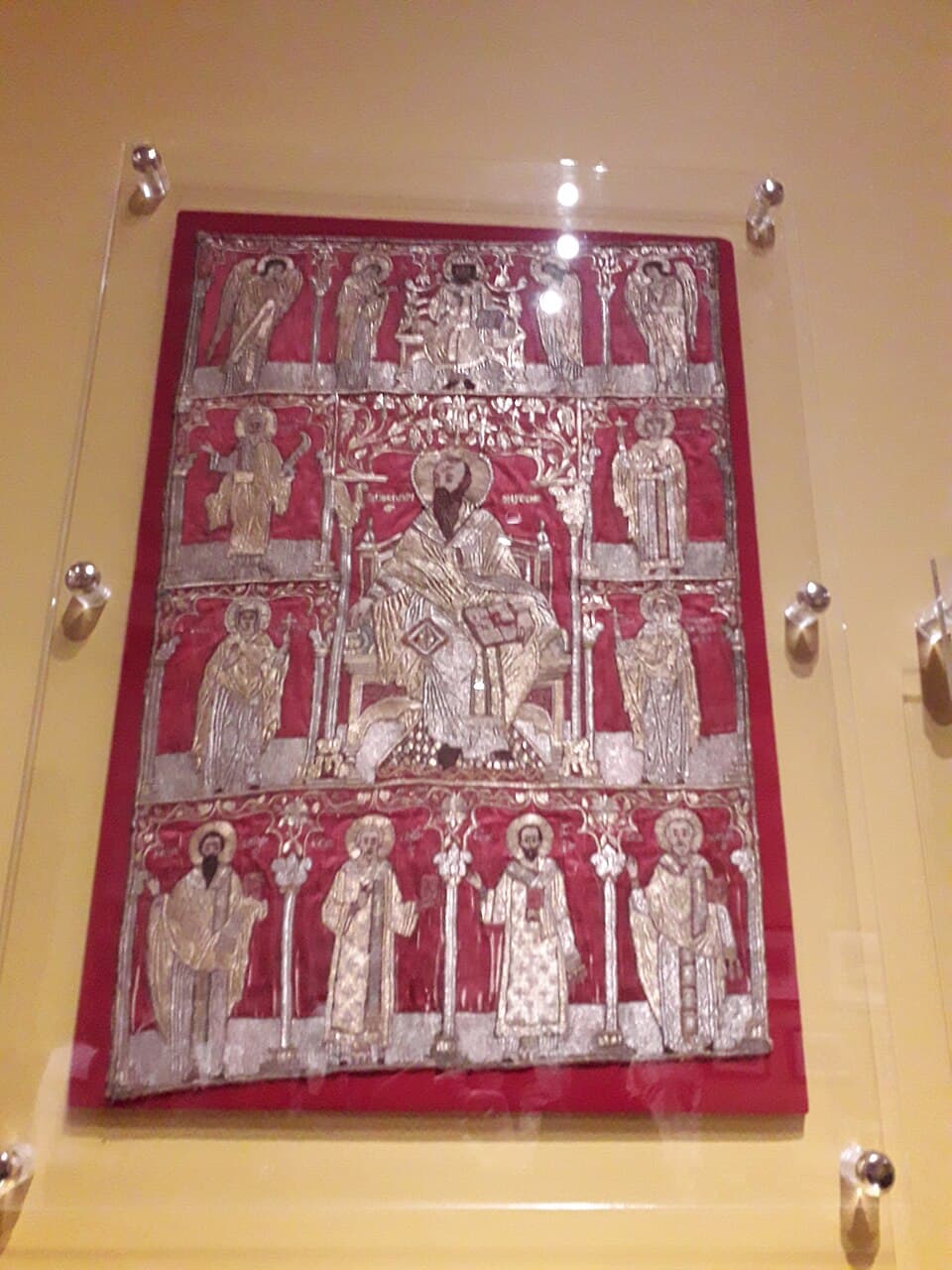
Gregory of Nyssa — CC BY-SA 4.0. Catlemur. Via Wikimedia Commons.
Life
Gregory was born around 335 in Caesarea in Cappadocia (modern Kayseri in central Turkey), into a family that has been called by some historians the most consequential Christian family of the fourth century. His grandmother Macrina the Elder had been a disciple of Gregory the Wonderworker. His father, the elder Basil, was a noted rhetorician; his mother Emmelia was the daughter of a martyr of the Diocletian persecution. There were nine children. The four sons — Basil the Great, Gregory of Nyssa, Peter (later Bishop of Sebaste), and Naucratius (who reposed young) — were a family of saints. The eldest daughter was Macrina the Younger, who as the leader of the family's household ascetic community at Annisi was a more decisive spiritual influence on her brothers than any of their teachers.
Gregory was the third of the four brothers. Unlike Basil (who was sent for the standard rhetorical education to Caesarea, Constantinople, and Athens) and Peter (who joined Macrina at Annisi from an early age), Gregory was educated entirely at home — by Basil himself, by Emmelia, and by Macrina. He was a quieter, more retiring brother than the senior Basil. He married a noblewoman of the city of Caesarea named Theosebia around 360 and intended a career as a rhetorician — the prestige profession of his generation, his father's profession — and was for some time a professor of rhetoric.
His brother Basil was consecrated bishop of Caesarea in 370 and immediately set about reorganizing the Cappadocian Church to give it the institutional weight to resist the Arian policy of the Emperor Valens. He created new bishoprics out of his diocese to give himself a synodal majority in Cappadocia. He consecrated Gregory of Nazianzus to the small wayside town of Sasima (a job his old friend hated and never properly accepted), and consecrated his own brother Gregory to the equally undistinguished town of Nyssa. Gregory served at Nyssa from 372 until his exile by the Arians in 376; he was restored under Theodosius in 378.
His brother Basil reposed in 379, just before the great vindication of the Cappadocian theology at the Second Ecumenical Council. Gregory took up Basil's mantle in the family — preaching at the funeral of his sister Macrina that same year (the basis of his Dialogue on the Soul and the Resurrection), then preaching at Basil's funeral that winter, and serving as the senior surviving Cappadocian voice at the Council of Constantinople in 381.
The years after the Council are the years of his greatest literary production. He wrote constantly through his last decade — the Great Catechetical Oration (a systematic apologetic of the Christian faith for educated pagans), the Life of Moses (an allegorical reading of the Exodus as the type of the soul's ascent to God, perhaps the most influential work of Greek Christian mysticism), the Commentary on the Song of Songs (the long mystical reading of the Song as the marriage of the soul and the Word), the Homilies on the Beatitudes, the long pastoral letter On Pilgrimage (an unsparing critique of the practice of pilgrimage to Jerusalem, written from the perspective of one who had been there and seen it). His treatise On the Making of Man (an account of human creation and the image of God in the human person) supplemented his brother's Hexaemeron and finished it.
He developed in his later writings the doctrine of the soul's perpetual ascent into God — the doctrine of epektasis. Because God is infinite, said Gregory, the soul that comes to know Him can never reach an end of His goodness; even in the eternal kingdom the saint is continually stretching forth into new depths of His being. This is the conceptual foundation of the Eastern Christian doctrine of theosis: union with God is real, but the depth of God always exceeds the creature's reach, so that the union is endlessly deepening rather than completed.
His Trinitarian theology — alongside the more rhetorical work of Gregory the Theologian — is the source of the precise Cappadocian formulae that have shaped all later Greek-language Trinitarian thought. The distinction of person (hypostasis) and nature (ousia) in the Trinity, the doctrine of the divine processions, the theology of the divine energies (later developed by Palamas) — all are present in Gregory's writings in their definitive forms.
He reposed at Nyssa around 394, at the age of about sixty. His relics rest at his small cathedral at Nyssa (modern Nevşehir in Turkey), where they have been continuously venerated. He is the youngest of the three great Cappadocian Fathers and the most systematically theological of them; the modern recovery of his work in the twentieth century has placed him among the half-dozen great minds of Christian history. His feast is January 10.
Traditions
Feast day
January 10
Topics
Works in library
Readings and commentaries
Against Eunomius
Twelve books defending the Nicene confession of the Son's consubstantiality against the Anomoean Eunomius — completing the polemical project begun by Gregory's brother Basil before his death.
Answer to Eunomius' Second Book
Companion volume to Against Eunomius, responding section by section to Eunomius's second book; sustained polemic on divine names, generation, and the Son's eternity.
Funeral Oration on Meletius
Eulogy delivered at the Council of Constantinople (381) for Meletius of Antioch — high rhetorical density, mourning a beloved bishop and friend.
The Great Catechism
A systematic exposition of Christian doctrine — Trinity, creation, fall, Incarnation, atonement, and the sacraments — written as a handbook for catechists addressing pagans, Jews, and heretics.
Letters
Eighteen festal and pastoral letters — including the famous letter on pilgrimages, the canonical letter to Letoius, and correspondence with fellow Cappadocians.
On "Not Three Gods"
Famous short treatise addressed to Ablabius arguing that the unity of the divine nature, known through the single divine operation, makes "three gods" a category mistake despite three hypostases.
On Infants' Early Deaths
A treatise wrestling with theodicy and the eschatological fate of children who die before knowing virtue — addressed to Hierius, prefect of Cappadocia.
On Pilgrimages
A short pastoral letter arguing that geographical pilgrimage to the Holy Land confers no special grace; the kingdom of God is approached by interior renewal, not travel.
On the Baptism of Christ
Sermon for the Feast of Lights (Theophany), meditating on the Jordan, sacramental regeneration, and the descent of the Spirit.
On the Faith
A short doctrinal letter to Simplicius restating the orthodox Trinitarian faith.
On the Holy Spirit, Against the Macedonians
A pneumatological treatise against the Pneumatomachi (Macedonians), defending the full divinity of the Holy Spirit and the unity of the divine activity across the three Persons.
On the Holy Trinity, and of the Godhead of the Holy Spirit
A brief letter to Eustathius arguing that the same divine names, operations, and worship are owed to all three Persons of the Trinity.
On the Making of Man
Thirty chapters on Christian anthropology, completing the Hexaemeron of Gregory's brother Basil — meditating on the image of God, the resurrection body, and the soul's destiny.
On the Soul and the Resurrection
A dialogue with Gregory's dying sister Macrina the Younger on the nature of the soul, the passions, and the final restoration — foundational for Orthodox eschatology.
On Virginity
Twenty-four chapters on Christian asceticism — Gregory's earliest extant work, framing virginity not as mere physical continence but as the soul's undivided ascent toward likeness with God.