saint
St. Gregory Palamas
Archbishop of Thessalonica whose defense of uncreated grace shaped Orthodox teaching on participation in divine life.
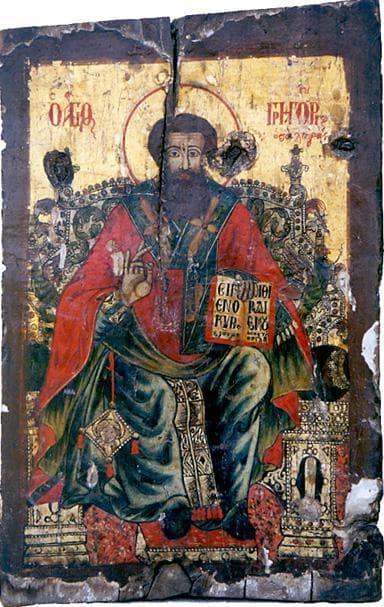
Gregory Palamas — Public domain. Via Wikimedia Commons.
Life
Gregory was born in 1296 in Constantinople, into a noble Byzantine senatorial family. His father, Constantine Palamas, was a senior official at the imperial court of Andronicus II Palaeologus and a man of deep personal piety who reposed in the monastic habit while Gregory was still a child. The family connections meant that Gregory and his brothers were raised at the imperial palace as companions of the young heir Andronicus III; he was given the best classical education the city offered, was already at twenty marked for the highest civil offices, and was personally known to the emperor.
At twenty he abandoned the world. He went with his two brothers — Macarius and Theodosius — and his three sisters (his mother had been widowed early and was a confessing Christian who supported the choice) to Mount Athos, where the women entered a women's monastery in the city of Thessalonica and the three brothers were tonsured at the monastery of Vatopedi. Gregory was given the standard Athonite discipline of unceasing prayer, fasting, prostrations, and the systematic reading of the Greek Fathers under the guidance of the elder Nicodemus the Hesychast. After several years he moved to the Great Lavra and from there to the sketes of the upper slopes, where he lived in extended solitude with two or three brothers at a time.
In 1325 the Turkish raids on Mount Athos forced the monastic communities into temporary exile. Gregory went to Thessalonica, was ordained priest at thirty, and spent some years at a hermitage near Berea before returning to Athos. By the early 1330s he was a recognized teacher of the hesychast tradition — the practice of unceasing inner prayer joined to a quiet bodily discipline (the controlled breathing, the gaze toward the heart) that the great Athonite monks had developed over the preceding three centuries.
The controversy that occupied the rest of his life began about 1335. Barlaam the Calabrian — a Greek-speaking Italian monk and philosopher of nominalist sympathies — had come to Constantinople and had begun to attack the hesychast practice as a kind of Bogomil-style materialism. He accused the monks who claimed to see the divine Light at prayer of seeing a created light (since God's essence is by definition unseeable) and ridiculed the bodily prayer technique. Gregory wrote in defense in the Triads (Three Treatises Defending the Holy Hesychasts), perhaps the most important work of late Byzantine theology.
The essence-energies distinction is at the heart of his teaching. God is unknowable and unparticipable in His essence, said Palamas — but truly knowable and participable in His energies (the operations by which He manifests Himself to the creation). The Light that the apostles saw on Mount Tabor at the Transfiguration was the uncreated divine Light, not a created luminance — and the hesychast monks could indeed see this same Light by grace, because the Light is the divine glory communicated to the creation through the divine energies. Without the distinction, said Palamas, you have either a deism (God absolutely unparticipable) or a pantheism (God's essence reaching into the creation). With the distinction, you have the Orthodox doctrine of theosis: real participation in God by grace, without the creature becoming the divine essence.
The teaching was contested at several Constantinople councils between 1341 and 1351 — Barlaam was condemned in 1341, then his disciple Akindynos in 1347, and at the final Synodal Tomos of 1351 the Palamite distinction was definitively affirmed as the teaching of the Orthodox Church. Gregory was consecrated Archbishop of Thessalonica in 1347.
His seven years as archbishop were difficult. The Zealot revolution had seized the city, and he was twice prevented from entering it; he was captured by Turkish pirates on one journey and spent a year in captivity in Asia Minor. He gave from his ransom to support fellow Christian prisoners and used the captivity to engage in lengthy theological discussion with Muslim scholars (the records of which survive). He returned to Thessalonica in 1355, served briefly, and reposed there on November 14, 1359, at the age of sixty-three.
He was canonized by the Patriarch Philotheus of Constantinople in 1368 — only nine years after his death. The Second Sunday of Great Lent (after the Sunday of Orthodoxy that triumphs over iconoclasm) was given to him as a special commemoration, since his theology was understood as the "second triumph of Orthodoxy" against the rationalism of his age. His relics rest at the Cathedral of St. Gregory Palamas in Thessalonica, where they have streamed myrrh on occasion. His feasts are November 14 (repose) and the Second Sunday of Great Lent.
Traditions
Feast day
Second Sunday of Great Lent
Topics
Works in library
Readings and commentaries
The Triads
Palamas articulates prayer, illumination, and participation in divine energies without confusion of essence.
Untitled commentary
St. Gregory Palamas — Introductory Note (Philokalia)
Editorial introduction to the Philokalic selections of St. Gregory Palamas.
The Declaration of the Holy Mountain in Defence of Those who Devoutly Practise a Life of Stillness
St. Gregory Palamas · The Declaration of the Holy Mountain in Defence of Those who Devoutly Practise a Life of Stillness — as included in the Philokalia.
Three Texts on Prayer and Purity of Heart
St. Gregory Palamas · Three Texts on Prayer and Purity of Heart — as included in the Philokalia.
To the Most Reverend Nun Xenia
St. Gregory Palamas · To the Most Reverend Nun Xenia — as included in the Philokalia.
Topics of Natural and Theological Science and on the Moral and Ascetic Life: One Hundred and Fifty Texts
St. Gregory Palamas · Topics of Natural and Theological Science and on the Moral and Ascetic Life: One Hundred and Fifty Texts — as included in the Philokalia.